Protecting Egypt’s underwater Paradise
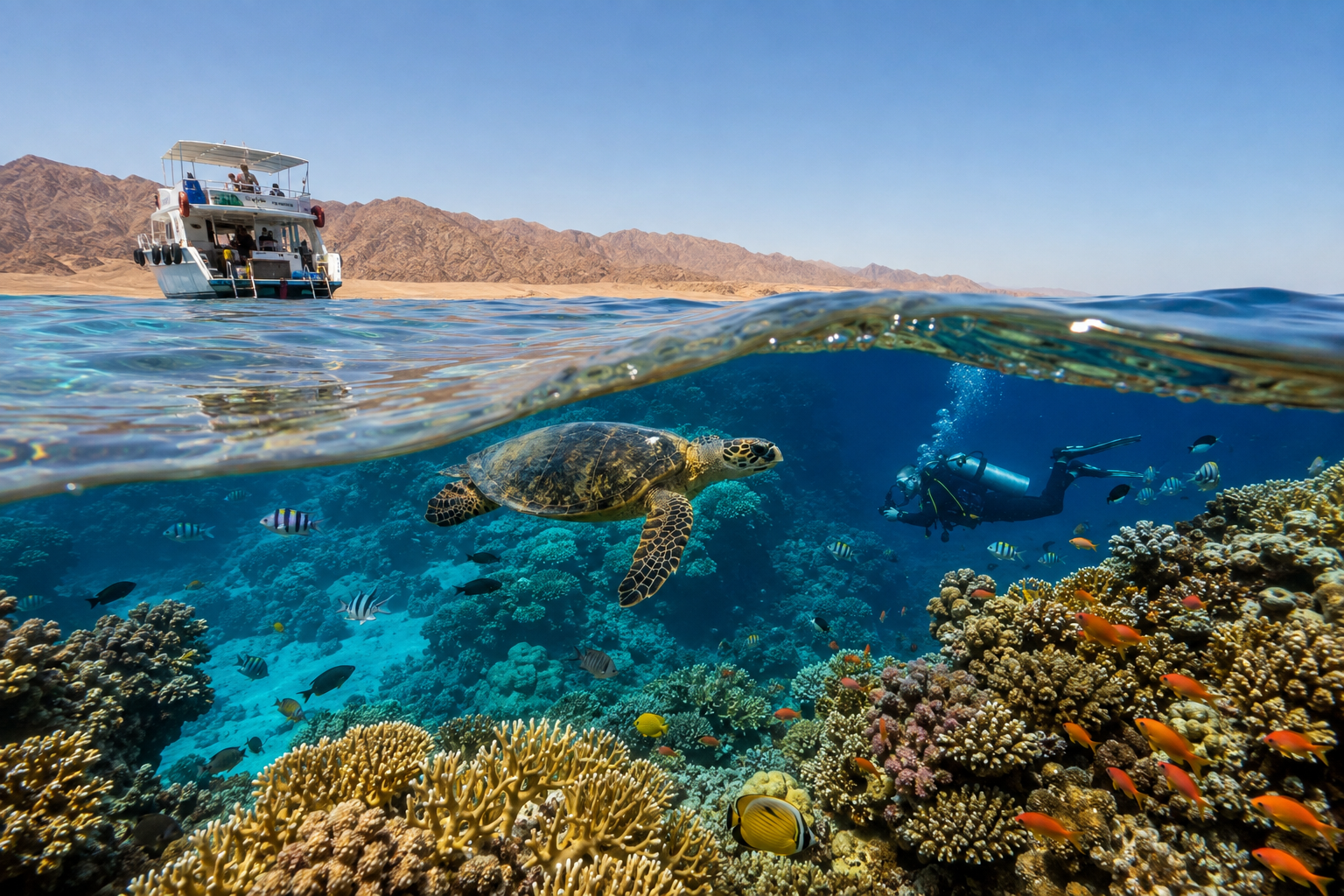
Ras Mohammed National Park, one of the world’s largest marine protected areas, located about 12 kilometers from Sharm El-Sheikh in Egypt, gives thousands of diving enthusiasts the opportunity every day to observe its rich marine biodiversity.
Strictly monitored as a protected area, Ras Mohammed National Park prohibits boats from dropping anchors in order to preserve its natural environment, while divers make every effort to protect the diversity of marine life, CE Report quotes Anadolu Agency.
Underwater documentary filmmaker and cinematographer Tahsin Ceylan told Anadolu Agency about the measures implemented to protect marine biodiversity at Ras Mohammed National Park, which he visited for diving.
Ceylan said that industrial fishing is prohibited and boats are not allowed to anchor once a marine area has been declared a protected zone.
“Egypt strictly implements these measures at Ras Mohammed National Park. These measures ensure that the species and resources there remain healthier and better protected,” he said.
Ceylan noted that the marine biodiversity found in protected areas encourages tourists to go diving, adding that thousands of people dive every day to see the rich diversity at Ras Mohammed National Park.
He pointed out that diving guides not only lead groups but also constantly monitor the underwater environment to prevent damage to corals, making them key guardians of biodiversity.
Ceylan said that diving activities organized by Scuba-Bay in protected areas are continuously guided by diving instructor Yalın Tolga Yılmaz, Mahmoud El-Sayed, Mohamed M. Salama and Ahmed Abdelhamed. He added that underwater photographer Taner Şahakalkan also made a major contribution by taking photographs and videos and providing background footage.
Ceylan recalled that marine areas off the coast of Fethiye and Kaş in Türkiye’s Muğla and Antalya provinces, as well as an area designated in the northern Aegean, were recently declared “Marine National Parks.”
“This decision and the measures that will accompany it will make a major contribution to protecting biodiversity in the region. We owe 70 percent of the oxygen we breathe to oceans and seas. Protecting this diversity is therefore of great importance. Protecting these areas means protecting life,” he said.
Ras Mohammed National Park
Located on the Red Sea Riviera, about 12 kilometers from Sharm El-Sheikh, Ras Mohammed was declared Egypt’s first national park in 1983 and placed under protection.
Situated at the intersection of the Arabian, African and Sinai tectonic plates, the protected area covers a total of 480 square kilometers, including 135 square kilometers of land and 345 square kilometers of water.
The park is considered a living natural museum thanks to its remarkable biodiversity both on land and underwater.
Its marine ecosystem features more than 220 coral species, including 125 soft coral species, as well as more than 1,000 fish species, around 500 of which are endemic. The area is also home to sea turtles, including green and hawksbill turtles, more than 150 species of crustaceans, starfish and sea urchins.
The national park’s terrestrial area lies along the migration route of birds, serving as a critical feeding and resting site.
Mangrove forests covering the shallow channel at the southern tip of the park, along with desert vegetation such as acacia and doum palms growing at the mouths of valleys further inland, add to the diversity of life in the arid region.
Photo: Chat GPT