NASA warns of microbes surviving on the Moon
Microbes that travel into space with astronauts may be able to survive in the permanently shadowed regions of the Moon’s South Pole and could interfere with efforts to search for traces of past life in lunar soil and, later, Martian soil, according to a NASA study published Wednesday in the journal Science Advances and cited by EFE and NASA.
The organisms were tested in simulations of the environment in three regions near the Moon’s South Pole: Nobile Rim, Connecting Ridge and De Gerlache Rim. The simulations used detailed environmental maps based on elevation and temperature data, CE Report quotes AGERPRES.
The result was a series of “survival niche” maps showing where microorganisms could survive, from the bottom of a crater several kilometers deep to a footprint left by a boot.
The team of scientists sought to determine which terrestrial microorganisms could survive extreme polar conditions. Researchers focused on organisms commonly found in spaceflight environments and those normally present on human skin. In addition to Aspergillus niger, they included Bacillus subtilis, Staphylococcus aureus, Deinococcus radiodurans and several Fusarium species. Based on an analysis of previous studies, the scientists determined the maximum amounts of heat and ultraviolet (UV) radiation each organism could withstand.
None of these microorganisms is an “extremophile,” meaning an organism capable of surviving conditions such as a vacuum. However, astronauts have discovered Aspergillus niger inside the International Space Station (ISS), and experiments have shown that the species can also survive outside the station.
To prevent such contamination, robotic spacecraft are exposed to temperatures above 204 degrees Celsius to destroy microorganisms. However, this is not possible when a human crew is aboard a lunar mission.
“I would have expected these microorganisms to have dried out,” NASA geomicrobiologist Aaron Regberg, a co-author of the study, said in a statement.
The most resilient microorganism was Aspergillus niger, which survived even in areas that receive little sunlight, despite the fact that UV radiation, which is lethal to most microbes, is used to sterilize hospitals.
“Humans are explorers by nature, and with them come their voices, their memories... and their microbes,” said Prabal Saxena, a planetary scientist at NASA’s Goddard Space Flight Center in Greenbelt, Maryland, who led the study. “For some scientists, myself included, this reality can be unsettling. But it also creates an opportunity to turn an imperfect situation into a useful experiment,” he added.
Bringing microbes into space is inevitable. For example, humans have, on average, one million bacteria living on every patch of skin roughly the size of a pencil eraser. These bacteria can spread from spacesuits and habitats. Although the authors are concerned that such contamination could interfere with the search for chemical clues about past geology or biology, they also argue that the Moon should be used as a natural laboratory. In the shadowed regions around the South Pole, scientists could test the true limits of microbial survival in an environment that cannot easily be replicated on Earth.
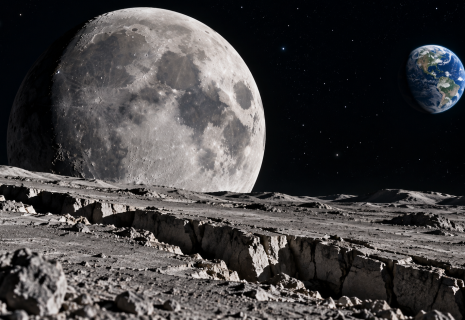
Because the Moon’s axis is slightly tilted, the Sun never rises far above the horizon at the South Pole and illuminates the landscape from the side, like a flashlight lying on a table. The ridges of craters and mountains block the sunlight, creating permanently shadowed and extremely cold areas that can retain water and provide protection from radiation.
“When we think about the Moon, biology usually isn’t the first thing that comes to mind,” said Heather Graham, a co-author of the study at NASA Goddard, which contributes to the development of instruments and techniques for detecting forms of life that may not resemble those found on Earth. “But the Moon is a place where a cell can survive, so our first exploration of these sites should pay close attention to microbial ‘stowaways’ and make sustained efforts to characterize the lunar chemical environment before our visits alter what we find there,” she added.
The study’s authors noted that although some microbes may survive in a dormant state in regions around the South Pole, potentially creating confusion for future scientific investigations, there is no evidence that the Moon contains the essential ingredients needed for their growth and reproduction. These include liquid water, which generally requires an atmosphere and moderate temperatures.
NASA plans to send its first crewed mission to the lunar surface in 2028, after more than half a century, paving the way for further missions to establish a human presence on the Moon and eventually missions to Mars.
Photo: Wikipedia