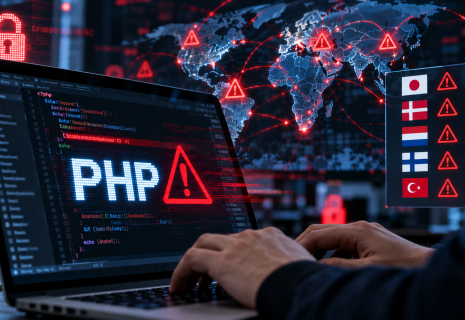
Critical PHP vulnerabilities prompt global cybersecurity warnings
Cybersecurity precautions are being tightened worldwide following reports of critical vulnerabilities in PHP, a programming language widely used in internet infrastructure, with experts urging public institutions and businesses to update their systems.
According to information compiled by Anadolu Agency (AA), some countries have temporarily restricted access to government websites and online services as a precaution against the reported security risks, CE Report quotes Anadolu Agency.
Japan, Denmark, the Netherlands and Finland are among the countries reported to have issued warnings concerning the vulnerabilities.
In Türkiye, the Presidency’s Cyber Security Directorate has launched security scans across national systems, particularly those operated by public institutions, and notified relevant authorities of the need to take urgent precautions.
The developments have raised questions about how organizations using PHP-based infrastructure can protect their systems and detect possible security breaches.
Turkish software federation calls for cybersecurity mobilization
Mustafa Çalış, President of the Turkish Software Developers Federation, described the situation as one of the most significant cybersecurity crises of the past decade.
Referring to the reported global threat as “PHP2Shell,” Çalış urged public institutions and private companies in Türkiye to strengthen their defenses, emphasizing that digital security is a matter of national security.
“This crisis has once again demonstrated how delicate the foundations of our digital infrastructure are,” he said.
“As Türkiye, we must rapidly launch a cybersecurity mobilization across our public institutions and companies managing critical infrastructure. Protecting our digital homeland is as vital a national responsibility as protecting our physical borders.”
Çalış expressed support for the national warnings and security assessments initiated by the Presidency’s Cyber Security Directorate.
He outlined three measures that software developers and system administrators should prioritize.
First, organizations should review their PHP versions and upgrade affected systems to the latest secure releases.
Second, systems containing critical data or those that cannot be updated immediately should be considered for temporary isolation from external networks until the necessary security patches are applied.
Third, information technology departments should conduct security assessments and penetration tests, including retrospective investigations into possible unauthorized access.
Çalış also said the federation was prepared to provide technical assistance to public institutions and domestic businesses during the reported crisis.
“As the federation, we are ready to provide all kinds of technical support to our public institutions and local companies through our expert teams,” he said.
“At a time when cyber threats have become global, I believe we can overcome this threat with minimal damage through the strength of our domestic software ecosystem.”
He urged software developers and system administrators to take immediate action to secure their infrastructure.
Experts recommend checking server logs and unusual activity
Yakup Özdemir, President of the Public Cyber Defense Association, noted that PHP is a fundamental component of numerous websites and enterprise applications worldwide.
He explained that critical vulnerabilities can arise from programming errors, memory management problems, inadequate security controls and delays in applying software updates.
Özdemir also highlighted the growing importance of artificial intelligence-assisted cybersecurity testing.
He urged public institutions, critical infrastructure operators, technology companies and other organizations to assess their systems without delay.
According to Özdemir, the level of risk facing Türkiye depends not only on the widespread use of PHP but also on how effectively organizations maintain software inventories, respond to vulnerabilities and conduct technical security audits.
He warned that vulnerabilities in PHP-based infrastructure could potentially affect websites and online services containing citizens’ personal information.
However, he emphasized that the existence of a vulnerability does not necessarily mean that personal data has been compromised.
“The presence of a security vulnerability does not mean that personal data has been stolen,” Özdemir said.
“Rather than panicking, citizens should follow basic digital security practices. Strong passwords should be used for important accounts, multifactor authentication should be enabled, and devices and applications should be kept up to date.”
He also advised users to avoid suspicious links and regularly review their banking transactions.
Businesses urged to identify affected PHP versions
Özdemir stressed that businesses should first determine whether their systems use PHP and identify the versions currently installed.
Once potentially affected versions have been identified, organizations should apply the relevant security updates without delay.
However, he warned that installing patches alone may not be sufficient.
“Server logs, unusual access activity and newly created files should also be examined,” he said.
He recommended that small and medium-sized enterprises without dedicated technical expertise seek assistance from hosting providers or qualified cybersecurity companies.
Regular backups, access restrictions and other fundamental security measures should also be implemented to reduce potential risks.
Experts emphasized that maintaining updated software, monitoring systems for suspicious activity and responding quickly to newly identified vulnerabilities are essential to protecting digital infrastructure and sensitive information.
Photo: Chat GPT