Moon is shrinking as scientists discover over 10,000 surface faults
The Moon is slowly shrinking as its interior continues to cool, and scientists have made significant progress in determining how much Earth's natural satellite has contracted over millions of years.
A new study published on October 14 in The Planetary Science Journal suggests that the Moon's radius has decreased by approximately 45 metres over the past 400 million to 800 million years, according to Space.com, CE Report quotes MOLDPRES.
The findings are based on detailed observations of the lunar surface, where researchers identified more than 10,000 relatively young geological faults. These formations provide evidence of the Moon's gradual contraction and offer new insights into its geological evolution.
Scientists believe the Moon formed approximately 4.5 billion years ago following a massive collision between the early Earth and a Mars-sized protoplanet known as Theia.
The impact is thought to have thrown enormous quantities of material into space, which eventually came together to form the Moon.
Since its formation, the Moon's interior has gradually cooled. As temperatures decrease, its internal material contracts, causing the outer crust to compress, crack and develop geological faults.
To better understand this process, researchers examined images captured by NASA's Lunar Reconnaissance Orbiter Camera (LROC), which has been mapping the lunar surface for years.
The study was led by Thomas Watters, a geologist and scientist emeritus at the Smithsonian National Air and Space Museum's Center for Earth and Planetary Studies.
Watters said the number of recently identified faults was far greater than he had anticipated.
He explained that as the Moon continues to cool and contract, existing fractures are expected to expand and new faults may continue to form.
Researchers identified several distinctive geological features associated with the contraction process.
These include lobate scarps, long, curved formations created when the Moon's crust compresses and sections of the surface are pushed upward.
Scientists also observed small mare ridges, narrow wrinkle-like structures found across the Moon's darker plains.
Unlike Earth, which has several major tectonic plates that move and interact with one another, the Moon has a single continuous outer shell.
As a result, lunar faults are not concentrated along tectonic plate boundaries but are distributed across the satellite's surface.
By mapping thousands of these formations, researchers have been able to reconstruct important aspects of the Moon's geological history and estimate the extent of its contraction.
The study also revealed that some lunar regions contain significantly more faults than others.
Areas with fewer fractures generally have a thicker crust, suggesting that these regions may be more geologically stable.
Researchers believe the thicker crust may have acted as an insulating layer during the Moon's earlier history, slowing the cooling of its interior and delaying the formation of surface fractures.
The findings also have implications for future lunar exploration, particularly as space agencies prepare to establish a longer-term human presence on the Moon.
Although the satellite's gradual shrinkage poses no immediate danger to Earth, geological faults associated with the contraction process may generate moonquakes.
Understanding where these faults are located could help scientists assess potential seismic hazards and identify suitable sites for future lunar missions, research stations and infrastructure.
The research provides one of the most detailed assessments of the Moon's ongoing contraction, offering new evidence that Earth's closest celestial neighbor remains geologically active despite its ancient origins.
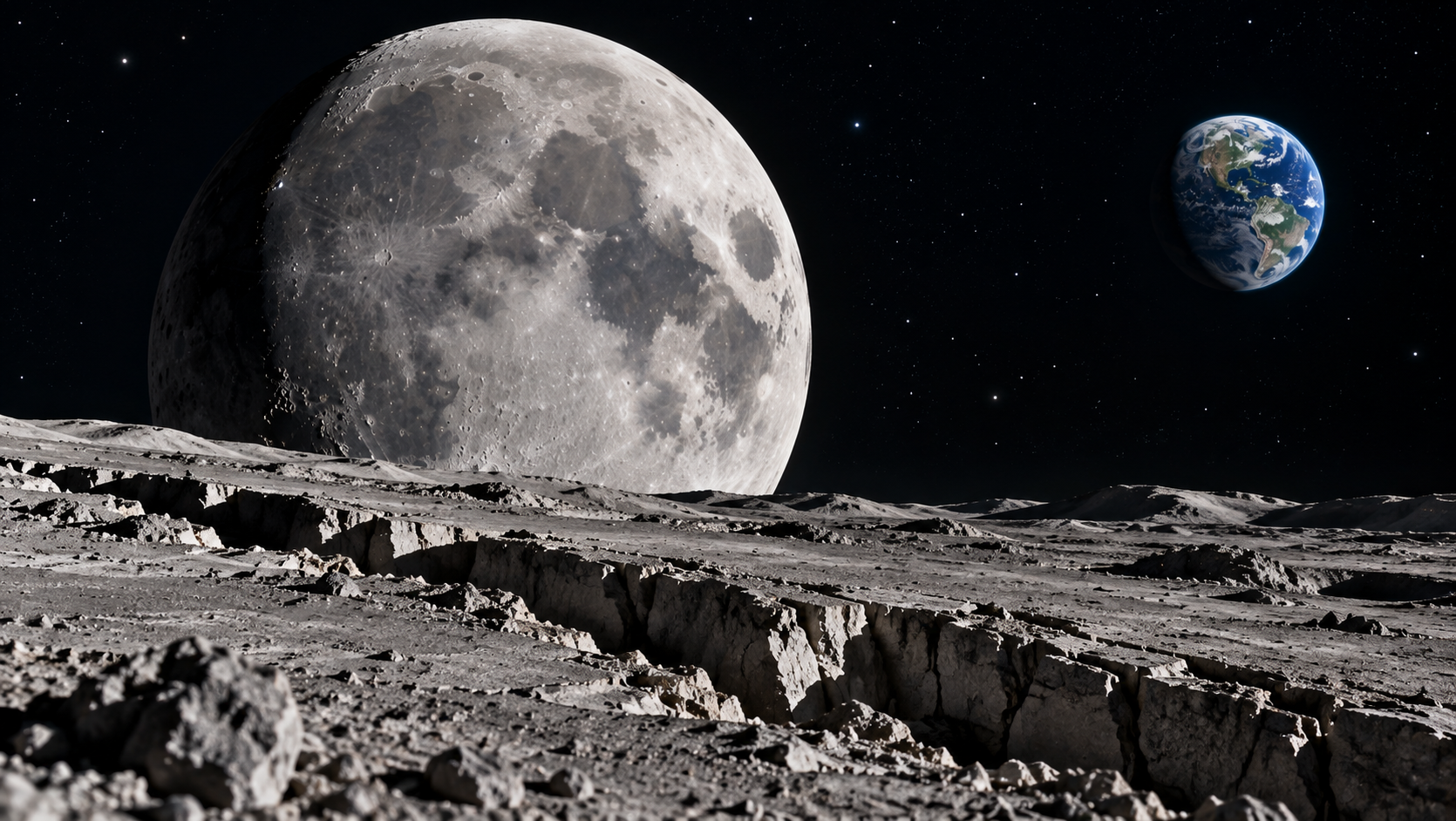
Photo: Chat GPT