ANA-MPA President outlines future strategy of news production
The new and complex challenges currently facing journalism during a time of transition, when information is not merely disseminated faster but is fundamentally transformed in terms of its form, source, and reliability, were discussed at the Pantion University conference in Greece.
As speakers noted, the newsroom is no longer solely a space for producing news, but a dynamic environment where speed collides with the need for verification, technology with ethics, and the abundance of information with credibility, CE Report quotes ANA-MPA.
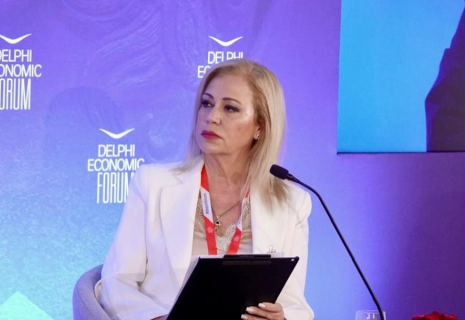
A central role in the discussion was held by Aria Agatsa, President of the Athens-Macedonian News Agency (ANA-MPA), who elaborated in depth on the agency's role as a pillar of quality and reliability.
"Information is not merely changing form; it is changing the very conditions of its existence," she stressed, pointing to the exponential acceleration of speed, the proliferation of information, and the simultaneous "industrialization" of disinformation.
Agatsa highlighted the link between these developments and broader geopolitical and social changes, noting that the "shifting landscape" affects the way citizens perceive reality as a whole. In this environment, she explained, the ANA-MPA does not function merely as a transmitter of news, but as an evidence-driven organization:
"It does not rely solely on what has happened, but on what has been substantiated and what can be verified."
She placed particular emphasis on the concepts of quality, validity, and credibility, which she described as "successive layers of accountability":
"Quality concerns how news is produced. Validity concerns why an institution has the authority to speak with credibility. And credibility concerns whether citizens can rely on it."
She focused especially on credibility, noting:
"Credibility is not inherited. It cannot be imposed. It is earned through reliability."
She added that trust is built only when information has undergone "strict verification and sound journalistic judgment."
The President of ANA-MPA also highlighted the challenges in the daily operation of a newsroom, where "the shift cannot wait" and where information, images, and data coexist in a continuous flow. In this context, she underscored the importance of training, technological upgrading, and investment in verification tools.
She also made particular reference to the role of artificial intelligence, which, as she noted, is already influencing the way news is produced and disseminated.
However, she set clear boundaries:
"Systems may generate false certainties and content that appears credible without being so. Technology enhances - but does not replace - journalistic judgment."
Furthermore, she outlined key priorities for the future: investment in verification tools, strengthening journalists' training, leveraging archives, developing partnerships with universities, and enhancing outward engagement.
Regarding her vision for the ANA-MPA, she said that she aspires it should "be modern, technologically advanced, and well-organised, producing original and competitive content."
Concluding, she reflected on the role of a public media organization in a democracy, highlighting the responsibility for transparency, accountability, and making a clear distinction between fact and opinion:
"A public news agency must set the example through editorial discipline and the responsible use of technology."
Photo: Instagram/aria.agatsa