Ancient marine reptile tooth discovered near Idrija
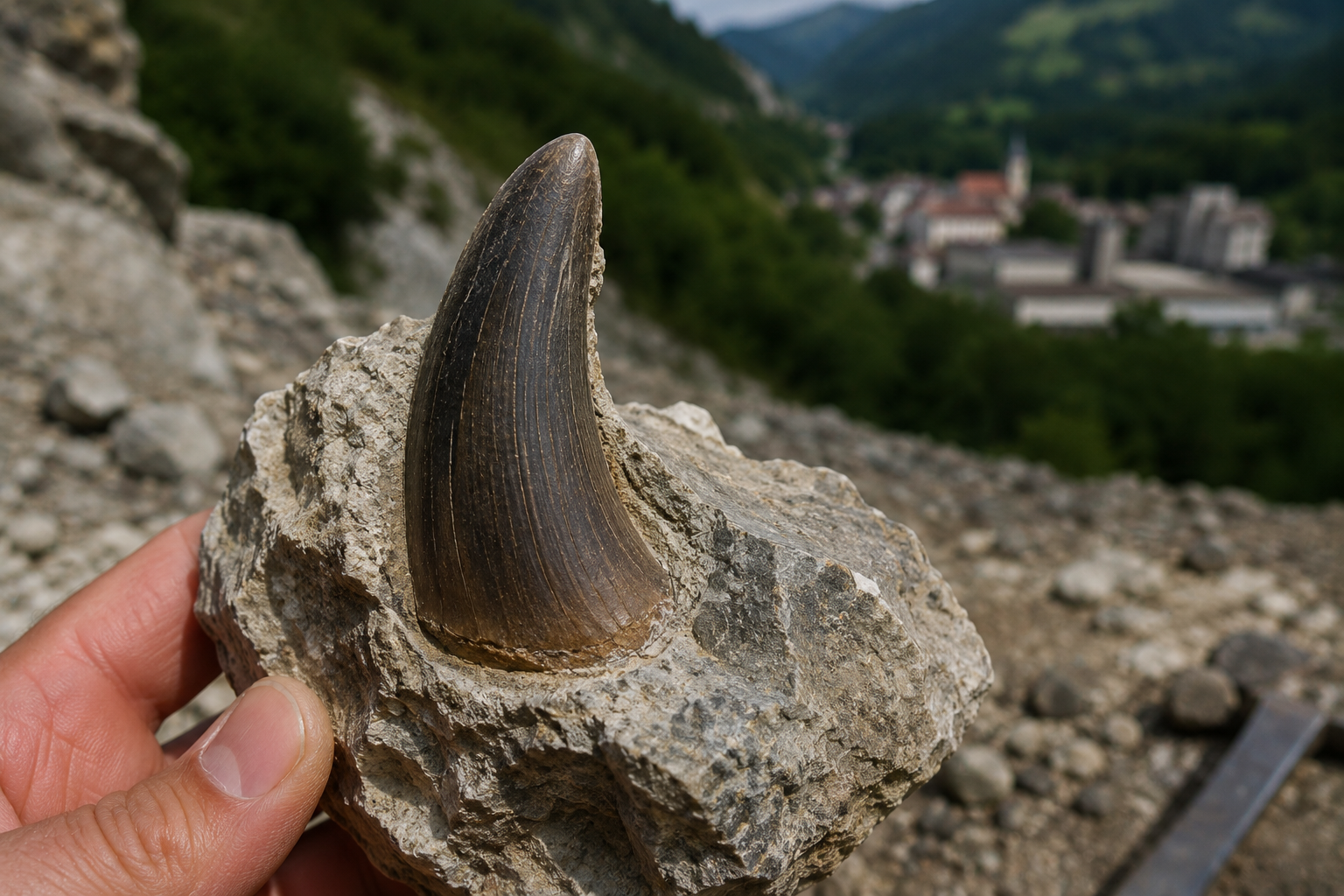
A fossilised tooth from an extinct marine reptile discovered in western Slovenia could rank among the largest placodont teeth ever found from the Triassic Period, offering a rare glimpse into life in the ancient Tethys Ocean some 235 million years ago.
The tooth, found near Idrija, belonged to a placodont, a group of armoured marine reptiles that lived during the Triassic, roughly 252 to 201 million years ago, CE Report quotes The Slovenia Times.
Researchers say the discovery is significant because of the fossil's exceptional preservation and the rarity of such finds from the Carnian age, a subdivision of the Triassic.
The fossil was discovered by Gregor Koželj, a ranger at the Zgornja Idrijca Landscape Park, during one of his routine patrols.
"I saw an interesting black object. It didn't look like a shell or an ammonite, but rather like a plant, a water lily. Although I couldn't identify it, I knew it was something special," Koželj told reporters.
After consulting several geologists, he sent the tooth to the Ivan Rakovec Institute of Palaeontology in Ljubljana, which confirmed it belonged to a vertebrate - a placodont dating back around 235 million years.
Placodonts inhabited the warm, shallow waters of the ancient Tethys Ocean, whose range extended as far as present-day China.
Although they lived in the age of dinosaurs, placodonts were not dinosaurs. They were marine reptiles, whereas the term dinosaur refers to land-dwelling reptiles of that era.
Placodonts measured between 1.5 and 2 metres in length and resembled turtles. They had heavy, shell-like armour that protected them from predators.
With short legs and broad heads, they were not strong swimmers and spent much of their time on the seabed, using their powerful teeth to crush shellfish.
"What is interesting about placodonts is that their teeth were flat like buttons, with a large surface area and a low profile, which is typical of animals that fed on very hard food," palaeontologist Irena Debeljak said.
"They mostly ate shellfish and had to crush hard shells, so their teeth had to withstand very high pressure, which is why they were flat. Their enamel also evolved to become very hard."
Placodont fossils from the Carnian age are relatively rare, making each new discovery important for understanding the evolution of these animals and the environment in which they lived.
Debeljak hopes the tooth will help palaeontologists better understand the evolutionary adaptations that gave placodonts such durable enamel.
Further research may allow palaeontologists to determine the exact genus of the animal, which they believe could have belonged to Cyamodus.
Photo: Chat GPT