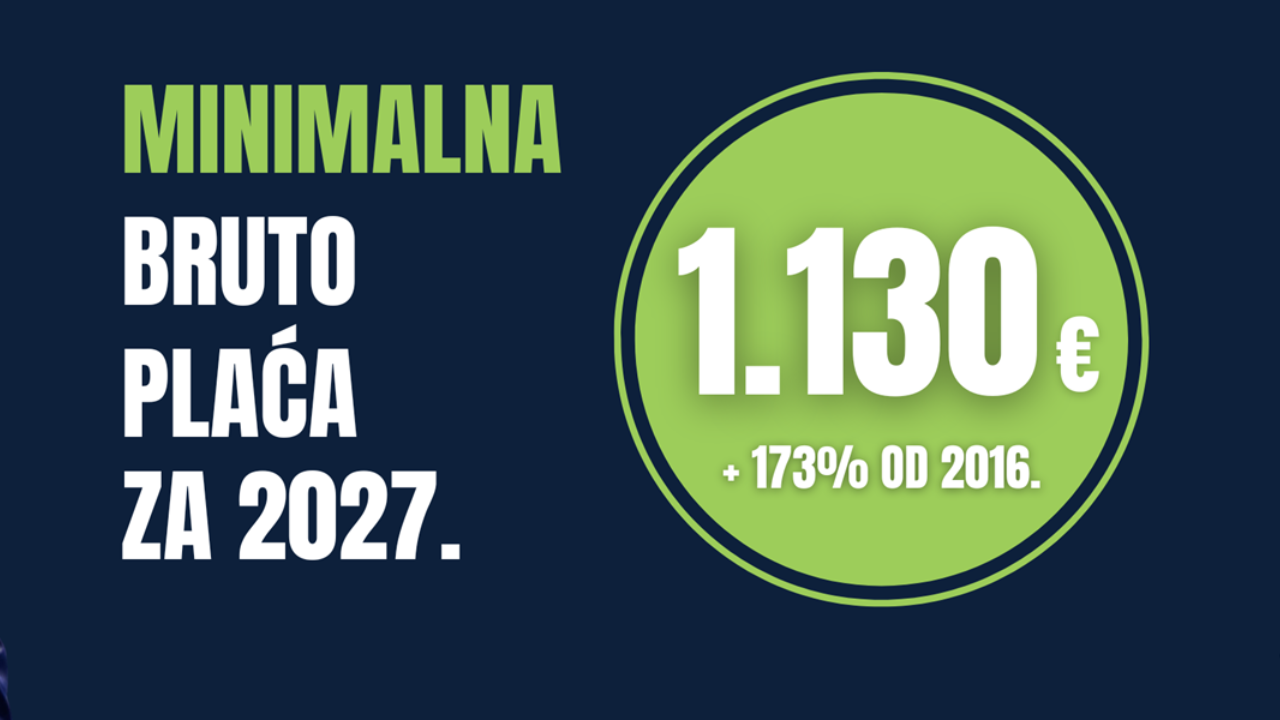
Croatia to raise minimum wage to €1,130 in 2027
The minimum gross wage currently stands at €1,050, and following consultations and assessments, the government has decided to increase it to €1,130, an €80 rise compared with this year, Prime Minister of Croatia Andrej Plenković announced during the opening remarks of a government session.
He said the increase represents annual growth of 7.6%. Plenković recalled that the minimum gross wage stood at €414 in 2016, when he formed his first government.
Since then, it has increased by 173% in nominal terms and 97% in real terms, representing an absolute increase of €716, CE Report informs via the Croatian government website.
Around 50,000 workers in Croatia, or 5% of employees, receive the minimum wage, Plenković added.
"We believe this proposed increase is realistic. It protects workers, particularly those with the lowest wages, while also taking into account the competitiveness and needs of the Croatian economy," the prime minister said.
He also announced the continuation of compensation measures through the Croatian Employment Service for all employers paying the minimum wage who submit an application. Under the scheme, the government will cover the difference between this year's gross minimum wage and next year's higher amount for the first three months of 2027.
Minimum Student Hourly Wage to Rise to €7.06
The prime minister emphasized that an increase in the minimum wage automatically raises the minimum hourly rate for student work, which currently stands at €6.56 and will increase to €7.06 next year.
He recalled that the minimum student hourly rate was €2 when he began his first term in 2016.
"Thanks to government decisions, our students can enjoy a meal at all student center restaurants for €0.86. We have yet to find another European Union country offering such an affordable meal for students," Plenković said.
In this context, the prime minister recalled that the government held a telephone session on Monday to introduce further regulations on petroleum product prices to support citizens and businesses.
Government Continues Fuel Price Interventions
Without government measures, a liter of diesel would cost 31 euro cents more, gasoline 14 cents more, and agricultural diesel 8 cents more. Liquefied petroleum gas for tanks would be 11 cents more expensive, while bottled gas would cost 23 cents more.
"All these measures are aimed at preserving social cohesion and enabling us to navigate external shocks and crises that are beyond the control of our citizens, businesses, or the state itself," Plenković said.
The prime minister also addressed several other current issues and government activities undertaken over the past week.
Following the completion of numerous reconstruction projects in Zagreb and the Banovina region over the previous two days, Plenković reviewed progress in the reconstruction process.
Around 500 Cultural Heritage Buildings Restored
The renovated Mimara Museum has been inaugurated, with the prime minister describing the €70 million project as one of Croatia's largest investments in cultural infrastructure.
In addition to undergoing comprehensive structural and energy-efficiency renovations, the museum will reopen to visitors on November 7, allowing the public to once again view the extensive and valuable art collection donated to the Croatian people by Ante Topić Mimara approximately 40 years ago.
"The new exhibition and art collection truly represent a cultural enrichment for Zagreb and Croatia as a whole," Plenković said.
He noted that approximately 500 cultural heritage buildings have undergone restoration, including 270 religious buildings.
However, reconstruction is not the government's only focus in cultural infrastructure. Across Croatia, more than 30 new or renovated libraries, 40 museums and other cultural venues, and 16 state archives have been opened or restored, alongside numerous other projects.
According to Plenković, the area stretching from the Mimara Museum to the new Croatian National Theatre building, near the new stadium on Kranjčevićeva Street, and the Croatian Conservation Institute in the former Zagreb Tobacco Factory building has effectively become a new cultural district in Zagreb.
The prime minister emphasized that the reconstruction of Zagreb and Banovina, which has so far received €5.3 billion in investment, is the result of systematic and organized government efforts in cooperation with counties, cities, and municipalities affected by the earthquakes.
Nearly €1 Billion Invested in Educational Institutions
The fully renovated Ministry of Construction building on Republike Austrije Street has also been inaugurated.
Plenković highlighted that the building houses officials responsible for reconstruction and housing policy, two strategic priorities of the government, praising their work over recent years.
The renovated Faculty of Pharmacy and Biochemistry building on Ante Kovačića Street in central Zagreb has also reopened.
The prime minister recalled that practically all university faculties in Zagreb have undergone reconstruction.
Referring to the celebration of the 250th anniversary of the University of Zagreb's Faculty of Law, held the previous evening, he noted that three of its buildings have already been renovated, located at Trg Republike Hrvatske 3, Ćirilometodska Street, and Nazorova Street.
Renovation work is continuing on the faculty's main building and the University Rectorate building at Trg Republike Hrvatske 14.
Plenković said nearly €1 billion has been invested in the reconstruction of educational institutions so far.
€5.3 Billion Spent on Reconstruction in Zagreb and Banovina
Reconstruction activities are also continuing in the Banovina region.
The completion of a major €48 million reconstruction and modernization project at the Topusko Health Resort was marked yesterday.
Plenković said the project forms part of broader efforts to revitalize Sisak-Moslavina County.
He also highlighted the opening of a branch of the University Hospital Centre Zagreb's Institute of Hyperbaric Medicine at the Veterans' Center in Petrinja, as well as a new €10 million Economics School building in Sisak.
In Banovina, 14 primary schools and 12 kindergartens have been renovated, while 57 of the 59 planned apartment buildings have been completed.
"All of this demonstrates the scope of our activities aimed at helping Zagreb and Banovina recover from the two devastating earthquakes," Plenković said.
He added that a total of €5.3 billion has been spent on reconstruction, including €3.15 billion in Zagreb and €2.15 billion in Banovina.
The prime minister stressed that these achievements did not happen on their own but resulted from systematic and organized work by the Croatian government in partnership with regional and local authorities in earthquake-affected areas.
National Children's Hospital to Crown Healthcare Infrastructure Investments
Another major project launched this week was the construction of the new National Children's Hospital in Blato, valued at €240 million.
The foundation stone was laid for the hospital, which is expected to be completed within a maximum of three years and two months.
Plenković said the long-awaited facility would serve approximately 300,000 children.
Discussing investments in healthcare infrastructure, he recalled that nearly all hospitals in Zagreb had been renovated following the earthquakes.
"Just as the government stood behind the education system, it has also supported the healthcare system in the capital, and this project will be the crowning achievement of these investments and reconstruction efforts," he said.
Among other activities, Plenković highlighted a meeting of the Economic and Social Council, where social partners discussed the broader global situation and macroeconomic forecasts.
These include projected GDP growth of 2.3% this year, a budget deficit expected to remain below 3% following the budget revision, and a reduction in public debt to 55.5% of GDP.
Croatia's GDP is expected to exceed €100 billion, while employment remains high, with one unemployed person for every 28 employed people.
Croatia Welcomes Positive Signals from Montenegro but Says Further Conditions Remain
Last week, Plenković visited Montenegro to attend a summit of Berlin Process leaders, which focused on advancing the European integration of Southeast European countries.
During the visit, he held what he described as a substantive and detailed meeting with Montenegrin Prime Minister Milojko Spajić.
"We acknowledged the positive signal and step in the right direction concerning the memorial plaque at the Morinj camp, commemorating the events of 1991, as well as the decision to rename the swimming pool in Kotor, which had been named after one of the guards at the Morinj camp, where Croatian prisoners were killed and tortured," Plenković said.
However, he emphasized that several important conditions remain unresolved, particularly those related to the fundamental rights chapter and the foreign and security policy chapter of Montenegro's EU accession negotiations.
The Croatian side has communicated its expectations to Montenegro, he added.
"We believe they have clearly understood these messages, and we are ready to work with them to resolve the outstanding issues and create the conditions for completing Montenegro's accession negotiations," Plenković said.
He stressed that these were not bilateral disputes but matters concerning fundamental values covered by Chapters 23 and 31 of the EU accession process.
Finally, Plenković once again expressed condolences, on behalf of the entire Croatian government, to the Spanish government and citizens following a major railway accident in the province of Toledo, which claimed dozens of lives and left many others injured.
Photo Croatian government website