Croatia aims to attract Chinese investment, expand exports
Attracting investment in manufacturing facilities in Croatia, strengthening the presence of Croatian companies in the Chinese market, and developing energy cooperation were the main priorities of Croatian Economy Minister Ante Šušnjar's official visit to the People's Republic of China.
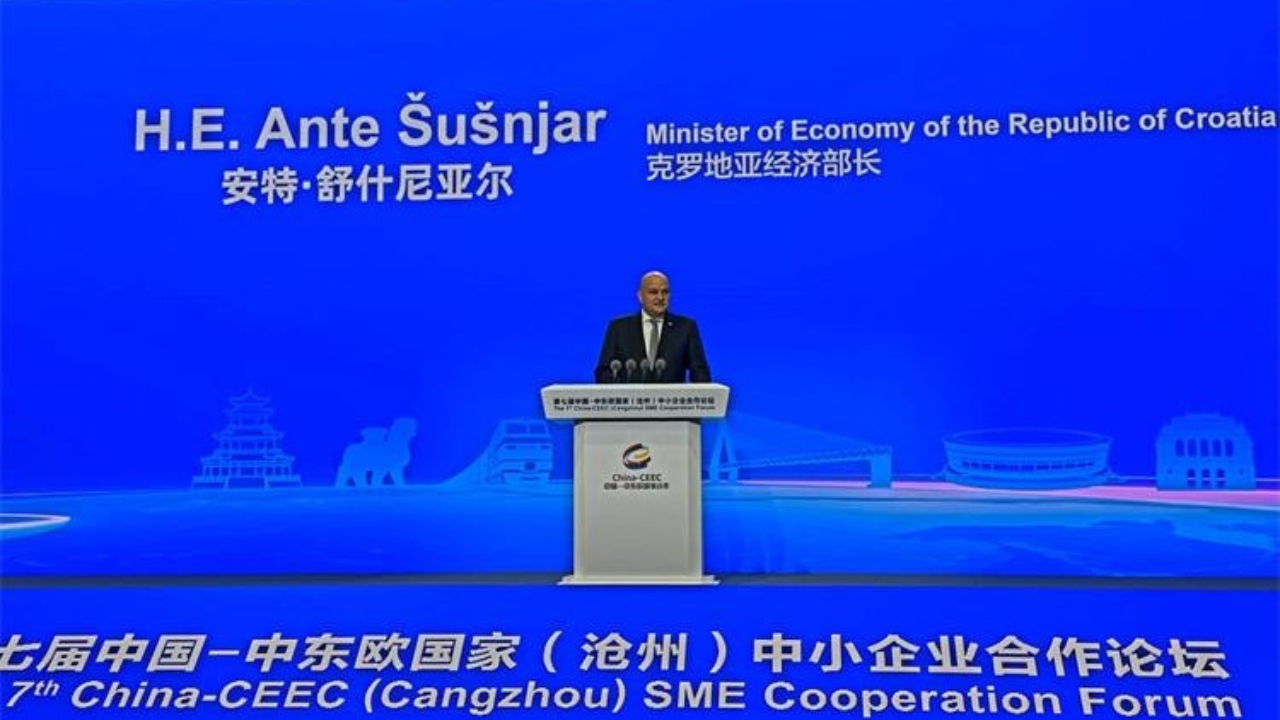
During the visit, the minister held meetings with representatives of Chinese institutions and companies and participated in the 7th China–Central and Eastern European Countries SME Cooperation Forum in Cangzhou, CE Report informs via the Ministry of Economy of Croatia's official website.
During the discussions, Šušnjar emphasized Croatia's interest in investments that bring not only capital but also new technologies, develop domestic manufacturing, and involve Croatian suppliers. This approach is linked to preparations for Croatia's National Industrial Development Plan for 2027–2034, which focuses on modernizing production, increasing productivity, and boosting exports.
In Beijing, Šušnjar met with China's Acting Minister of Industry and Information Technology, Xiong Jijun, to discuss connecting Croatian companies with Chinese business partners and investors, as well as opportunities to expand the presence of Croatian products in the Chinese market.
At a meeting with Chinese Vice Minister of Commerce Ling Ji, the two sides explored opportunities for economic cooperation, particularly in advanced manufacturing and innovative technologies, while respecting the European regulatory framework and competition rules.
An important part of the visit focused on nuclear energy and opportunities for Croatian businesses to participate in energy projects. The minister met with State Power Investment Corporation (SPIC) Chairman Liu Mingsheng, State Nuclear Power Technology Corporation (SNPTC) Chairman Ma Yuanhua, and China National Nuclear Corporation (CNNC) Chairman Zhang Tao.
The discussions covered experience in developing nuclear projects, knowledge transfer, specialist training, and conditions for involving Croatian companies in international supply chains, ranging from the production of electrical equipment and auxiliary systems to engineering services.
Croatia is preparing its nuclear program based on more than four decades of experience with the Krško Nuclear Power Plant. International discussions form part of a structured information-gathering process aimed at collecting comparable data on available technologies and their technical, safety, and economic aspects before decisions are made on future projects.
As part of the official visit, members of the Croatian delegation toured CNNC's Zhangzhou Nuclear Power Plant and met with its management. In Shenzhen, they visited the Daya Bay Nuclear Power Plant operated by China General Nuclear Power Group (CGN), where they also held discussions with plant executives. The visits and meetings were part of an information program designed to learn from China's experience in nuclear energy.
The minister also discussed broader energy development with Wang Jianbo, deputy head of China's National Energy Administration (NEA). Topics included nuclear energy, renewable energy sources, and electricity infrastructure, including smart grids and battery storage systems aimed at improving grid stability.
During a visit to Suzhou Industrial Park, Šušnjar learned about the model used to connect research centers, technology companies, and manufacturing facilities. Established through cooperation between China and Singapore, the park hosts companies operating in sectors such as electronics, automation, and biotechnology.
At GCL Energy Technology, the minister met with Huang Yueyuan, Chairman of GCL Energy International. They discussed energy storage technologies and battery systems, which are becoming increasingly important for energy supply security and electricity grid management as renewable energy capacity expands.
At BYD's headquarters in Shenzhen, the company presented its plans to expand manufacturing within the European Union.
Šušnjar met with Jenny Ji, Deputy General Manager for Europe, the Americas, the Middle East, and Africa, and Jeremy Wang, Regional Director for Southeast European Markets, to discuss Croatia's potential for investment in manufacturing, battery technologies, and logistics.
Particular attention was given to Croatian ports and transport connections with European markets, as well as opportunities to integrate domestic companies into the supply chains of BYD's European manufacturing facilities.
The minister also exchanged information on industrial digitalization and manufacturing automation with Huawei Vice President Tommy Zhou and Chris Luo, Huawei's Chief Executive Officer for the region that includes Croatia.
The discussions covered Huawei's existing activities in Croatia and its cooperation with educational institutions. Šušnjar stressed that technological development must comply with Croatian and European regulations and cybersecurity requirements.
Export opportunities were discussed with Cai Yu, Director of the Croatian Chamber of Economy's representative office in Shanghai, as part of preparations for a Croatian business delegation's participation in the China International Import Expo (CIIE).
A total of 37 Croatian companies from the food industry, energy, transport, and logistics sectors have registered for the visit scheduled for November 2–7. Discussions focused on organizing their participation and connecting them with Chinese business partners.
At the 7th China–Central and Eastern European Countries SME Cooperation Forum in Cangzhou, Šušnjar emphasized the importance of direct business contacts, innovation, and access to international markets.
Croatia leads the SME Coordination Mechanism within this cooperation framework, which operates under the Ministry of Economy.
Alongside participation in the forum and a visit to the trade fair, discussions were held with representatives of Hebei Province and the city of Cangzhou on economic cooperation and business networking.
In Cangzhou, the minister also met with Zihao Dong, owner and Chairman of Eureka Group, to discuss investment opportunities in Croatia, the development of logistics infrastructure, and connections between Croatian companies and international business partners.
Economic cooperation between Croatia and China will continue in early November, when a Croatian business delegation travels to Shanghai for the CIIE, where companies will showcase their products and services and establish new business contacts.
"We used this visit to present Croatia's manufacturing and export potential to the people who make decisions on investments and supply chains. We discussed where Croatian companies can offer their equipment and expertise and what types of manufacturing we can attract to Croatia.
"For the preparation of our nuclear program, it is important to learn directly from the experiences of other countries and understand the conditions under which Croatian industry can participate in future projects.
"We will measure the value of these discussions by new export contracts, manufacturing investments, and the involvement of Croatian suppliers in international projects," Minister Šušnjar said.
Following his visit to China, the minister will travel to the Republic of Korea, where he will participate in the International Atomic Energy Agency's (IAEA) 6th International Ministerial Conference on Nuclear Energy in Incheon.
Bilateral meetings are also planned with representatives of Korean institutions and companies to discuss nuclear energy, liquefied natural gas (LNG), industrial cooperation, and trade.
Photo Ministry of Economy of Croatia