Kaja Kallas warns Bosnia's EU reforms have stalled over past two years
Bosnia and Herzegovina made good progress on its European path until 2024, but the past two years have seen a worrying slowdown in reforms, European Union High Representative for Foreign Affairs and Security Policy and Vice-President of the European Commission Kaja Kallas said in an interview with FENA.
Referring to the fact that Bosnia and Herzegovina received the green light to open accession negotiations with the European Union, but that reforms continue to progress slowly due to political blockages, Kallas stressed that the EU is ready to help Bosnia and Herzegovina, but that the country's authorities must deliver the reforms needed by its citizens, the country's prosperity, and its EU membership, CE Report informs.
“Bosnia and Herzegovina really did a good job in the period leading up to 2024 by delivering reforms. Over the past two years, however, we have seen a slowdown in reforms, which is why we are very concerned, and that is why I am here for the third time. Other European representatives are also asking what more we can do to help you deliver these reforms,” Kallas said.
She emphasized that the reforms are important not only for the formal EU accession process, but above all for the citizens of Bosnia and Herzegovina.
“These are reforms that your people need, that are necessary for your country's prosperity and the well-being of everyone here, and they are also essential for accession to the European Union,” she said.
Kallas also warned that Bosnia and Herzegovina is already losing significant funding from the EU Growth Plan for the Western Balkans because of political deadlock.
“The European Union is here for you, but your politicians and your government must also deliver results. Take the ratification of the Growth Plan as an example. This is a plan intended for the people of Bosnia and Herzegovina. €108 million has already been lost, and there is now a risk of losing another €373 million,” Kallas said.
She noted that these funds could be invested in improving infrastructure and enhancing citizens' quality of life.
Asked what concrete signal the European Union could send to citizens of candidate countries to demonstrate that the European perspective is genuine, Kallas said that the process is always a two-way street.
“On the one hand, there are the reforms we expect candidate countries to deliver. You also have elections coming up, and this is a question you can ask every political party taking part in them—whether they are delivering those reforms. On the other hand, there is our side, and we are trying to help your country as much as we can,” she told FENA.
As examples of tangible benefits for citizens, she mentioned projects such as "Roam Like at Home" (RLAH), which would allow people to use mobile services across Europe under conditions similar to those at home, as well as ongoing work on payment systems.
Asked whether enlargement towards the Western Balkans is today more a matter of the European Union's credibility or European security, Kallas said that enlargement has always been a geopolitical process.
“If we look at geopolitical developments around the world, it is clear that we are stronger together. Enlargement brings peace and stability. We have already seen that. Countries that were once at war with one another are now working hand in hand within the European Union. It is clear that this is something we must continue to advance,” she explained.
She added that the European Union cannot let down its partners, including the countries of the Western Balkans, and expressed hope that the enlargement process would move forward more quickly.
“We hope we will be able to move quite rapidly in the enlargement process, provided that both sides do their homework—both the Western Balkan countries and the European Union,” Kallas said.
Commenting on proposals by France and Germany for a new approach to enlargement, under which candidate countries would gradually be integrated into certain EU policies, institutions and the single market before achieving full membership, Kallas said that the various ideas stem from the fact that the enlargement process has taken too long.
“We want to see future member states genuinely working together with us because together we are much stronger. But it is also true that everyone wants access to the single market. At the same time, we want to see those countries deliver on what we call the fundamentals—fundamental freedoms, media freedom, freedom of assembly and the rule of law—which are what actually bring prosperity to those countries,” Kallas said.
She stressed that access to the single market and reforms must go hand in hand.
Asked whether the European Union is institutionally, financially and politically prepared for a new enlargement, particularly if the Union grows to more than 30 member states, Kallas said enlargement should not be viewed as an all-or-nothing process.
“If we take Montenegro or Albania as examples, these are very small countries and the European Union has the absorption capacity to accommodate them. Or if we take Bosnia and Herzegovina, you are not a large country either. I think we need to assess each country individually and see how we can move forward,” she said.
However, she added that it is clear the European Union will need more efficient decision-making processes as its membership expands.
Speaking about changes in the international order, the war in Ukraine, shifts in transatlantic relations, and the influence of Russia and China, Kallas said the European Union cannot afford to leave the Western Balkans outside the Union for much longer.
“The geopolitical situation is such that, if you look at the map, Europe is actually a very small continent. We have many nations, many different cultures and languages, but we are all very small. To stand up to all those challenges and adversaries from outside, we must work together,” Kallas said.
She concluded that it is also in the European Union's own interest for the Western Balkan countries to become members.
“It is clearly in our interest for the Western Balkans—that is, the countries of the Western Balkans—to join the European Union,” Kallas said in the interview with FENA.
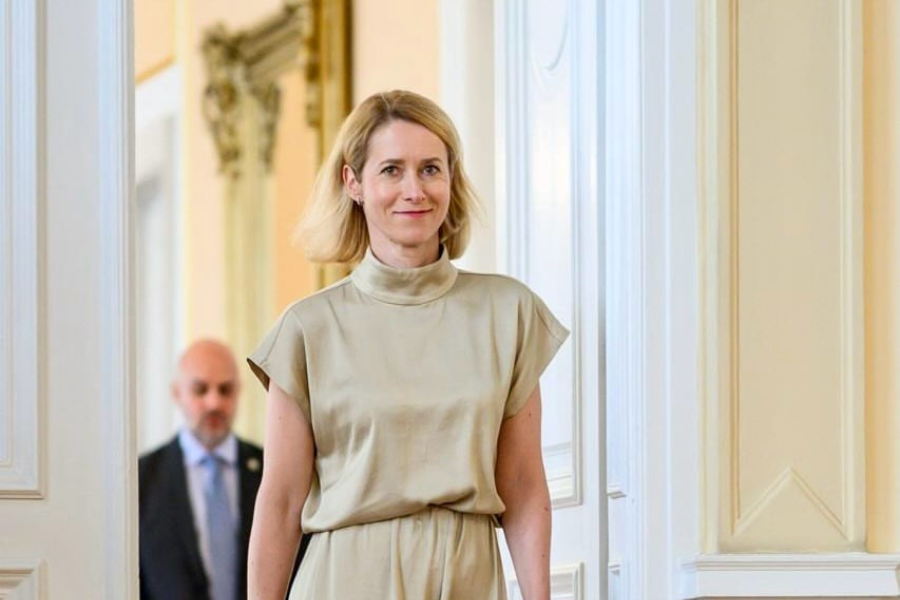
Photo Instagram/kajakallas