Türkiye's hidden heritage captured on camera
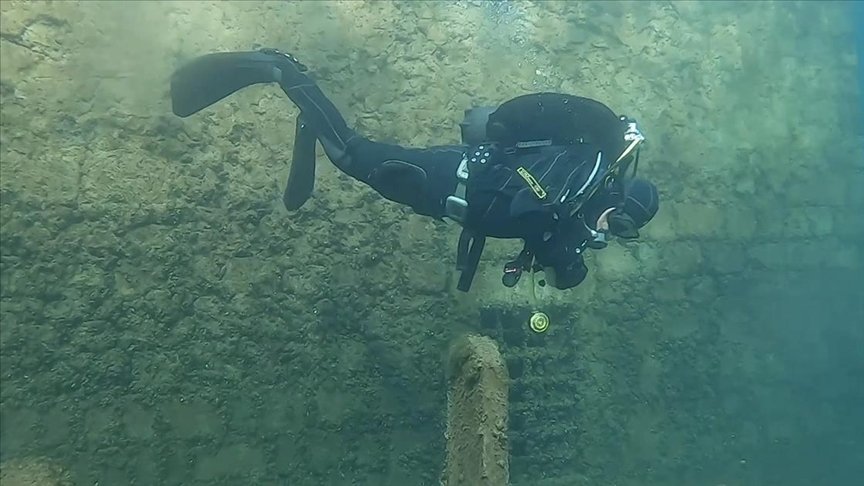
In the Eğil district of Diyarbakır, Türkiye, approximately 2,400-year-old historical structures lying underwater have been captured on camera.
Located 52 kilometers from the city center, Eğil—home to many civilizations from ancient times to the present—attracts attention with its religious, natural, and cultural heritage, CE Report quotes Anadolu Agency.
The Dicle Dam Lake, whose construction began in 1986 and was completed in 1997, serves as an important source of drinking and utility water for the city. At the same time, it draws attention for the historical structures hidden beneath its depths.
The tombs of the prophets Zul-Kifl and Elisha, located in Eğil, were moved to Nebi Harun Hill in 1995 to prevent them from being submerged. However, some rock tombs, as well as structures such as a mosque, madrasa, and bathhouse, remain preserved underwater.
Underwater Search and Rescue (SAK) teams from the Provincial Gendarmerie Command recorded images of some submerged structures during training dives in the reservoir.
Prof. Dr. İrfan Yıldız, Dean of the Faculty of Art and Design at Dicle University, emphasized the historical importance of Eğil. According to current knowledge, the first settlement in the district dates back to the Hurri-Mitanni period. Later, many civilizations—including Assyrians, Urartians, Medes, Persians, Romans, and Byzantines—ruled the area, followed by Islamic states after 639.
Yıldız noted that with the construction of the dam, many settlements and historical structures that were once along the Tigris River were submerged.
He explained that especially the Tekke and Hacıyan neighborhoods were affected. In Tekke, numerous historical sites—including the tomb and mosque of Prophet Elisha, the mosque next to it, the madrasa known as Caferiye or Lala Kasım (built during the Ottoman period), a cemetery, and rock tombs—were submerged. Similarly, the tomb of Prophet Zul-Kifl in Hacıyan was also covered by the dam waters.
Yıldız added that the Deran Bath, dating back to the Byzantine period and located between the prophets’ tombs and the castle, is also underwater. These structures can be observed through diving activities.
He stated that footage recorded by SAK teams includes the tomb of Prophet Elisha and the adjacent mosque, as well as the Caferiye Madrasa and the Tekke neighborhood cemetery.
During dry years, when water levels recede, the silhouettes of some structures become more visible in the reservoir. Yıldız emphasized that these remains have preserved their integrity and structure despite being underwater for many years.
He concluded that there are approximately 2,400-year-old artifacts in Dicle Dam Lake and that underwater archaeology—an increasingly important field in Turkey—could be conducted to study these submerged historical sites.