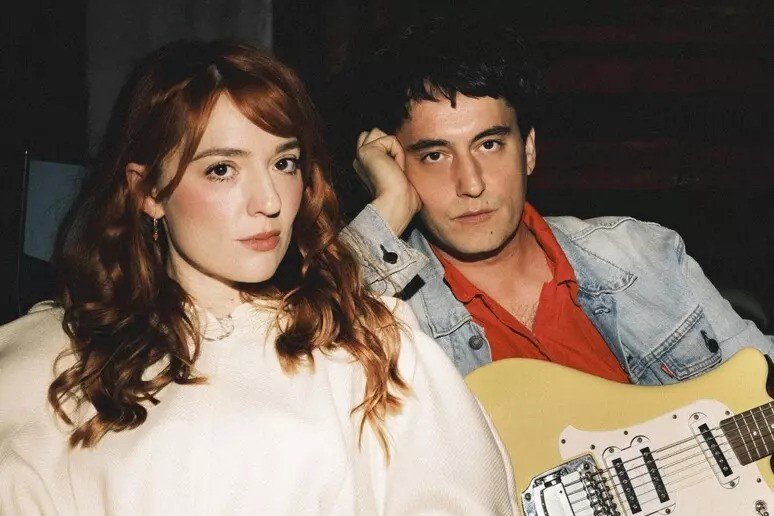
Maria Antonietta and Colombre turn joy into protest
How wonderful it would be if happiness were truly democratic and accessible to everyone.
But unfortunately, in an increasingly warped world set ablaze by wars, it isn’t, CE Report quotes ANSA.
And so perhaps even the crime of robbery would be forgiven, if the loot were made of happiness and smiles, of serenity and well-being.
It won’t be constitutional scholar Gustavo Zagrebelsky bringing this theory to the Sanremo stage, but rather the delightful indie song by the singer-songwriter duo Maria Antonietta and Colombre, “La felicità e basta” (“Happiness, That’s All”), in which they sing:
“Baby, let’s pull off a robbery together, baby / to take back our whole life. / What do you think? / I think we’ll just take happiness for ourselves.”
“We are a collective,” the two artists from the Marche region (born in 1987 and 1982 respectively) explain to ANSA, “and we sing about this happiness that is taken away from us by all the expectations imposed by society, which demand that you always be up to the task. And if you fail, it’s your fault. We reject this deep-rooted sense of guilt according to which, if you’re unhappy, you must somehow deserve it — you must have done something wrong, maybe you didn’t believe hard enough. We think this ‘just believe in it’ fairy tale is a distortion of an economic system where even happiness becomes a commodity: something you have to earn, not something that’s free. To us, this is a deeply perverse mechanism, one that we ourselves also suffer from. We’re not life gurus — we’re part of this world like everyone else.”
According to Maria Antonietta and Colombre, “happiness is something you take. In the song,” they explain, “we don’t say ‘I believe happiness is X, Y, or Z.’ There’s no didactic definition. Happiness is ‘we take it.’ So not passivity — and above all,” they stress, “we don’t look for definitions, because everyone finds happiness in their own way. Some people have a family and find happiness there; others are alone and just as happy; some have ten dogs and are happy; some have a conventional job and love it; others have a crazy, unstable job and are happy because of their freedom. No one has the recipe — but there is an invitation to act, to take it.”
In a world at war, how hard is it to talk about happiness?
“It’s certainly a very unhappy world, one that produces a lot of unhappiness. In that sense, happiness is also political — an act of resistance, in a way. When you are happy, you are powerful; you are more capable of affecting things, reality, the world, and yourself. When you’re unhappy, you’re drained, annihilated, and you just endure. And in this terrible world, built on injustice, domination, and economic logic, there’s no room for empathy and for those feelings that we believe should instead be the starting point — the zero point — and the most important thing at the center of everything.”
For the duets evening, rumors say they will be joined by Brunori Sas, but they remain vague:
“We won’t say if it’s a man or a woman, but it’s someone we love very much and who loves us very much.”
As for whether they would go to the Eurovision Song Contest if they won — possibly carrying a message of peace — or boycott it, as fellow artist Levante has said she would, they are clear:
“When you make music, you always carry a message — that’s obvious. But we take one step at a time. In this hypothetical, surreal scenario of winning the festival — which won’t happen — when we get to that moment, then we’ll say what we think about the situation. Not before. That doesn’t mean we’re indifferent or without ideas; we’ll say it if and when it’s needed. Our song already makes our position quite clear.”
Speaking about their artistic partnership, born alongside their love after years in the underground scene, they say: “We work,” Colombre explains, “with mutual respect, each with their own things and spaces — which is essential. Thank God, the stars, luck, whatever it is, we match well, so we argue very little.”
“The sense of time divides us,” adds Maria Antonietta. “I’m very British; he’s more Jamaican in his approach. That’s the only real friction between us. Otherwise, we have a lot of fun making things, living our lives, making music.”
After the case of Coma_Cose, who broke up after their Sanremo success, do they have any fears?
“We know who we are, and we’ve known it for a long time,” Colombre replies. “If there’s a voyeuristic or almost ritualistic attitude from people wishing you a different fate, it depends on how you position yourself. If you want to put on a show, you’re more exposed to judgment. But if you just are who you are — with your limits and bad days too — then if we don’t like the game or the party, we’ll go somewhere else. No problem.”