Turkish filmmakers discuss controversial series on LGBT influence
TRT's international digital platform Tabii's original documentary "Rainbow Fascism" has premiered for its audience.
The six-part production examines the aims, functioning, and sphere of influence of LGBTQ+ lobbies whose global impact has increased in recent years, offering a critical perspective on one of the most debated issues of our time.
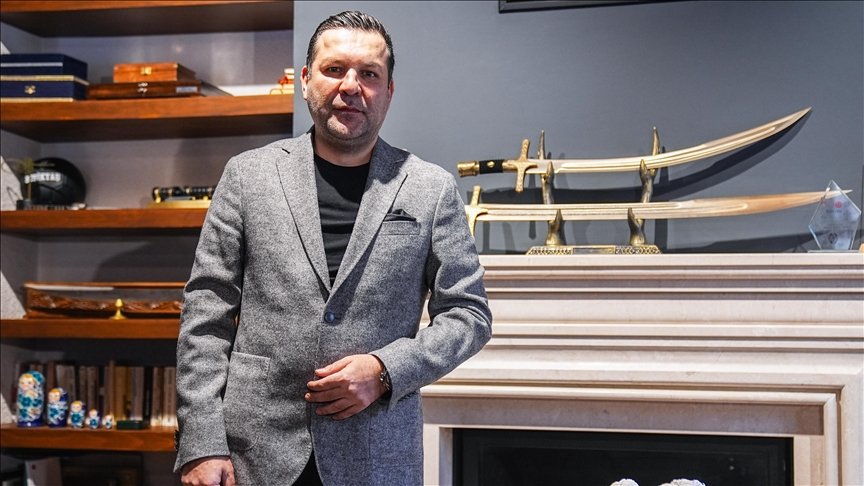
Turkish Producer Eyüp Gökhan Özekin and director Erkam Bülbül spoke to an Anadolu Agency correspondent about how the documentary came about, its goals, and the issues they aim to highlight — particularly what they describe as gender-neutralization, CE Report quotes Anadolu Agency.
Özekin emphasized that the documentary focuses on children, noting that protective instincts regarding children have generally increased worldwide.
“A company that makes such a documentary has no chance of being hosted in Hollywood”
Pointing out that people with very different political views converge on this issue, Özekin said:
“I have an oppositional, atheist academic friend who told me, ‘At home we only watch TRT Çocuk,’ because we realized that other children’s channels subtly steer children in certain directions. Sensitivity around family values has started to rise in every society, culture, and belief system. We wanted to do a project related to this.”
Özekin explained that the title Rainbow Fascism was chosen as a reference to lobbies engaged in activities related to homosexuality and gender issues, adding:
“These people are extremely intolerant. Aside from experts, most of those who speak in the documentary are people who have, in some way, been part of the LGBT environment. Even they know how ‘fascist’ this structure is. Through the ‘cancel culture’ directed at both us and the academics who speak in the documentary, we saw that the word fascism was a very accurate choice.”
He added that reactions to the documentary were expected, saying:
“Especially in the West and the United States, a company that makes such a documentary has no chance of being accommodated in Hollywood or the TV and film industry. An academic who speaks in such a production may risk being unable to practice their profession. Fascism is much more widespread in the West. We positioned our line of resistance beyond our own borders.”
“Anyone who doesn’t view them sympathetically is accused of homophobia”
Özekin said that the pressure and what he calls fascism described in the documentary exist across all sectors, but operate in a less visible way in cinema and television.
Giving examples, he continued:
“This has even entered sports console games. A sequel to a game you love comes out and your character turns homosexual. For example, there was La Casa de Papel, which we enjoyed watching. Because the first two seasons were produced by Spanish television, the roles were shared by ‘ordinary people.’ When the series moved to Netflix, half of the characters somehow became homosexual.”
He stressed that they avoided using a propagandist language and aimed instead to highlight a shared concern voiced by experts and different belief groups.
Özekin said the documentary stands with what he calls ancient values in the debate on gender, stating:
“The documentary defends whatever the traditional definition of family is. What are those? From evolutionary theory to Roman, Islamic, Jewish, and Christian law, all ancient teachings converge on woman-and-man-centered families and the civilizations they established. Therefore, whatever is natural is exactly where the documentary stands.”
“We could hardly get any academics in Europe to speak on camera”
Director Erkam Bülbül said the preparation process took about two and a half years and initially focused on local studies.
Emphasizing Turkey’s sensitivity about protecting family structure, Bülbül said:
“We listed more than 200 academics worldwide who are interested in the topic. The main difficulty we faced was that those we contacted did not want to give opinions. Especially in Europe, we could hardly get any academics to sit in front of the camera. The climate in the U.S. is somewhat more relaxed. Europe, on the other hand, stands in a much more authoritarian position on this issue.”
Bülbül argued that large capital holders want to establish a “new world order,” adding:
“To implement this idea, they first need to eliminate micro-culture. The strongest foundation of micro-culture is the family. On the other hand, humans are beings who seek a sense of belonging. When our belonging within the family and micro-culture ends, we reach what is called ‘gender belonging.’ One of the pillars of neoliberalism today is formed by LGBT and similar lobbies.”
Pointing to South Korea as an important example of how gender-neutralization policies operate, Bülbül said:
“After the major Asian financial crisis, the West provided aid to South Korea but wanted to shape its cultural policies in return. This had major effects on conservative Korean society. One of the main examples is K-pop. This is a perception marketed to conservative Eastern societies such as Egypt, Pakistan, and Turkey. We tend to receive Western influences defensively, but when the same trend comes from an Eastern culture like South Korea, the situation changes. The same gender-neutralization policy is presented to us with a more conservative coating.”
“The west imposes an idea of civilization on us every 50 years”
Bülbül said the aim of lobbies promoting gender-neutralization and population policies is “to redesign the order created by God.”
Referring to the story of Lot in the Qur’an, Bülbül said:
“In the story, the stance is not against homosexuality itself, but against its promotion and encouragement. I can’t say the same for Western civilization. When they return to their ancient values, they reach even more eugenic places, such as witch hunts. In Judaism and Buddhism there is even the death penalty. In our society, this does not exist. In our jurisprudential sources, there is a medical reality called ‘khunsa,’ or intersex, and legal solutions have been developed for it.”
Concluding his remarks, Bülbül said he can find solutions to the issue within his own society but not in the West, adding:
“The West imposes a new idea of civilization on us every 50 years. Today it tries to sell us LGBT-related ideas under the name of ‘modern civilization.’ You can clearly see a ‘are you with me or not?’ mentality. However, when we return to our own sources and form our discourse accordingly, we can position ourselves differently from both Christian Western civilization and Judaism.”