North Macedonia’s inflation holds below euro area average in August
The latest data for August show continued price stabilisation and positive developments in the Macedonian economy.
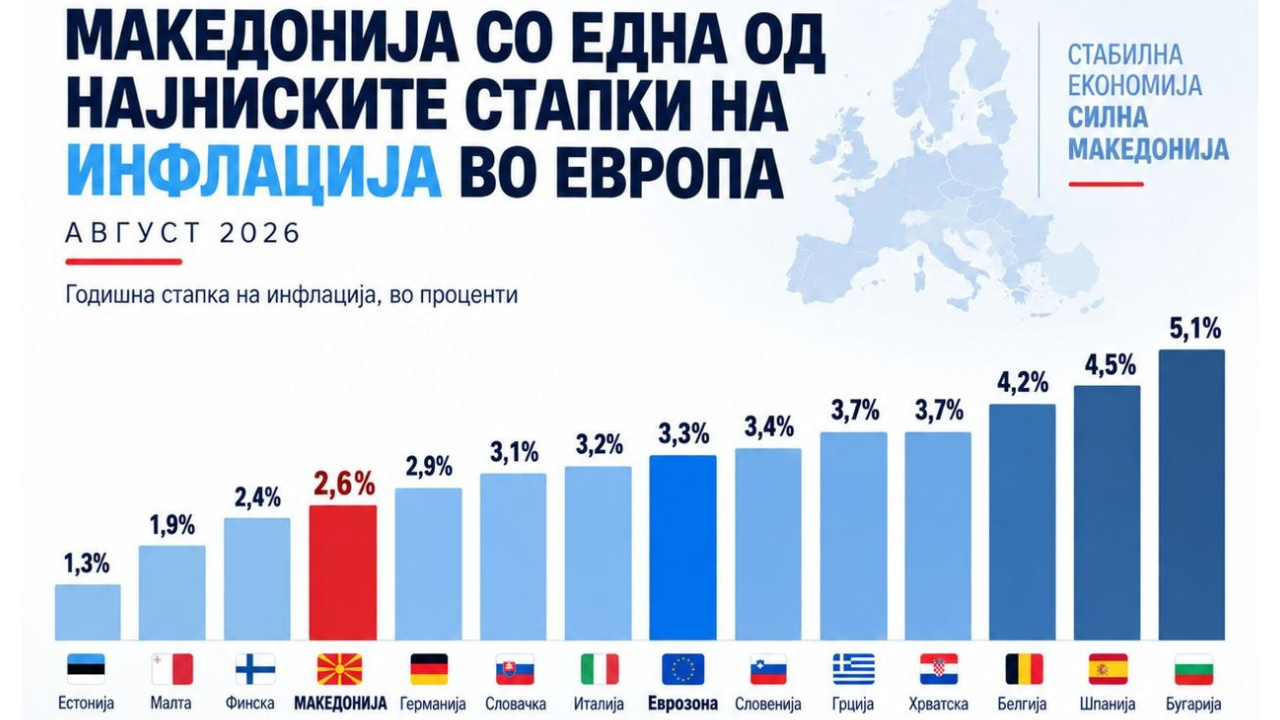
The annual inflation rate in August 2026 stood at 2.6%, compared with as much as 16.8% in August 2022. This highlights the significant decline in inflationary pressure compared with the period when citizens and businesses were facing a sharp rise in prices.
The comparison with European economies is particularly significant. According to Eurostat data published so far, inflation in the euro area is estimated at 3.3% in August, compared with 2.6% in North Macedonia, CE Report informs via the Government of North Macedonia's official website.
In July, inflation in the euro area stood at 2.9%, while in North Macedonia it was 2.3%. This means that for the second consecutive month, North Macedonia has recorded a lower inflation rate than the euro area.
Based on the Eurostat data published so far for August, only Finland, at 2.4%, Malta, at 1.9%, and Estonia, at 1.3%, recorded lower inflation rates than North Macedonia’s 2.6%. At the same time, inflation was higher in a number of European economies, including Bulgaria at 5.1%, Spain at 4.5%, Belgium at 4.2%, Croatia at 3.7%, Greece at 3.7%, Slovenia at 3.4%, Italy at 3.2% and Germany at 2.9%.
These figures are particularly important given that inflationary pressures in Europe are strengthening again. Euro area inflation increased from 2.9% in July to an estimated 3.3% in August, with the energy component recording an annual increase of 14.3%.
Amid renewed external price pressures, North Macedonia has managed to keep inflation at a relatively low level.
This represents another positive economic indicator at the beginning of September. Industrial production increased by 1.3% year-on-year in July, while it rose by 0.9% in the first seven months of the year.
The latest economic indicators should be viewed as a whole – growth in industrial production, economic growth and the stabilisation of inflation at a level below that of the euro area.
The Government remains fully committed to policies aimed at ensuring price stability, protecting living standards, increasing wages and pensions, attracting new investment and accelerating economic growth.
From inflation of 16.8% in August 2022 to 2.6% in August 2026 – from price shocks to stabilisation, and from economic uncertainty to growth and greater predictability.
The Macedonian economy is stabilising, while the positive indicators at the beginning of September provide a basis for this trend to continue.
Photo Government of North Macedonia