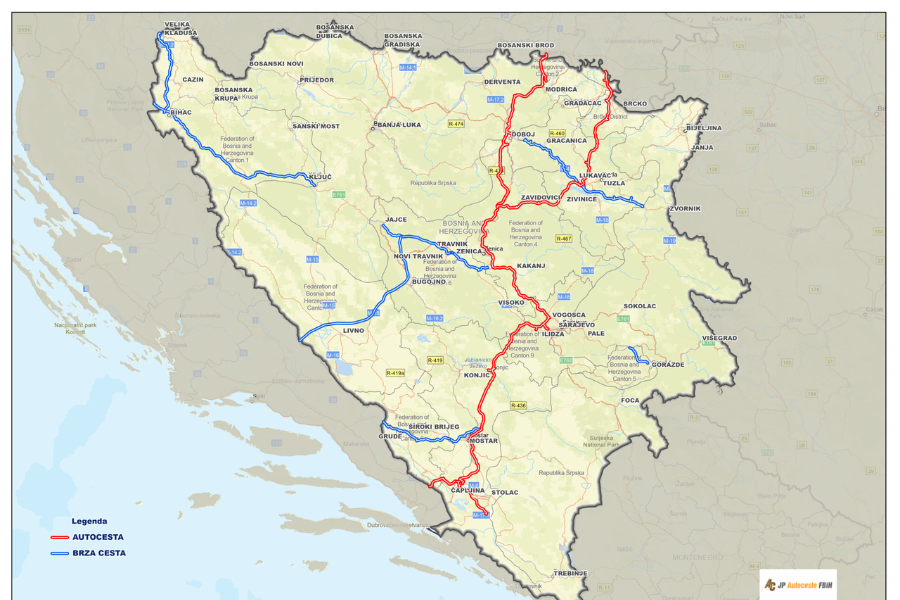
Construction advances on Mostar-Croatia border expressway
The Mostar North – Polog – Široki Brijeg – Grude – Border with the Republic of Croatia Expressway represents one of the most significant infrastructure projects in western Herzegovina. Its construction will enable better connectivity between Herzegovina, Corridor Vc, border crossings with the Republic of Croatia, and European transport flows, while simultaneously improving traffic safety, reducing congestion on existing main roads, and creating more favorable conditions for economic development, tourism, and the mobility of residents.
The implementation of this project will strengthen transport links between western Herzegovina, the rest of the Federation of Bosnia and Herzegovina, and the European Union, while also enhancing overall regional and cross-border connectivity, CE Report informs via the FBiH Motorways' official website.
The need for such infrastructure projects stems from the necessity to improve the level of service on the existing road network, eliminate traffic bottlenecks, increase traffic safety, and create conditions for further economic growth. The strategic importance of this route was confirmed in the Transport Strategy of the Federation of Bosnia and Herzegovina for the period 2016–2030, which envisages the preparation and construction of an expressway approximately 61 kilometers long along the route Mostar – Široki Brijeg – Grude – Border with the Republic of Croatia. Within the planned development of the Federation’s road network, this route has been identified as one of the key expressway projects. The Federal Ministry of Transport and Communications and the Public Company Motorways of the Federation of Bosnia and Herzegovina (JP Autoceste FBiH) have been designated as the implementing institutions, while loan arrangements and concession models have been identified as potential financing mechanisms.
Additional confirmation of the project’s importance comes from its inclusion in the process of developing the indicative extension of the Trans-European Transport Network (TEN-T) to the Western Balkans. The Mostar – Vinjani route was included in the document “Development of Indicative TEN-T Extension of the Trans-European Transport Network (TEN-T) in the Western Balkans,” published by the Transport Community in May 2025. In the report, it is listed as an international road connection approximately 53.8 kilometers long, linking Mostar with the Vinjani border crossing and the road network of the Republic of Croatia.
The inclusion of this route is the result of a multi-year process of developing the indicative TEN-T network carried out by the Transport Community since its establishment in 2017. An additional institutional framework was established through the adoption of the new TEN-T Regulation of the European Union (EU Regulation 2024/1679), which defines the Core Network, Extended Core Network, Comprehensive Network, and the Western Balkans–Eastern Mediterranean Corridor. The significance of the project was also confirmed through the document “TEN-T Report 2023 – Development of Indicative TEN-T Extension in the Western Balkans,” published in December 2023, while the European Commission published official maps of the indicative TEN-T extension to the Western Balkans in September 2024 through the publication “Indicative Extension to Neighbouring Countries: Western Balkans Region.”
While the strategic importance of this route continues to be recognized at the international level, activities related to the preparation and implementation of its individual sections are simultaneously underway on the ground.
The Mostar North – Polog section, approximately 20.3 kilometers long, is currently in the phase of preparing the conceptual design and accompanying study documentation. The spatial planning basis for the development of this section is provided by the Spatial Plan for the Area of Special Significance to the Federation of Bosnia and Herzegovina “Motorway on Corridor Vc” and the Spatial Plan of the Herzegovina-Neretva Canton for the period 2017–2022.
As part of earlier activities, a conceptual route design was prepared, including a pre-feasibility study. Based on the 2019 conceptual design, a preliminary environmental impact assessment was also prepared, covering both environmental aspects and demographic impacts along the planned route. According to the 2019 conceptual design, the estimated construction cost of this section amounts to BAM 461,893,790 excluding VAT.
Further project development continued with the signing of Contract No. JPAC 1508-E 821-23 on April 24, 2023, for the preparation of the conceptual design. The contract was awarded to a consortium consisting of IPSA Institut d.o.o. Sarajevo and IGH d.o.o. Mostar and includes the preparation of the conceptual design, Feasibility Study, Traffic Study, Environmental Impact Study, documentation required for obtaining urban planning approval, and the execution of investigative works. The contract value amounts to BAM 1,493,890 excluding VAT and is financed through the Federation of Bosnia and Herzegovina Government’s Capital Transfers to Public Enterprises – Road Infrastructure Program.
During the implementation of the contract, four annexes were signed. Annex 1 was signed on January 15, 2024, Annex 2 on August 30, 2024, Annex 3 on November 13, 2025, and Annex 4 on March 17, 2026. The annexes were required due to the need to update the Radobolja and Studenac Water Source Protection Study, extend deadlines for the preparation of relevant studies, and obtain the opinion of the City of Mostar regarding the route alignment.
As part of the preparation of project documentation, investigative works are being carried out to define technical solutions and the route alignment. At the same time, the Water Source Protection Study for Radobolja and Studenac was updated to ensure compliance with the 2012 Rulebook on Determining Sanitary Protection Zones and Protective Measures for Water Sources Intended for Public Water Supply.
The presentation of the conceptual design was held on June 6, 2018, at the Mostar City Hall. Following the completion of the Environmental Impact Study, a public consultation process will be conducted in accordance with applicable environmental protection regulations.
The Mostar North – Polog section is currently in the phase of preparing the conceptual design and accompanying study documentation. The expropriation study is being prepared under the current contract, meaning expropriation procedures have not yet commenced. Upon completion of the project documentation, studies, and approval procedures, conditions will be created for advancing to the next stages of project implementation.
Unlike the Mostar North – Polog section, the Polog – Border with the Republic of Croatia section has already entered the construction phase for certain segments. Conceptual and detailed designs have been completed for the entire route, urban planning approval and preliminary construction approval have been obtained, and the project has been aligned with the Spatial Plan of Bosnia and Herzegovina for the period 1981–2000, the Spatial Plan of West Herzegovina Canton, and the Spatial Plan of the City of Mostar.
The preparation of the conceptual and detailed designs was contracted on June 25, 2020, to a consortium consisting of Institut IGH d.d. Zagreb, IGH d.o.o. Mostar, Integra d.o.o. Mostar, and Geocon d.o.o. Čitluk. The contract value amounted to BAM 7,765,911 excluding VAT and was financed through JP Autoceste FBiH’s own funds.
On June 2, 2022, the Government of the Federation of Bosnia and Herzegovina adopted a Decision Declaring Public Interest for the Construction of the Polog – Border with the Republic of Croatia Section, creating the legal basis for land expropriation and the continuation of project implementation.
Following the completion of the design phase and the acquisition of the necessary approvals, land expropriation activities were launched. Construction contracts have been awarded for the Podledinac – Grude East and Polugrno – Podledinac sections, while the remaining five sections are currently in the land expropriation phase.
According to the detailed design, the estimated value of constructing the entire section amounts to BAM 476,033,796 excluding VAT. In October 2025, contracts were signed for the construction of the Podledinac – Grude East and Polugrno – Podledinac sections, with a total value of approximately BAM 106.4 million excluding VAT. Funding for both sections has been secured from the Budget of the Federation of Bosnia and Herzegovina, marking the beginning of the actual construction phase of part of the route toward the Croatian border.
The current status of the project demonstrates that the Mostar North – Polog – Široki Brijeg – Grude – Border with the Republic of Croatia Expressway is progressing simultaneously through both design and construction phases. While key planning, design, and study documentation is being finalized for the Mostar North – Polog section, construction work has already commenced on the first contracted sections of the Polog – Border with the Republic of Croatia section. This pace of implementation confirms that one of Herzegovina’s most important infrastructure projects is gradually transforming from a planning document into a tangible transport investment of regional and international significance.
Photo FBiH Motorways