Millions await rare solar eclipse in Europe
Millions of Europeans and astronomy enthusiasts around the world will look to the sky on Wednesday to observe a rare total solar eclipse that will briefly plunge northern Spain into darkness in the middle of the day, AFP reports.
The rare astronomical phenomenon, the first of its kind visible in Europe since 2006, will begin in Russia at around 17:00 GMT before crossing the Northern Hemisphere and passing over Greenland and then the Atlantic Ocean, CE Report quotes AGERPRES.
In addition to parts of Iceland, the eclipse will be total along a band crossing Spain, from Oviedo to Palma de Mallorca, passing through Burgos, north of Madrid, before disappearing at around 18:30 GMT.
Outside this path, the eclipse will be partial, including in France, as well as parts of Canada, northwestern Africa and the United States.
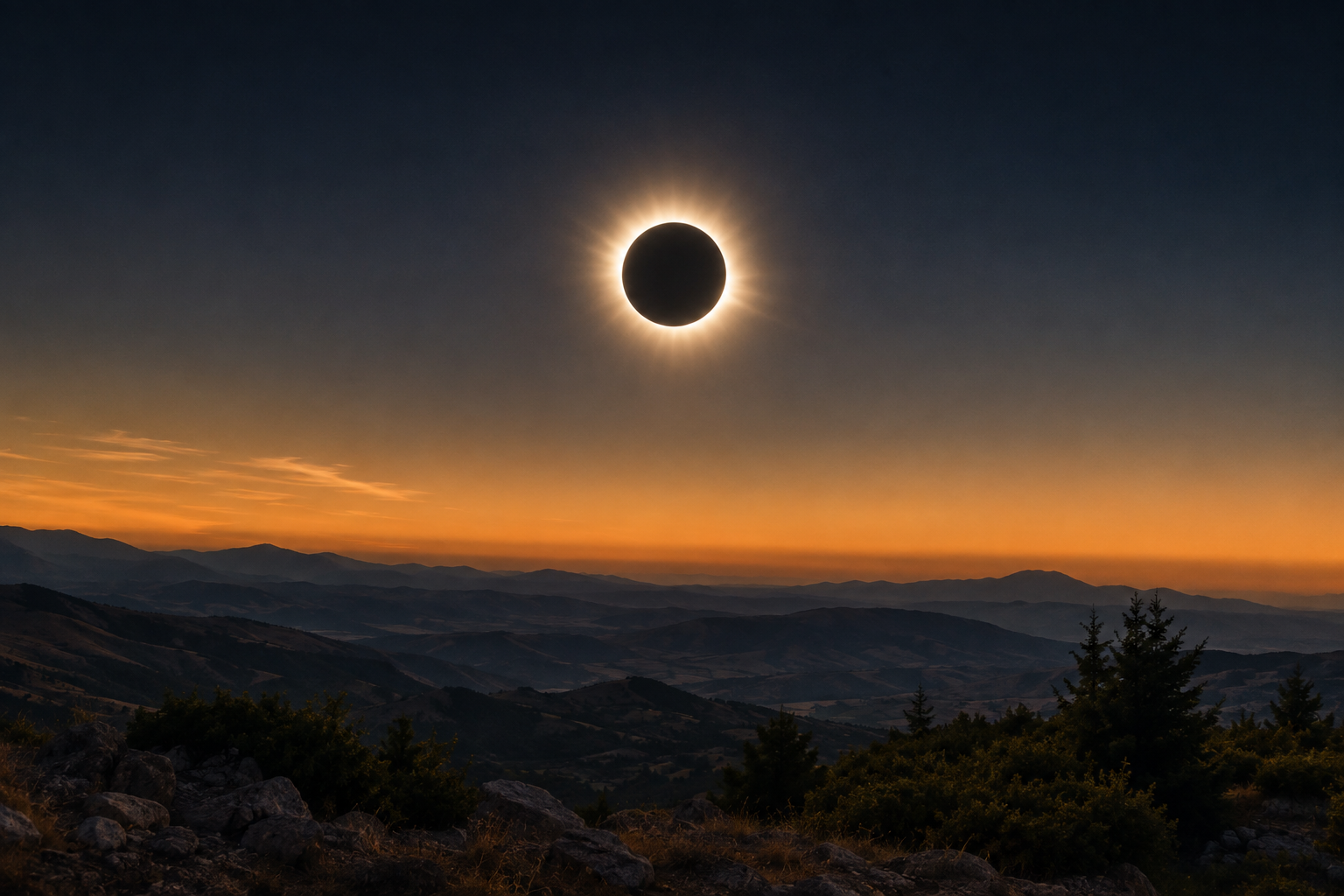
The perfect alignment of the Sun and Moon will plunge the world into an eerie, purplish darkness, while temperatures will drop sharply, AFP reports. Some animals, becoming disoriented, are expected to display unusual behaviour. However, the spectacle will be brief: the total phase, when the Moon completely covers the Sun, will last just under two minutes in Spain.
Overall, however, the eclipse will last much longer, around two hours. This is because the phenomenon begins with a partial eclipse, followed by the total phase, and then continues with another partial eclipse.
The event should also allow scientists to study the Sun's atmosphere and its outermost layer, in the hope of obtaining new data on the solar wind and the star's magnetic field.
Regions of Spain where the eclipse will be total have been swept by excitement. Some locals, as well as tourists who arrived later to witness the astronomical event, are struggling to find the protective glasses required to watch the eclipse.
“I’ve been looking since Friday, but I can’t find them anywhere,” Mabel, a resident of Barcelona, told AFP. “They’re not even available on Amazon anymore, so it’s impossible,” she added disappointedly.
Eclipse chasers, the dedicated enthusiasts who prepare for months in advance, are expected to gather in the region to secure the best possible views.
Skies are expected to be clear across Spain on Wednesday evening, with some exceptions in the north and east of the country, Spain’s national weather agency Aemet said on Tuesday.
Spain, the world's second most popular tourist destination, also expects the eclipse to boost its economy during the peak summer season, particularly in rural areas in the north that have suffered from population decline for decades.
The net contribution to the economy is estimated at EUR 347 million, while nearly 450,000 additional tourists are expected in key areas from which the eclipse can be observed, according to Madrid’s Economy Ministry.
However, the prospect of a large influx of foreign tourists is also raising concerns among authorities, who are not accustomed to events of this scale and are urging caution.
Aemet has also warned of a “very high” or “extreme” fire risk amid a summer marked by devastating wildfires. Experts say the danger could be increased by the expected presence of hundreds of thousands of people in very dry areas, with vehicles potentially blocking small rural roads.
Authorities expect up to 1.5 million additional car journeys on roads in regions where the eclipse will be total.
To prevent massive traffic jams and other public-order problems, several regions and municipalities have established dedicated viewing areas while also increasing the number of security and emergency personnel for what will be the first total solar eclipse visible from mainland Spain in more than 100 years.
Two more solar eclipses will be visible from other parts of Spain over the following two years: in the far south on August 2, 2027, and across much of the south of the country on January 26, 2028, AFP notes.
Photo: Chat GPT