EU sets timeline to complete single market overhaul
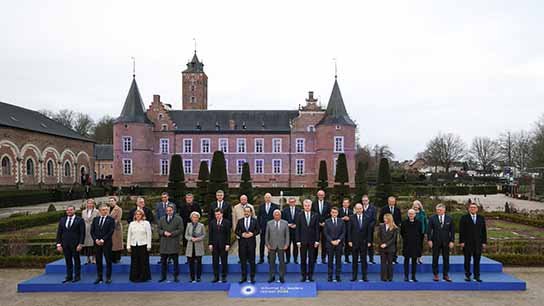
EU leaders met for an informal retreat at Alden Biesen to discuss how to deepen the single market, reduce economic dependencies and boost competitiveness.
"We have a clear priority – to strengthen economic growth in Europe. This is essential for our prosperity, to create quality jobs, and to sustain our economic social model," said European Council President Antonio Costa.
The leaders were joined by Mario Draghi for a working session on EU competitiveness in a new global geoeconomic context and by Enrico Letta for a working session on how to better leverage the single market in a fast-changing world, CE Report informs via the European Council official website.
Looking ahead, the leaders agreed on a set of priority areas to strengthen EU competitiveness and strategic autonomy. They will follow-up on these discussions at the upcoming European Council meeting in March, at which point the Commission is also expected to present a roadmap on 'one Europe, one market'.
António Costa summed up the leaders' discussions in a speech following the meeting.
Simpler EU rules for businesses
President Costa reported that there was a unanimous agreement among EU leaders to continue to push ahead with the EU's ambitious simplification agenda.
A deeper EU single market
"We hold a powerful card: our single market. With 450 million consumers, it is Europe's true superpower and we must use it to the fullest potential," said President Costa.
The leaders accepted Enrico Letta’s challenge to move from an incomplete single market to 'one market for one Europe'. President Costa emphasised that this work is urgent and must be done in 2026 and 2027.
In this context, the leaders also agreed on the importance of moving forward on a '28th regime', to ensure that EU companies can operate seamlessly across borders within a single set of corporate rules. This in turn can help companies grow across Europe, reduce administrative burdens and ease access to financing.
Investments and innovation
"Europe lacks investment. There will be no competitiveness without more investment," said President Costa.
He reported that the leaders agreed on allowing a degree of company consolidation in certain strategic sectors, such as the telecom sector, to achieve the necessary levels of investments and innovation.
In this regard, he stated that it is also important that these investments should be part of a social contract and that the ongoing review of merger guidelines play an important role in this.
The leaders also discussed how to mobilise private investments. In this context, they agreed to speed up work with the savings and investment union. In terms of public investments, President Costa noted that the leaders must discuss the role of European instruments, also in the context of negotiations for the next multiannual financial framework, the EU's long-term budget.
Energy
"The energy transition remains the best long-term strategy for Europe to achieve strategic autonomy and lower prices," said President Costa.
In view of electricity prices, he stressed that we need pragmatic solutions that take into account the specific challenges of member states and some industrial sectors.
Working closely with the European Commission, EU leaders will look at concrete measures at the European Council meeting in March.
Strategic industries
President Costa stated that there is a broadly shared understanding about the strategic importance, for Europe, to protect and reinforce certain sectors. This includes sectors such as defence, space, clean tech, quantum technologies, artificial intelligence and payment systems.
Moving forward, he stated that the EU will map and identify dependencies and tackle them through a diversification strategy. In view of 'European preference', he stated that there was broad agreement among leaders to use it in selected sectors, following an in-depth analysis to identify where it is necessary and useful.
Open trade policy
President Costa stressed that there was unanimity among the leaders that Europe is open for trade. In this context, a pragmatic trade policy that focuses on diversification is in Europe's collective interest. EU leaders will continue to support the work made by the European Commission in trade policy.
Photo: European Council official website