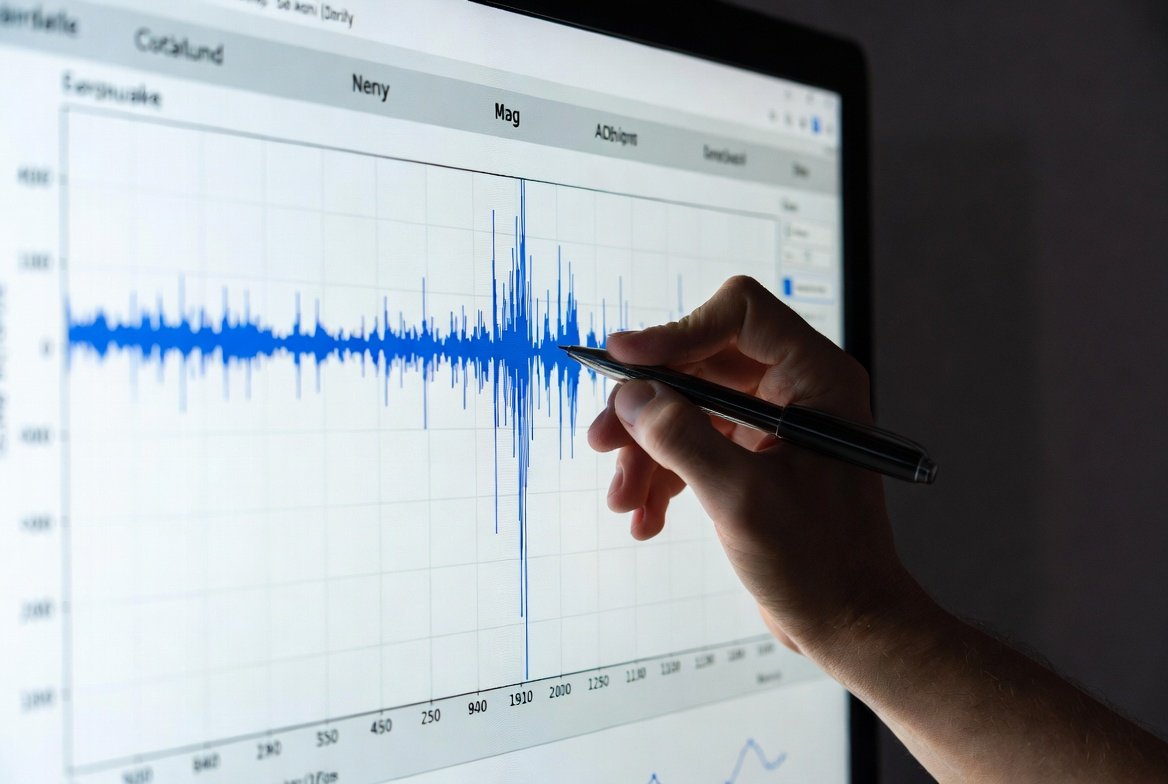
Metallica concerts, EuroLeague final drive crowd “seismic” activity captured by Greek seismograph
Seismic vibrations from the concerts of Metallica and Iron Maiden, as well as the EuroLeague Final Four final—won by Olympiacos—were recorded by a high-sensitivity seismograph installed at the Athens Olympic Sports Complex (OAKA).
The device was placed there specifically to record and study ground vibrations caused by large-scale music events and mass audience participation, CE Report quotes ANA-MPA.
According to findings from a study conducted as part of a pioneering scientific experiment by the Geodynamic Institute of the National Observatory of Athens, Metallica emerged as the “champions” of vibration, producing ground tremors 2.5 times stronger than Iron Maiden. Their energy output corresponded to an equivalent local magnitude of approximately 1.5 ML, compared to about 0.9 ML for Iron Maiden.
As for the EuroLeague Final Four final, researchers noted that fan reactions during Olympiacos’ victory at OAKA—especially during the trophy ceremony—also generated clear seismic signals comparable to those recorded at the Iron Maiden concert.
The station operated during Metallica’s concert (9 May 2026) and Iron Maiden’s concert (23 May 2026), continuously recording tiny ground movements caused by tens of thousands of spectators. The recordings showed that crowd intensity and participation are clearly reflected in seismic data, even allowing correlations between specific peaks and individual songs in the setlists.
Analysis by the scientific team, composed of K. Boukoura, E. Daskalaki, M. Charalambaki, I. Fountoulaki, and C. Evangelidi, showed that the Metallica concert produced significantly stronger ground vibrations than Iron Maiden’s. The maximum recorded accelerations were about 2.5 times higher, while the total seismic energy corresponded to a local magnitude of approximately 1.5 ML for Metallica and 0.9 ML for Iron Maiden.
As the researchers explain, although these values do not correspond to real earthquakes, they provide a useful way to quantify and compare the intensity of ground vibrations caused by crowds. The higher acceleration recorded at the Metallica concert is linked to a larger and more energetic audience, which transferred significantly more energy into the ground compared to Iron Maiden.
From the seismic analysis, the song that generated the strongest seismic response at the Metallica concert was “Moth Into Flame,” during which the highest ground acceleration was recorded. High values were also observed for “Master of Puppets,” “Fade to Black,” “Wherever I May Roam,” and “One.”
At the Iron Maiden concert, the strongest seismic response was recorded during “Killers,” while strong audience participation was also detected during “2 Minutes to Midnight,” “Seventh Son of a Seventh Son,” “Rime of the Ancient Mariner,” and “Wrathchild.”
According to the findings, the comparison shows that the Metallica concert at OAKA produced clearly higher peak seismic acceleration than Iron Maiden, which is reflected in the higher equivalent local magnitude (ML).
The more intense and synchronized movement of the Metallica audience resulted in accelerations roughly two to three times higher than those at Iron Maiden, corresponding to an ML of about 1.3–1.5 versus 0.8–1.0.
Although these values do not represent actual seismic activity, they provide a useful measure of the energy transferred to the ground and highlight the ability of seismographs to record large-scale human-induced vibrations.
In addition to the two major concerts, the temporary seismic station also operated during the EuroLeague Final Four 2026 final at OAKA. The recordings showed that fan reactions during key moments of the match—and especially during the trophy ceremony—produced clearly detectable seismic signals.
As the researchers emphasize, although vibration levels were generally lower than those recorded at the Metallica concert, they were comparable to those of Iron Maiden, highlighting the significant role of collective human behavior in generating measurable ground motion.
The project is part of so-called “crowd seismology.”
The results demonstrate the potential of seismology to record not only natural phenomena but also the impact of human activity on the environment, turning two of the year’s biggest music events into a unique field scientific experiment. The OAKA concerts functioned as a large-scale natural laboratory, where the temporary installation of a seismic station allowed the Geodynamic Institute to study how collective movement, rhythm, and enthusiasm of tens of thousands of spectators are transformed into measurable seismic signals.
The findings offer a rare opportunity to explore the interaction between human gatherings and ground response, bridging scientific observation with live music experience in a striking way and highlighting the importance of seismology as a tool for understanding broader environmental dynamics, the institute’s researchers noted in an official statement.
Photo AI