Kosovo brides keep ancient ritual alive with colorful face painting
In Bosniak villages linked to the southern Kosovo city of Prizren, a bridal makeup tradition believed to protect brides from the evil eye has been preserved for centuries.
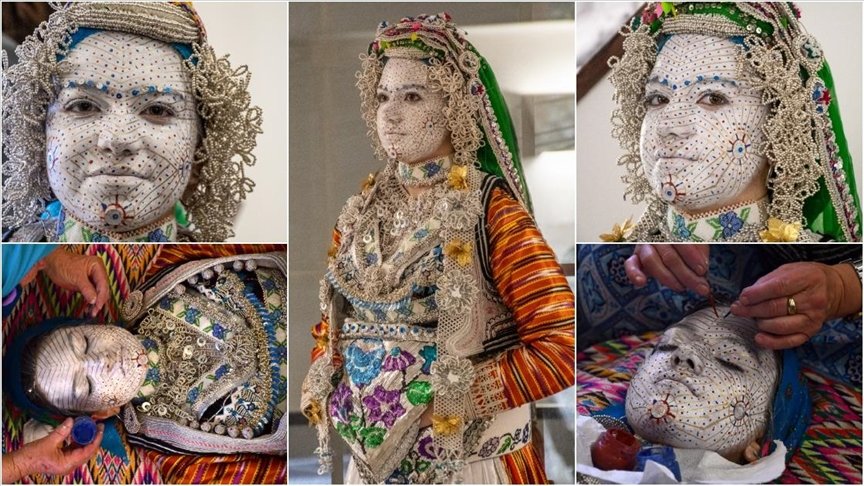
In Bosniak villages such as Donje Ljubinje, Gornje Ljubinje, Manastrica, Musnikovo, and Planjan, located at the foothills of the Šar Mountains near the city of Prizren, brides have their faces completely painted in different colors as part of a centuries-old tradition.
Aziza Sefitagic, one of the last representatives of this tradition — which attracts strong interest from local and foreign researchers, journalists, and tourists — told Anadolu Agency (AA) that she learned bridal face painting from her mother-in-law, CE Report quotes Anadolu Agency.
Sefitagic, in her 70s, said she has traveled to various countries around the world to promote the tradition.
“I continue this tradition even in my old age because it is close to disappearing. I want it to continue for many years; I think it is necessary. I want to pass the torch to my daughter-in-law. She was with me in Australia, I taught her too, and she will carry it on — then I plan to step aside,” she said.
“Traditional weddings are still held in villages in Kosovo”
Medisa Sagdati Karavidaj, who has worked in the tourism sector for 20 years, said she takes part in activities promoting the region’s traditions and culture.
She explained that Bosniaks in villages around Prizren have practiced bridal face painting for centuries, adding that similar traditions exist in North Macedonia and Bulgaria, though the techniques and styles differ.
Sagdati Karavidaj noted that the bride’s face painting begins in the morning of the wedding day.
“Different colors are used, and each color has a meaning — usually blue, red, gold, and white. Circles symbolizing the cycle of life are drawn in different cultures, with dots around them representing seeds and the beginning of new life,” she said.
She emphasized the symbolic meaning of painting the bride’s face, stating:
“The face is painted to symbolize a young woman stepping into marriage. In the past, there was also a strong belief in the evil eye, so the painting was believed to protect the bride from jealousy and misfortune. With painted faces, the girls all looked similar.”
She added that the tradition still continues in Kosovo, though less frequently than before.
“Weddings used to last a week; now they last at most two days. Still, traditional weddings are held in villages in Kosovo.”
Sagdati Karavidaj explained that wishes such as luck, happiness, and fertility are symbolized through colors and shapes painted on the bride’s face. Based on oral legends, she said the tradition may have come to Kosovo from the Persians or date back to the pagan era.
She noted that the tradition has evolved over time and varies from village to village.
“In Donje Ljubinje, traditional weddings are held every year, but they adapt more to fashion. Colors may vary, while other villages try to preserve the tradition exactly as it is,” she said.
She added that the face painting process takes about two hours.
“The bride sits down for her ‘last breakfast’ with her family, then the face painting begins. Afterward, she puts on her traditional clothes and appears with a piece of sugar in her mouth. From that moment on, she does not eat, speak, or move her face until she reaches the groom’s house.”
Farewell songs are sung by family and friends, and the bride is not supposed to cry — as tears are believed to ruin the painting and bring bad luck. The groom then arrives on horseback to take the bride. Her painted face is covered, and once she arrives at the groom’s house, it is uncovered and checked.
If the face painting remains intact, it is believed the bride will be strong and hardworking.
Elmedina Shkurti Haxhifazliu, a representative of the Association for Education for Development and Cultural Dissemination (EDUCO), said that an interactive workshop featuring Sefitagic was held during the traditionally organized Prizren Annual Tourism and Hospitality Conference, emphasizing efforts to preserve and promote this unique tradition.