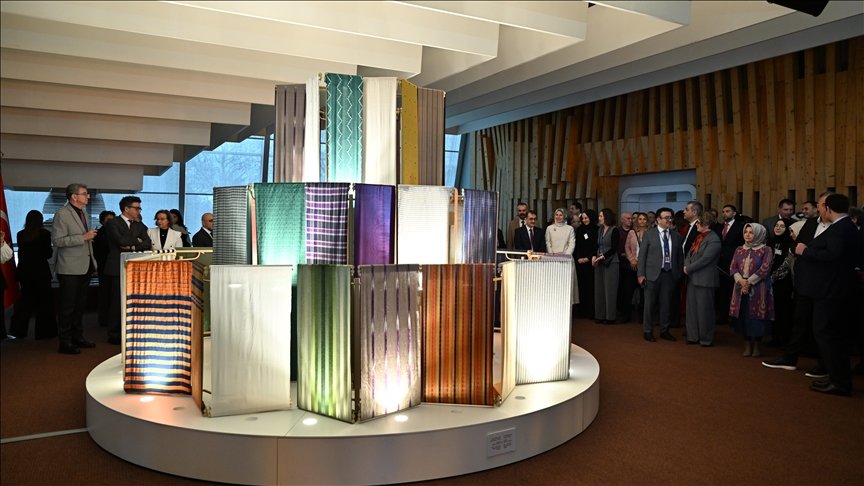
Türkiye Weaving Atlas exhibition opens in Strasbourg
The official opening of the exhibition titled "Türkiye Weaving Atlas – The Memory of Fabric" was held at the Council of Europe in Strasbourg, France.
The exhibition opened at the Council of Europe building under the auspices of the Turkish Delegation to the Parliamentary Assembly of the Council of Europe (PACE) can be visited until January 30 during PACE’s winter session.
Organized within the scope of the Türkiye Weaving Atlas project, held under the patronage of Emine Erdoğan, wife of Turkish President Recep Tayyip Erdoğan, the exhibition was attended by members of the Turkish PACE delegation and parliamentarians from many countries, CE Report quotes Anadolu Agency.
The exhibition features colorful woven textiles produced in an environmentally respectful way using natural fibers and local raw materials as part of the Turkey Weaving Atlas project.
Samples of the raw materials used to create natural pigments for weaving were also displayed, while miniature weaving looms attracted particular attention from visitors.
Traditional tools used in production methods such as shuttles were introduced, and garments designed with traditional fabrics — including ehram and Ankara sof cloth — were exhibited.
At the event, a message from Emine Erdoğan was read on the occasion of the exhibition’s opening.
In her message, Emine Erdoğan expressed her satisfaction that the exhibition would introduce Anatolia’s centuries-old and deeply rooted weaving tradition, along with its historical depth and artistic richness, to the international community.
Calling it highly meaningful that such a valuable project was crowned with an exhibition under the auspices of the Council of Europe — an institution that encourages the preservation of cultural heritage and supports dialogue between societies — she stated that establishing a global environment of peace is possible by protecting and sustaining the unique values each culture contributes to humanity’s shared heritage.
Emphasizing her belief that as societies get to know one another through their cultures, awareness of humanity as one big family will grow and an atmosphere of tolerance where no one is excluded will continue to develop, Emine Erdoğan said: “I hope that this exhibition, which opens a door to Anatolia’s thousands of years of accumulated knowledge, its nature-friendly production wisdom, and the invaluable contribution of women’s labor, will offer an inspiring experience for all visitors.”
“Every region of Türkiye has its own style, motifs, and traditions”
Speaking at the opening, Bjorn Berge, Deputy Secretary General of the Council of Europe, noted that Türkiye has been one of the Council’s important members since 1949.
Stating that Türkiye’s impressive cultural heritage dates back centuries, Berge said, “Every region of Türkiye has its own style, motifs, and traditions.”
“Turkey has taken concrete steps to protect and revive this living heritage”
Fatih Dönmez, Head of the Turkish Delegation to the Parliamentary Assembly of the Black Sea Economic Cooperation (PABSEC), said: “This exhibition is not only a presentation of Turkish textiles, but also a deep witness to our shared memory.”
Noting that Anatolia has expressed itself through craftsmanship for thousands of years, Dönmez added: “Türkiye has taken concrete steps to protect and revive this living heritage. The Turkey Weaving Atlas project aligns with our Zero Waste initiative and is also a strong example of how cultural policies and environmental responsibility can move forward together.”
Zeynep Yıldız, a member of the Turkish PACE delegation and an AK Party Ankara MP, said the exhibition represents a synthesis of centuries-old cultural interactions in harmony with the founding principles of the Council of Europe.
Emphasizing that Türkiye does not merely represent a bridge between Europe and Asia, Yıldız said: “Turkey is both Asia and Europe. From the heart of the Balkans to the Far East, from Africa to Crimea, Türkiye carries traces of many geographies while also leaving its own mark.”
Drawing attention to the etymology of “gauze,” which takes its name from Gaza, Yıldız said: “Just as we use this fabric to protect and heal, Gaza has been healing humanity’s wounds for centuries.” She expressed hope that humanity would also be able to heal Gaza’s wounds.
“Women’s labor is present throughout this story”
Speaking to an Anadolu Agency correspondent about the strong interest in the exhibition, Yıldız said: “I honestly see this as a blessing of the sincere efforts of the women who weave these fabrics stitch by stitch across Türkiye.”
She added that she has witnessed firsthand how much labor goes into weaving these textiles in different parts of the country, saying: “I sincerely want to thank Emine Erdoğan. She truly believed in these women and in their vision. We wanted to showcase this here as a beautiful example of women’s solidarity, because women’s labor is present throughout this story.”
Visitor Valentine Lechien said discovering how the fabrics are produced was fascinating, adding, “I admire the work women do in Türkiye.”
Semine Çavuş, who lives in Strasbourg, said she was impressed by how carefully the exhibition was prepared and by the presentation of different fabrics, adding: “I found the exhibition very meaningful and beautiful.”