White House counsellor: World no longer depends on US - EXCLUSIVE INTERVIEW (VIDEO)
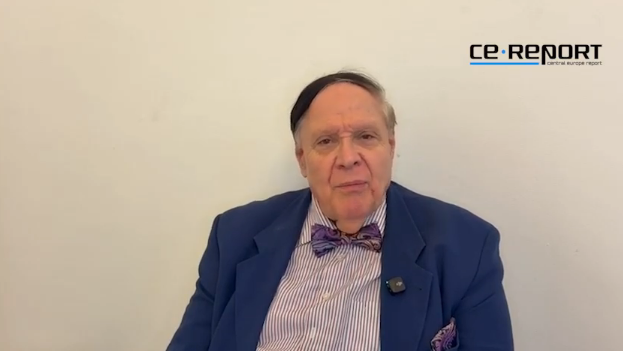
Dr. Harvey Dzodin, former vice president of ABC News, White House counsellor, and lecturer of journalism at Tsinghua University in Beijing, shared his insights on U.S. foreign policy and the National Security Strategy in an exclusive interview with CE Report in the aftermath of the World Economic Forum in Davos.
Asked about the National Security Strategy, Dzodin described it as what he calls the “National Insecurity Strategy,” noting that it reflects the insecurity of President Trump and his administration. He explained that the administration is imbalanced, has its own particular point of view, but it is very important to understand where they are coming from.
He highlighted that the strategy represents a major departure from traditional U.S. policy. According to Dzodin, the National Security Strategy represents an abandonment of the international, rules-based global order and a return to an order that hearkens back centuries, where strength is what matters and might makes right.
The expert pointed out that the world is no longer organized around cooperation. He noted that the United States no longer operates in a framework of international organizations trying to solve global problems, and everything regarding the U.S. is completely transactional, depending on what, in President Trump’s words, “the deal” is.
On the division of the world into spheres of influence, Dzodin explained that the strategy claims the Western Hemisphere as America’s domain. It goes much further than the Monroe Doctrine of 1823, which told Europe to stay out of the Western Hemisphere but also promised that the U.S. would stay out of Europe’s backyard. Under the strategy, Europe is treated as fair game.
Reflecting on the long-term implications, he added that Trump may only remain in office for a few more years, and ideological successors are not guaranteed. National security strategies are issued periodically, and the strategy may not be the last word.
Dzodin expressed cautious optimism, saying that he hopes — though not necessarily predicting — a return to a rules-based international order, because the global problems faced today are bigger than any one country and no country can solve them alone.
When asked about the slogan “Make America Great Again,” he argued that in practice, it means isolating America. He explained that the United States, even as a powerful country, cannot go it alone in the long term, because the world is multipolar and interconnected. America cannot act irrespective of the EU, China, or the Global South; cooperation is essential.
He warned that this approach could have serious consequences. In China, there is a joke that by ceding cooperation and influence to China and the Global South, President Trump is effectively “making China great again.” Dzodin noted that he does not see many long-term benefits for America from this approach and that it risks making the U.S. marginal rather than great.
On Europe’s strategic position, Dzodin emphasized the need for alliances in a multipolar world. Europe has had a rude awakening: since the United States is not dependable, it must form alliances with other powers, both great and middle powers, and other countries will have to do the same.
He pointed to regional groupings such as BRICS and ASEAN as potential stabilizers. While institutions like the United Nations have lost some effectiveness, Dzodin believes they could become stronger, empowered by countries working together outside of U.S. leadership.
Dzodin also discussed personal dynamics influencing U.S. foreign policy, expressing concern about Vladimir Putin. He believes Trump is beholden to Putin, with Putin acting as the puppet master and Trump as the puppet. This raises concerns about Russia’s ambitions in Europe and the former Soviet Union, with Trump either willingly or unwillingly enabling those ambitions.
Asked about trust and alliance obligations, Dzodin was unequivocal. He said that there are no alliances that can be fully relied upon anymore. Trump’s approach is transactional, motivated by money and power, and capable of doing anything, legal or illegal, to maintain them. While the American system is strong, it depends on good people, and bad actors can disrupt it temporarily. Dzodin believes that eventually, the system can return to normal.
He concluded with a measured perspective on the future, noting that the Trump national security strategy, the white supremacy elements, and the push to dominate Europe and other regions are likely temporary. Dzodin believes that history will steer the United States back toward being a more responsible country, and this period is abnormal and unlikely to last.
This interview was prepared by Aytan Aliyeva