Azerbaijan's mugham tradition lives on through master and apprentice
Mugham, one of the deeply rooted forms of Azerbaijani music, continues to live on stage today through its master–apprentice tradition.
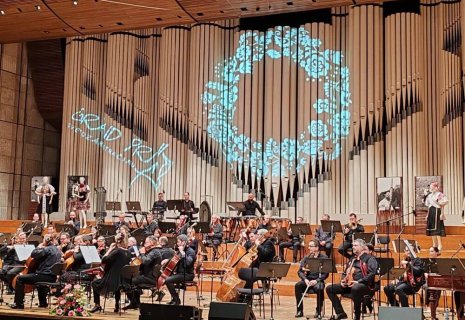
One of mugham’s most important representatives, Alim Qasimov, together with his daughter Fargana Qasimova and Azerbaijani artist Ferid Merd, met with music lovers at CSO Ada Ankara, CE Report quotes Anadolu Agency.
Before the concert, Alim Qasimov spoke to an Anadolu Agency reporter about the spiritual world of mugham, its transmission across generations, its relationship with different musical cultures, and his own musical journey. He said he did not begin music through a planned education, but rather through a calling that developed over time.
“Since childhood, wherever I happened to be, I played and sang. People who saw me told me to pursue this art. I worked in different jobs, did manual labor, worked as a driver,” Qasimov said. He later realized the central role music would play in his life, adding: “In the end, I saw that nothing else would work, so I came and enrolled in a music school—that’s where it began.”
Qasimov explained that he started learning the secrets of mugham at school, stressing that mugham is not an ordinary musical genre. He noted that mugham can only be understood by listening and feeling it deeply: “To understand mugham, one must listen with the ear of spirituality. This is a Sufi, dervish state. It is a path toward God. That’s how I understand it. It is a music that purifies a person.”
He emphasized that this tradition is passed down through the master–apprentice relationship, where the student repeats what the teacher performs. Qasimov also recalled that mugham’s inclusion on UNESCO’s Intangible Cultural Heritage List came after an intense period of international concerts, particularly in Europe.
“We continue to keep this tradition alive,” Qasimov said, noting that mugham remains a living and evolving tradition in Azerbaijan. He highlighted the growing interest among younger generations, both instrumentalists and vocalists, and explained that mugham is performed at weddings and concerts alike. In concerts, mugham is often combined with other musical genres due to its adaptable structure: “Our mugham can fit into any music. Wherever you place it, mugham is still there.”
He added that this approach is reflected on stage through collaborations with musicians from different backgrounds, both in Azerbaijan and abroad. Speaking about Ankara, Qasimov recalled that he first visited the city nearly 40 years ago at the invitation of the French Consulate, though he had hoped for such an invitation from Turkish brothers.
Addressing young artists, Qasimov advised that a musical journey should begin with spiritual foundations: “Light music can come later, but the beginning should be folk music, mugham, and spiritual values. This music requires thought and a certain state of soul. Its audience may be small, but it is a qualified one.”
Fargana Qasimova said she was surrounded by mugham sounds since infancy and grew up immersed in this music. “Just as a child grows by imitating sounds—hearing their mother or grandfather—I grew up among these sounds. But among them, there was a different sound: the sound of mugham. They say I used to cry when my father played the tar,” she recalled.
She described mugham as a sound connected to human existence: “Mugham exists on its own. Whether we exist or not, it was there before us. Perhaps it is the sound of the universe itself. Not everyone can sing mugham—it must be written by God into a person.”
Qasimova explained that mugham’s structure, built on poetic ghazals, makes words and sound inseparable. Sharing the stage with her father has become a lifelong path, which she described as “one soul in two bodies, or one mugham speaking through two souls.” She noted that they have worked together for about 35 years and expressed hope that mugham will never disappear and that its audience will continue to grow worldwide.
Azerbaijani artist Ferid Merd said that after his stage experiences in Türkiye, he has been working on his own compositions in Azerbaijan. He described meeting Alim Qasimov as a dream come true: “Alim Bey is a living music legend of Azerbaijan. Every musician dreams of sharing the stage with him. I once dreamed that we gave a concert together, and the next day I decided to call him—and it truly happened.”
Merd emphasized that their concerts aim to unite different musical cultures: “We see our concerts as a harmony of several musical traditions. I come from Turkish classical music and Italian opera, while Alim Bey and Fargana Hanım complete this with Azerbaijani mugham. It becomes a balanced meeting of Eastern, Western, and European music.”
He concluded by saying that music is one of a nation’s most important legacies and that their goal is to pass this heritage on to future generations in a pure and high-quality form.