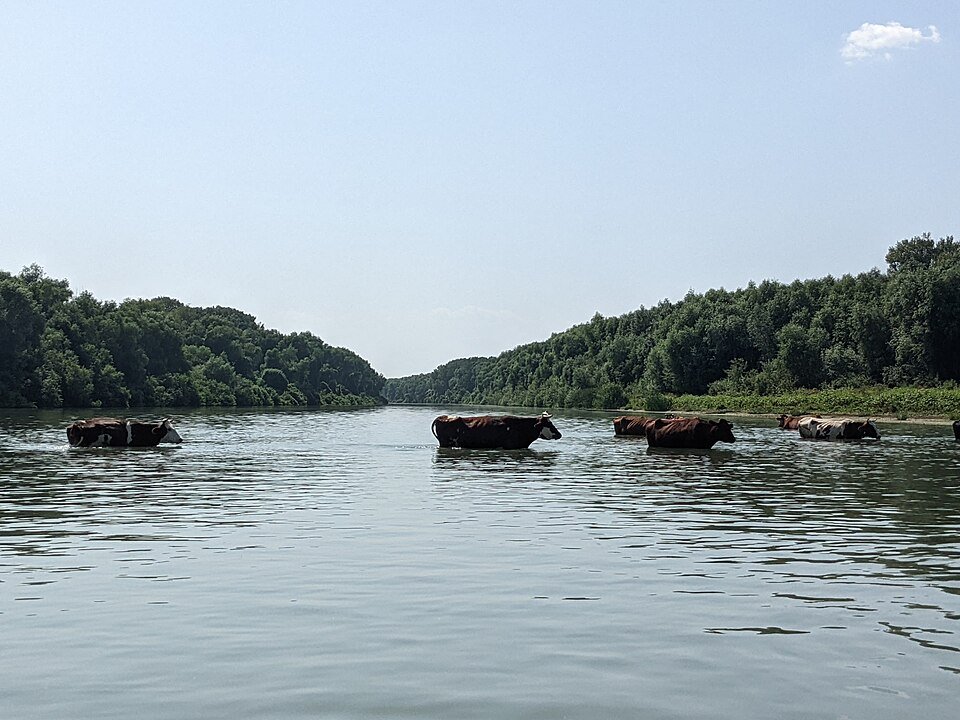
Low Danube flow raises risks
The extremely low flow of the Danube is beginning to alter the natural balance in the Danube Delta. In Sfântu Gheorghe, the river level remains sufficient for navigation due to the influence of the Black Sea, but the low current speed allows saltwater to penetrate along the bottom of the river channel up to 20–25 kilometers upstream. The phenomenon could affect ecosystems and, under extreme conditions, the drinking water supply of settlements near the coast, CE Report quotes MOLDPRES.
The Danube is currently experiencing an exceptional hydrological episode. At the entrance to Romania, in the Baziaș section, the flow fell to 1,350 cubic meters per second on August 16–17, while the long-term average for August is 3,900 cubic meters per second, according to the National Institute of Hydrology and Water Management. INHGA estimated that the flow would remain around this level before falling further to approximately 1,300 cubic meters per second in the following days.
Downstream of the Iron Gates, flows are also declining, but the situation near the Black Sea differs from that along the main river course.
In the Danube Delta, the very low flow does not automatically translate into a similar decline in water levels at the river mouths.
Data from the Lower Danube River Administration (AFDJ) for August 18 showed a water level of 18 centimeters in Tulcea and 58 centimeters in Sulina, following similar readings in previous days. AFDJ also reported a minimum surveyed depth of 7.32 meters on the Bara Sulina, Sulina–Tulcea and Tulcea–Isaccea sections.
The explanation lies in the direct influence of the Black Sea. Alfred Vespremeanu-Stroe, a professor of physical geography at the University of Bucharest and coordinator of the Sfântu Gheorghe Marine and Fluvial Research Station, told Radio România Constanța that the Danube's water level near its mouth is significantly influenced by sea levels.
Thus, even though a much smaller volume of water is arriving from upstream, the river level near its mouth cannot fall to the same extent as it does further upstream.
The problem, however, appears elsewhere: the Danube's current becomes much weaker.
With the river flow reduced, the Danube no longer has enough force to push seawater toward the open sea. Denser seawater can move upstream along the bottom of the Sfântu Gheorghe branch.
This creates what specialists call a saltwater wedge.
“There have been cases when we were able to record it as far as 20–25 kilometers upstream,” Alfred Vespremeanu-Stroe told Radio România Constanța.
However, this does not mean that the entire water column in the branch becomes salty. Seawater remains mainly in the deeper layers, while the less dense freshwater stays above it.
For this reason, the penetration of saltwater into the Delta's shallower lakes and channels is much more limited. An increase in the Danube's flow would push the saltwater wedge back toward the sea.
The effects are not limited to salinity. The slower flow of the Danube also means slower water circulation through the channels that feed the Delta's lakes.
Water is renewed more slowly and may become less oxygenated, creating conditions that favor eutrophication — the proliferation of algae and aquatic plants, followed by declining water quality and disruption of aquatic ecosystems.
The effects could become significant, particularly if the period of extremely low flows continues.
One of the most sensitive issues concerns settlements near the Danube mouths that rely on river water.
If the saltwater wedge advances far enough to reach water intake points, water extracted for public supply could mix with seawater and become brackish.
Photo: Wikipedia