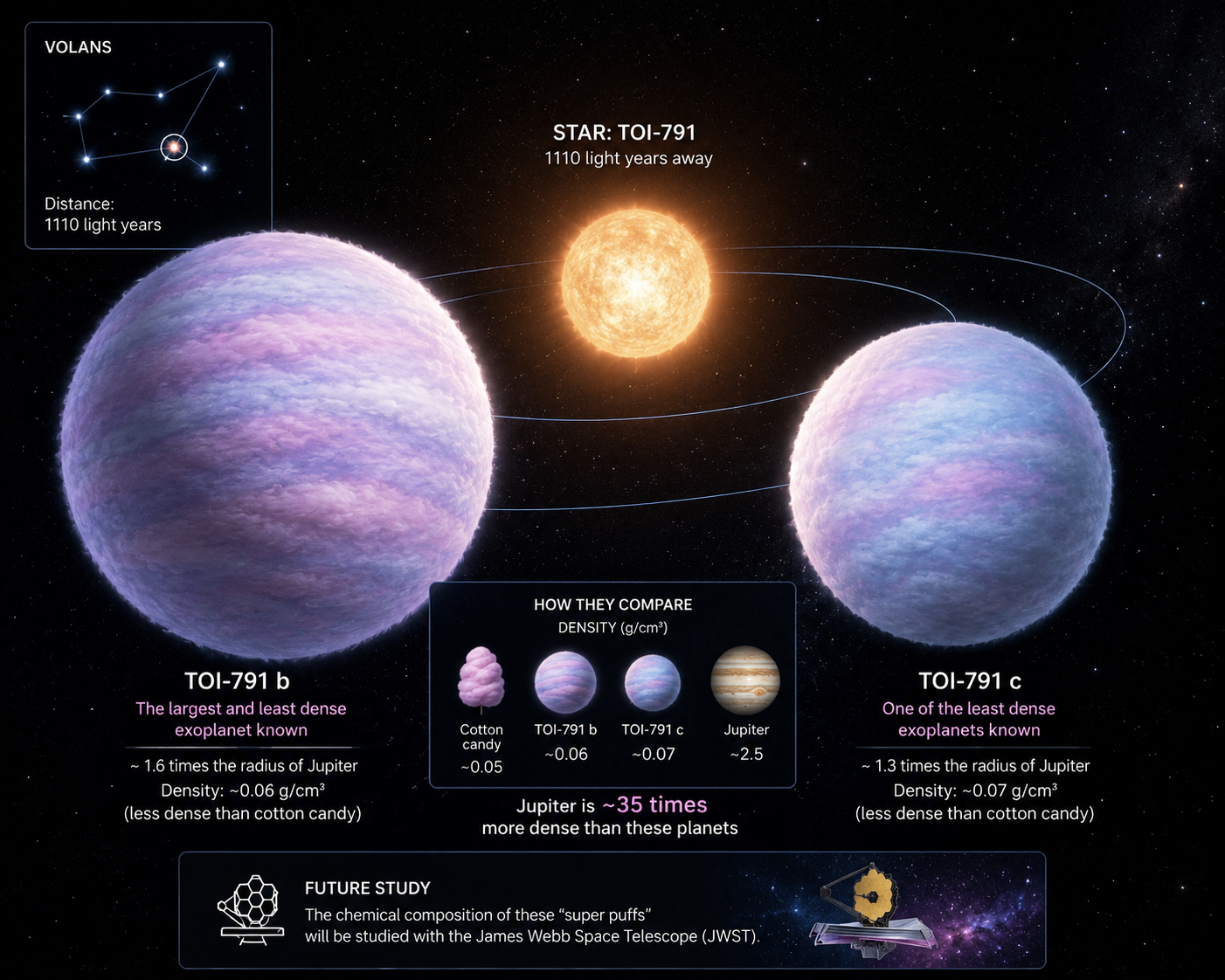
Astronomers discover giant super-puff planets
Astronomers from the United Kingdom and France have discovered what they describe as the two largest exoplanets with densities lower than cotton candy, located about 1,110 light-years from Earth.
Researchers from the University of Oxford, University of Birmingham, and Université Côte d'Azur analyzed the densities of two exoplanets detected 1,110 light-years away using NASA's Transiting Exoplanet Survey Satellite (TESS) and ground-based telescopes, CE Report quotes Anadolu Agency.
The scientists found that TOI-791 b and TOI-791 c are the largest known exoplanets with densities lower than cotton candy.
The planets orbit a star in the Volans constellation. Their chemical composition is expected to be studied in greater detail using NASA's James Webb Space Telescope.
Researchers noted that Jupiter is about 35 times denser than these planets.
One of the study's authors, George Dransfield, said the newly discovered worlds are the lightest known planets of their size.
Dransfield suggested that the planets may appear white or blue and are likely composed mainly of hydrogen and helium.
These so-called "super-puff" planets, with densities lower than cotton candy, are thought to have formed within the gas- and dust-rich disks surrounding young stars.
Scientists believe the planets gradually became lighter over time by shedding some of their material into space.
The findings were published in the scientific journal Monthly Notices of the Royal Astronomical Society.
Photo: Chat GPT