Ministry reveals details of fifth-generation Slovenian passport - EXCLUSIVE
The new, fifth-generation Slovenian passport was developed to reflect technological advancements made over the past decade while also introducing a modernized design. Although the updated design continues to follow the established visual identity of Slovenian travel documents—thereby ensuring the passport remains easily recognizable abroad—it has also been aligned more closely with the latest version of the Slovenian national identity card.
This was said by the source in the Ministry of the Interior and Public Administration of the Republic of Slovenia in an exclusive interview with CE Report.
The new passport incorporates over 100 security features distributed across its various components, including the cover, the paper visa pages, and the polycarbonate data page. Rather than acting as standalone elements, these features are holistically integrated into the document's unified security design and interconnected within a coherent visual concept.
The combination of state-of-the-art personalization technologies provides a high level of protection against counterfeiting, forgery, and misuse. A significant technological advancement is the introduction of a paperless, 100% polycarbonate data page integrated into the passport booklet. This innovative solution substantially enhances the document’s security, durability, and resistance to wear and tampering.
A particularly prominent security feature is the transparent window shaped in the outline of the Republic of Slovenia. Transparent windows are among the most advanced supplementary security features and are also recommended by the International Civil Aviation Organization (ICAO). One of the key advantages of this feature is that it enables simple and rapid visual verification. From a manufacturing perspective, it combines several highly sophisticated technologies within a single element, making document forgery significantly more difficult and enhancing resistance to fraud and misuse. The window also serves as a security platform that can accommodate additional advanced features, such as a relief security element with optical effects and a security feature responsive to laser light. The production of the transparent window is technologically highly demanding, requiring the precise layering of different materials and the integration of advanced security components. Beyond its security function, the Slovenia-shaped window also reinforces the document’s distinctive national identity and contributes to the passport’s modern and recognizable design.
For the first time, Slovenian identity documents incorporate a colour photograph of the holder, which is visibly reproduced in three locations within the passport. During the personalization process, each photograph is further secured with unique personal data. The holder’s name and year of birth are embedded across the photograph using ultraviolet (UV) printing, while the passport serial number is additionally displayed across the neck area alongside these personal details.
The primary advantage of a colour photograph is significantly improved visual identification of the document holder. Colour imagery provides a more natural representation of skin tone, eye colour, hair colour, and subtle facial features, enabling border and law enforcement authorities to compare the individual with the document more quickly and accurately, even without the use of specialized equipment. This substantially reduces the risk of fraud in cases where different individuals may appear similar in a black-and-white or grayscale photograph.
In addition, colour photography facilitates the integration of advanced security features, including ultraviolet fluorescent components and infrared contrast elements, allowing for multilayered authentication of the document. Another important benefit is enhanced interoperability with modern facial recognition systems, which generally achieve higher accuracy and performance when processing colour image data.
Slovenian travel documents also incorporate a book edge design, a modern security feature that has gained increasing recognition and importance in the passport industry in recent years. Although it may appear relatively simple at first glance, it is in fact a highly sophisticated security element that has only recently been adopted within the security document sector.
The production of such a feature requires exceptional precision in aligning all internal passport pages throughout the printing, cutting, and binding processes. The security element relies on a complex combination of manufacturing techniques, including offset printing, page folding, and the precise finishing of the document’s edges.
The principal advantage of the book edge design is its simplicity and speed of verification. When the passport is closed and viewed under ultraviolet (UV) light, a continuous motif or pattern (“SVN”) becomes visible across the edges of all internal pages. This integrated design is extremely difficult to replicate and therefore provides an effective safeguard against document tampering.
The feature offers strong protection against a range of fraudulent interventions, including the removal, replacement, insertion, or substitution of individual pages. Any such manipulation disrupts the continuous pattern along the edge of the booklet, allowing authorities to detect alterations quickly and reliably. In addition to its security function, the book edge design enhances the passport’s distinctive appearance and contributes to its modern, innovative visual identity.
The passport is a globally standardized, machine-readable, and cryptographically verifiable identity document. Its international interoperability is based on compliance with standards established by the International Civil Aviation Organization, which ensure that border control and identity verification systems worldwide can reliably read, authenticate, and trust passport documents.
The integration of a polycarbonate data page, colour photographs, and biometric-compatible features significantly enhances the passport’s functionality by supporting secure identity verification in both physical and digital environments. The polycarbonate data page provides exceptional physical integrity, durability, and consistent readability of personal data. Colour photography improves visual identification and facilitates compatibility with modern facial recognition systems. In addition, the ICAO-compliant biometric chip enables secure electronic authentication and digital verification of both the document and its holder.
Together, these features provide a robust framework for secure identity verification, efficient passenger processing, and seamless interoperability across international travel, border management, and identity verification systems worldwide.
The design of the new Slovenian passport reflects the distinctive characteristics of the Republic of Slovenia, emphasizing its national identity, cultural heritage, and state symbols. Key national symbols, including the Slovenian coat of arms and the text of the national anthem, are integrated with motifs drawn from Slovenian history, culture, architecture, geography, and nature. These elements not only reinforce the document’s visual identity but also provide the foundation for the integration of numerous security features.
A particularly important role is played by Zdravljica (A Toast), the poem by France Prešeren, Slovenia’s most celebrated poet. Under the Constitution, the seventh stanza of Zdravljica serves as the official text of the Slovenian national anthem. As such, it holds profound significance for Slovenians while also enjoying international recognition. The text appears throughout the passport in several forms, including ultraviolet security features on every page based on both the original manuscript preserved by the National and University Library of Slovenia and its transcription. It is also incorporated as microtext flowing along the rivers depicted on the map of Slovenia on the biographical data page. In addition, the anthem’s text appears in a spiral design and as tactile and embossed security element.
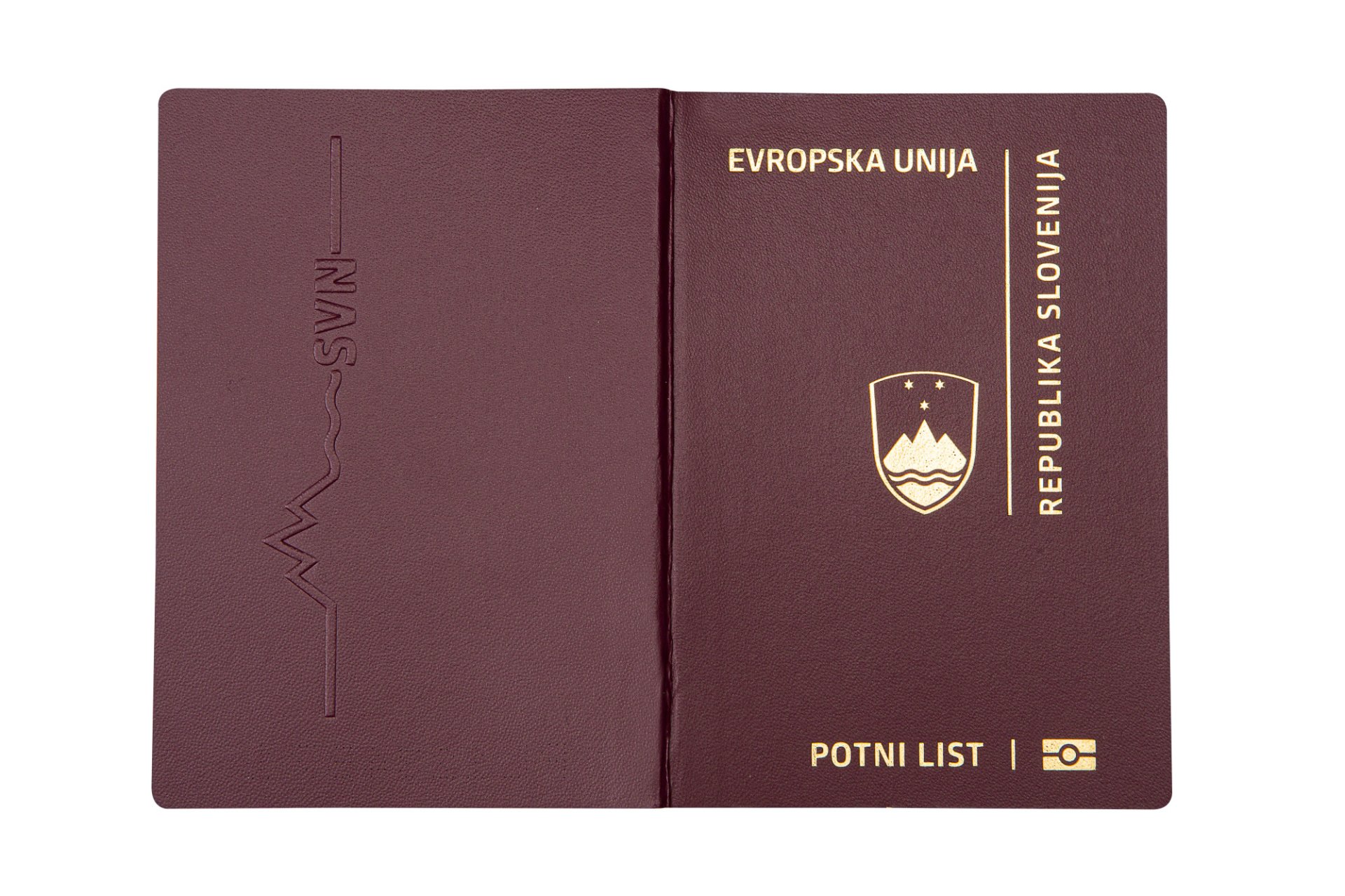
Contemporary design principles are particularly evident in the redesigned front cover. The back cover incorporates a new security feature: an embossed stylized image of Triglav, Slovenia’s highest peak, transitioning into a curve symbolizing the country’s sea and rivers. This is accompanied by the inscription “SVN,” the internationally recognized three-letter country code assigned to Slovenia under the ISO 3166 standard.
The graphic design is further enhanced by a dynamic triangular composition inspired by Triglav, which appears as an intaglio-printed background on the inside covers and throughout the visa pages. To support ultraviolet printing and microtext security features, the visa pages incorporate contour lines from cartographic representations of Slovenia’s terrain as guilloche patterns in the background.
The passport also incorporates imagery from the Vače Situla, particularly the figure of the horseman, which symbolizes travel and mobility. The horseman appears in optically variable ink (OVI), within the watermark, and as an animated feature next to the numbering of each visa page, creating a dynamic effect when the pages are rapidly flipped. Additional motifs include the linden leaf, a powerful symbol of Slovenian national identity, tradition, and community, as well as the outline of Robba Fountain.
These motifs provide the framework for the implementation of security features. By presenting the same motifs through multiple printing techniques, materials, and security technologies, the design achieves both strong visual recognition and a high level of document security.
Slovenia is currently participating in discussions on the proposed Council Regulation concerning the issuance of digital travel documents and the establishment of an application for the electronic submission of travel documents.
As the initiative remains in the coordination phase, the specific solutions, technical specifications, and implementation framework have not yet been finalized and it is not possible to provide further details at this stage.
Photo: Slovenian government website
This interview was prepared by Julian Müller