Poland, Spain discuss EU future and NATO cooperation in Barcelona
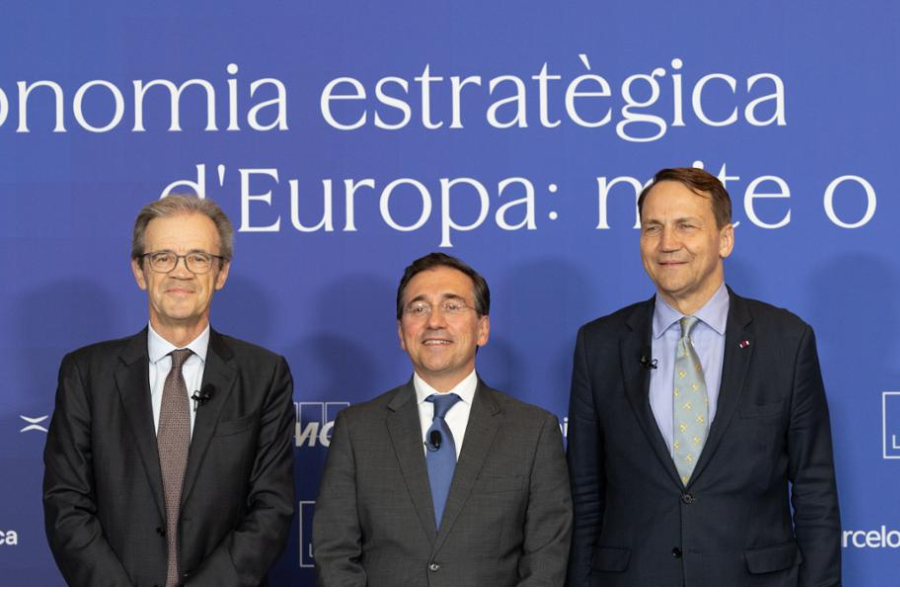
“European Strategic Autonomy: myth or reality” was the theme of this year’s edition of the Spanish think tank Cercle d’Economia meeting, in which Polish Deputy Prime Minister Radosław Sikorski took part in Barcelona.
During his visit to Spain, the Polish Foreign Minister also met with Spain’s Minister of Foreign Affairs José Albares, CE Report informs via the Polish Foreign Ministry's official website.
The foreign ministers of Poland and Spain in Barcelona discussed current security issues in Europe, particularly in the context of Russia’s aggression against Ukraine. They emphasized the need to strengthen cooperation between the two countries not only bilaterally and within the European Union, but also within NATO.
The heads of diplomacy also discussed Polish-Spanish relations, highlighting intensive economic cooperation. The value of trade between Poland and Spain in 2025 reached a record level of over 19 billion euros, and increased by around 6 percent last year.
Both ministers also participated in a panel organized by Cercle d’Economia. They discussed geopolitical challenges related to the war in Ukraine and Europe’s strategic autonomy. Minister Sikorski stressed that the war in Ukraine represents a fundamental security threat, especially for countries on NATO’s eastern flank, but added that European states should not panic in response to Russian aggression.
“We thought that (Putin) had the second-largest army in the world. He himself thought he had the second-largest army in the world. In reality, he has the second-largest army in Ukraine. And not only is he starting to lose positions, but he is suffering losses greater than the number of new recruits. He is also losing control over some key logistical routes, such as the M14 highway from Donbas to Crimea,” Sikorski said, adding that 20 to 30 percent of Russia’s refining capacity has been disabled and that the Russian economy is beginning to feel the impact.
Spanish Foreign Minister José Albares also acknowledged that the situation on the front line does not indicate that Putin is gaining strength or benefiting from the war.
“We cannot allow the aggressor and the war of aggression to prevail, to benefit, or to be rewarded. That would contradict everything the European project has always stood for. The European project is a peace project. It is a project that rejects the idea that war can be an instrument of foreign policy,” Albares said.
He also stressed that peace and respect for international law must guide policy both in Ukraine and in Gaza, Lebanon, and Iran.
The ministers also discussed the future of the European Union and its guiding principles, including unanimity.
“When national interest is at stake, it seems completely normal to me that a state uses its veto to defend its vital interests. That is what unanimity is for. However, I will be very open: I have always opposed situations in which a state does not use the veto to defend its national interest, but instead uses it solely to block the progress of others or to extract concessions in entirely unrelated domestic matters,” Sikorski said.
During discussions on the economy and security, Minister Albares stressed the need to create a unified European capital market. He also said that European savings should finance ideas and innovation generated in Europe. He further emphasized that European security means strengthening the European pillar of NATO and called for reinforcing democratic values, pluralism, tolerance, and openness.
The visit of Deputy Prime Minister Radosław Sikorski to Barcelona and the alignment of positions with Minister José Albares confirmed that Poland and Spain, despite geographical distance, remain key partners in shaping Europe’s future. Their joint commitment to supporting Ukraine, strengthening NATO cooperation, and rapidly growing trade relations form a strong foundation for building a more secure and united Europe.
Photo: Polish Foreign Ministry