Japanese student blends Seljuk geometry with micro art
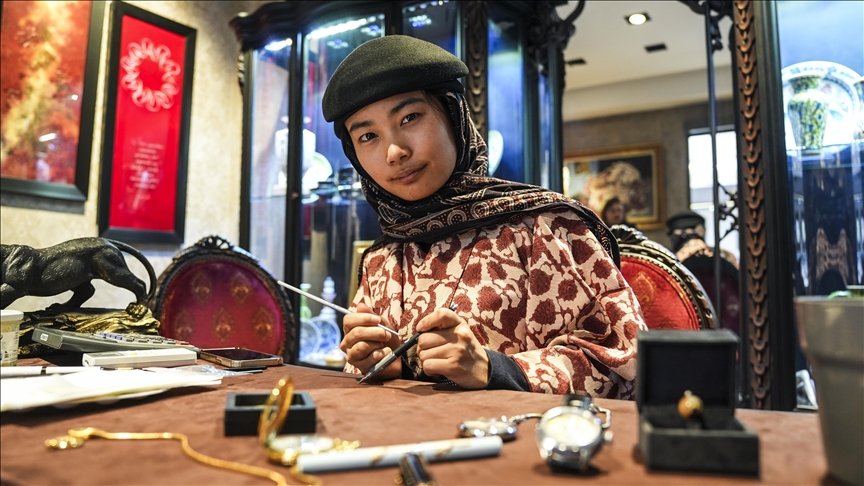
Murat Uçar, a lecturer in the Department of Traditional Turkish Arts at Mimar Sinan Fine Arts University, and Japanese student Şule Shinku Shirakawa create works using the micro art technique, combining Japanese traditional motifs with Seljuk geometry on various objects, especially fountain pens.
Shirakawa brings together the lines of Japanese aesthetics with the geometric order of Seljuk art, which carries the idea of infinity, in the same work, CE Report quotes Anadolu Agency.
Describing her academic journey in Türkiye as a “turning point in her life,” the 27-year-old Shirakawa says she is particularly inspired by the approach of Turkish artisans, where patience, elegance, and mastery are intertwined.
Speaking to an Anadolu Agency reporter at the workshop in Istanbul’s Fatih district where she studies and prepares for an exhibition, Shirakawa talked about her process of choosing Islam, her interest in traditional Turkish arts, and her work.
After converting to Islam, Shirakawa also began using the name Şule.
“Two years ago, I found myself in a void. I wanted to belong to a religion. During that search, I went to India and became interested in many religions, trying to learn their details. Among them, I chose Islam, which I felt closest to. My family respected my decision,” she said.

Inspired by Tokyo Mosque and Turkish Culture Center
Shirakawa said she was deeply impressed by the Tokyo Mosque and Turkish Culture Center, built with contributions from the Turkish government. After visiting it, she became interested in Turkish-Islamic arts and wanted to come to Türkiye.
She explained that she came to Mimar Sinan Fine Arts University in Istanbul as an Erasmus student from Tokyo.
“I was studying Fine Arts at the University of Tokyo. I wanted to learn about Türkiye and traditional Turkish arts, so I enrolled at Mimar Sinan University’s Faculty of Fine Arts. When I choose a religion, I believe I must learn all its details and then progress professionally in its unique art. That’s why I embraced this very seriously. I am learning Turkish and Islamic art in Türkiye,” she said.
Regarding her exhibition works, which also reflect Turkish-Japanese friendship, Shirakawa said:
“I engrave both Japanese and Seljuk geometric patterns onto fountain pens using micro art. I also want to depict a mosque. All mosques are so beautiful, but I would especially love to portray the Sultanahmet and Hagia Sophia mosques. I aim to hold an exhibition in Sultanahmet, Istanbul. I would like to live in Istanbul in the future. I want to live in an Islamic country. Islam is growing in Japan; many people are converting. I have plans to help increase the number of mosques there. We have very few, and I want to work on that. I’m very happy and very proud. I love Islam very much. God willing, I will continue on this path.”
Art sends a message against consumerism
Murat Uçar said that Shirakawa, who came from the University of Tokyo, took computer-aided design classes from him. He explained that they began combining Seljuk patterns with traditional Japanese geometric designs, which eventually evolved into an exhibition project.
As reported by CE Report, Uçar emphasized that the exhibition highlights Turkish-Japanese friendship and added:
“Our aim is to write a beautiful story by synthesizing the art of there with the art of here. Şule is receiving miniature art training and learning motifs and patterns from traditional Seljuk arts. Now, inspired by my works on artistic watches, pens, and jewelry, she is trying to tell another story. Pens are very important for the Japanese; they consider them almost sacred. Şule also has a special mission regarding pens. In a world where everything is consumed very quickly, she believes a pen holds great importance, which is why she wants to work on pens.”