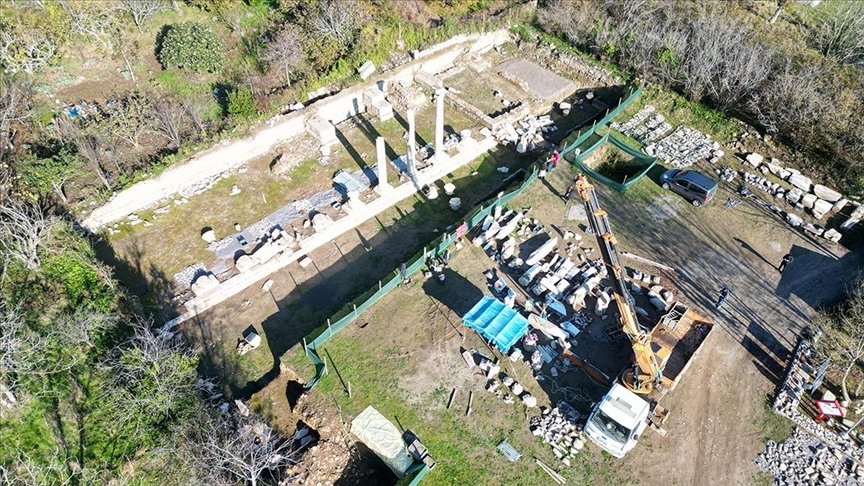
Roman-era stoa uncovered in ancient city of Amasra
It has been determined that a stoa structure, notable for its Roman-era marble columns reaching up to 9 meters in height and destroyed by natural disasters, has been uncovered in an ancient city where work is being carried out under the “Legacy for the Future Project” of the Ministry of Culture and Tourism.
As part of the excavations conducted over an area of 2,850 square meters under the leadership of Prof. Dr. Fatma Bağdatlı Çam, Director of the Bartın University (BARÜ) Archaeology Application and Research Center, several columns of the structure have been re-erected, CE Report quotes Anadolu Agency.
Built in the Corinthian order (a classical architectural column style), the structure is being restored in line with its original form through meticulous work using authentic pieces.
With the permission of the General Directorate of Cultural Heritage and Museums of the Ministry of Culture and Tourism and the support of Turkish Petroleum Corporation (TPAO), the project involves expert academics and students from BARÜ as well as many other universities.
“We plan to open the site to visitors by late 2026 or early 2027”
Speaking to Anadolu Agency (AA), Prof. Dr. Fatma Bağdatlı Çam stated that after historical remains were discovered during a school construction in Kum Neighborhood in 2017, the area was placed under protection, and rescue excavations began in 2022, revealing the stoa structure.
She explained that three columns were re-erected last year, while this year the remaining four columns, along with related blocks, ceiling coffers, and architectural elements, were fully uncovered and reassembled using the anastylosis method (the restoration of an ancient structure stone by stone in its original form).
Çam said:
“The four columns located immediately west of the three columns erected last year have now also been restored and placed in their original positions. Other architectural blocks are currently on display in the exhibition area. In the next phase, we aim to uncover another stoa structure previously identified on the western side of the site and open the area to visitors by late 2026 or early 2027.”
She emphasized that the structure highlights the grandeur of the ancient city and continued:
“The structure we uncovered is a Roman portico dated to the mid-2nd century AD. Its size and architectural ornamentation show that it is the only stoa structure in the Black Sea region. Together with another structure previously discovered to the west, the findings indicate that this area was an agora (city square, marketplace). Excavations will continue on the western side to reveal the new stoa area, which will be partially opened to visitors. As additional structures are uncovered in other directions, the entire area will eventually be opened. Our main goal is for the Ancient City of Amastris to gain official archaeological site status.”
Çam also noted that Amasra, as one of the rare port cities of the Western Black Sea region and a growing center for cruise tourism, will benefit significantly from this cultural heritage, especially since the ancient city is located in the town center and is rapidly being restored.
She added that previous excavations at the site uncovered artifacts such as a head of Alexander the Great, statues of a Nymph and Lares (household gods), as well as amulets, coins from different periods, and inscription fragments.
“We will continue to shed light on Amastris’ thousands of years of history”
Bartın University Rector Prof. Dr. Ahmet Akkaya stated that, in cooperation with relevant institutions, efforts are being carefully carried out to bring world heritage artifacts to light.
As reported by CE Report, emphasizing the importance of the discoveries for both Anatolian and world history, Akkaya said:
“We will continue to illuminate the thousands of years of history of Amastris, one of the most important ancient settlements of the Black Sea. I would like to thank our Minister of Culture and Tourism Mehmet Nuri Ersoy for his support, our YÖK President Prof. Dr. Erol Özvar and the YÖK members for their motivating approach to regional development, as well as Prof. Dr. Fatma Bağdatlı Çam and the excavation team.”