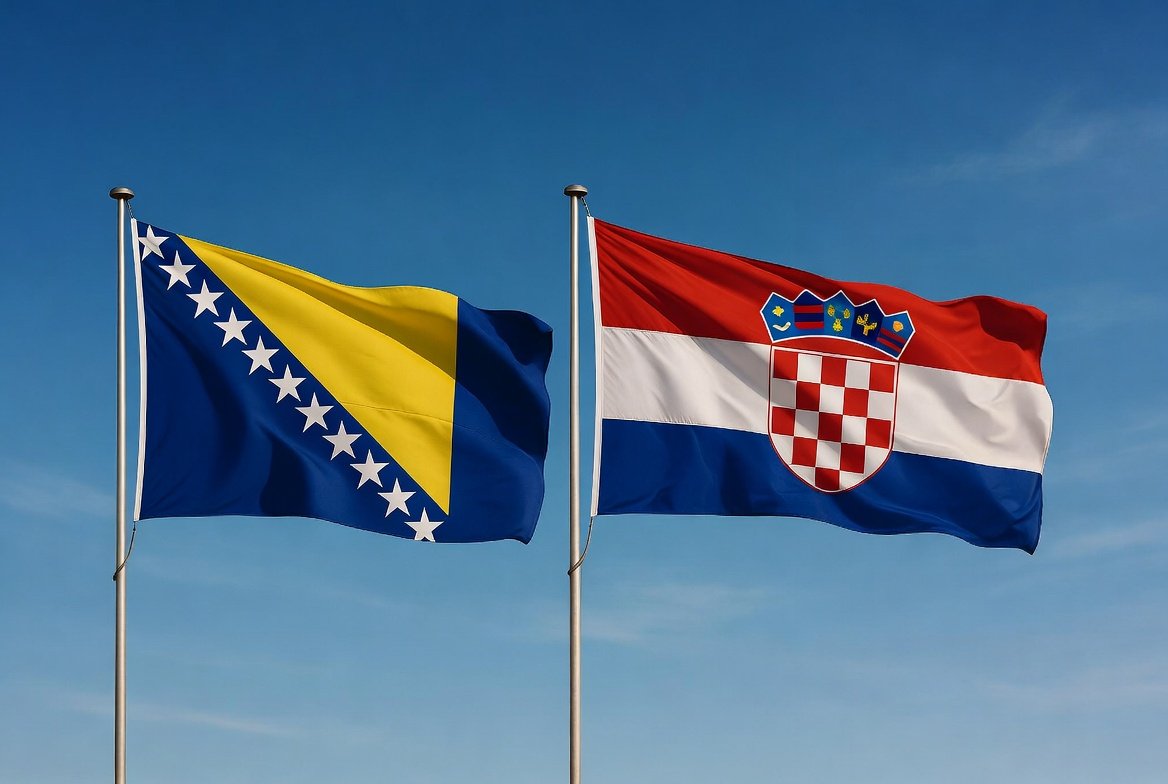
Bosnia joins cross-border review of Croatia's Trgovska Gora waste storage facility
Bosnia and Herzegovina will participate in the transboundary environmental impact assessment procedure for Croatia's planned radioactive waste storage facility at Trgovska Gora, gaining the right to review project documentation, submit comments and ensure public participation.
At the same time, studies conducted in the Federation of Bosnia and Herzegovina indicate that the proposed location is unsuitable for such a facility, CE Report quotes FENA.
At the same time, legal experts warn that Croatia selected the site before completing the environmental impact assessment, a move that could significantly influence the future of the project and the international legal proceedings initiated by Bosnia and Herzegovina.
Bosnia and Herzegovina has officially informed Croatia that it intends to participate in the environmental impact assessment procedure for the construction of a long-term storage facility for low- and intermediate-level radioactive waste from the Krško Nuclear Power Plant, as well as institutional radioactive waste, at the Čerkezovac site on Trgovska Gora in the Croatian municipality of Dvor.
In June, Croatia's Ministry of Environmental Protection and Green Transition notified Bosnia and Herzegovina of the launch of the procedure and requested confirmation on whether it wished to take part in cross-border consultations in accordance with the Espoo Convention.
Bosnian institutions responded that Croatia's notification was unclear, incomplete and submitted too late, arguing that the procedure had not been conducted in line with the Espoo Convention and other international agreements.
They requested that the procedure be returned to an earlier stage, that Croatia provide all relevant information and documentation, and that the two countries establish a joint body or conclude a special bilateral agreement.
Environmental study still pending
Croatia has not yet provided Bosnia and Herzegovina with the environmental impact assessment study or the accompanying documentation. The study is expected in the final quarter of this year, after which consultations and public hearings should begin.
Nemanja Galić, a member of the Legal Team responsible for developing Bosnia and Herzegovina's legal protection strategy, told FENA that participation in the procedure grants the country access to all information relevant to assessing the project's potential impacts on its territory.
"Croatia is now obliged to provide the relevant documentation and additional information, particularly regarding possible transboundary effects. Bosnia and Herzegovina has the right to submit comments, objections and proposals, primarily concerning the environmental impact assessment study," Galić said.
He added that public hearings should also be held in Bosnia and Herzegovina and that Bosnian citizens must be given the same opportunities to participate as the public in Croatia, including access to all relevant documentation.
According to Galić, the main issue lies in Croatia's decision-making sequence, as the exact location of the facility was selected before the environmental impact assessment had been completed.
"Croatia first decided on the precise location of the facility and only afterwards approached Bosnia and Herzegovina. Such a sequence undermines both the environmental impact assessment and the purpose of the transboundary consultation process," he said.
He stressed that the environmental assessment should have preceded the site selection rather than being conducted after the location had already been determined.
Possible breach of international obligations
Galić believes Croatia's approach could constitute a violation of the Espoo Convention, other rules of international law, European Union legislation and Croatian law.
"As the deadline for taking over the radioactive waste approaches, it is becoming increasingly clear that Croatia made its final decision well before completing the environmental study. These shortcomings could affect the further course of the procedure," he said.
The Federation of Bosnia and Herzegovina's Ministry of Environment and Tourism confirmed to FENA that it participated in drafting the joint response to Croatia together with the Ministry of Foreign Trade and Economic Relations of Bosnia and Herzegovina, the competent ministry of Republika Srpska, and the Expert and Legal Teams.
According to the Ministry, the Federation's position is fully aligned with that of the other competent institutions in Bosnia and Herzegovina.
The formal response was submitted to the Croatian authorities by the Ministry of Spatial Planning, Construction and Ecology of Republika Srpska, which serves as Bosnia and Herzegovina's contact institution for implementing the Espoo Convention. The Federation Ministry of Environment and Tourism acts as the country's contact institution for the Aarhus Convention.
The Ministry also noted that research into the potential environmental, water, public health and protected area impacts of the project began in 2019.
The research has involved the Federal Hydrometeorological Institute, the Federal Agro-Pedological Institute, the Federal Institute for Geology, the Institute for Public Health of the Federation of Bosnia and Herzegovina, and the Sava River Basin Agency.
"All completed reports confirm that the Trgovska Gora location is not suitable for establishing a radioactive waste management centre," the Ministry stated.
The reports and studies have been adopted by the Government of the Federation of Bosnia and Herzegovina, while additional research is continuing.
Particular concern relates to the proximity of Una National Park, home to numerous protected and endangered species and their habitats. Federal institutions have previously warned that the area should become part of the European Natura 2000 protected areas network.
Multiple international legal proceedings
Bosnia and Herzegovina has already initiated proceedings concerning Trgovska Gora before several international bodies. Submissions have been made to the Espoo, Aarhus and Bern Convention bodies, the Sava and Danube Commissions, as well as the European Commission.
In May, delegations from Bosnia and Herzegovina and Croatia held a hearing before the Espoo Convention Implementation Committee in Geneva. Within the Aarhus Convention framework, Bosnia and Herzegovina argued that its public had not been provided with adequate access to information or meaningful participation in decision-making.
Galić believes that although these mechanisms are not traditional court proceedings, they can significantly influence Croatia and the implementation of the project.
He highlighted the European Commission as having a particularly important role, noting that it has the authority to initiate infringement proceedings against Croatia before the Court of Justice of the European Union.
"The opinions of international bodies carry considerable weight and are generally respected in practice. If the focus remains on legal rather than political issues, Bosnia and Herzegovina's chances of achieving concrete results will increase," he said.
Bosnia and Herzegovina is acting in accordance with the Legal Protection Strategy adopted by the Council of Ministers in 2022.
Galić explained that initiating proceedings against Croatia before the International Court of Justice or through international arbitration would not be straightforward, as both countries would have to agree to the jurisdiction of such bodies.
Nevertheless, he stressed that Bosnia and Herzegovina's legal options are far from exhausted.
"We are currently preparing several additional measures. If Croatia continues with the project despite Bosnia and Herzegovina's well-founded objections, further legal action will be taken in accordance with the strategic guidelines," he said.
Asked about the possibility of halting the project entirely, Galić said it was still too early to draw final conclusions because the environmental impact assessment has not yet been published.
However, he believes Bosnia and Herzegovina's actions have already produced tangible results, primarily by slowing down the project.
"Croatia's procedural shortcomings have significantly improved Bosnia and Herzegovina's chances of success before international bodies," he emphasized.
As the most reasonable alternative, Galić suggested that the radioactive waste should remain in Slovenia, where it was generated, or at least as close as possible to its point of origin.
According to him, such a solution would be more acceptable both to the citizens of Bosnia and Herzegovina and to residents of Croatia living near the planned storage facility.
Photo AI