Mount Etna identified as unique type of volcano
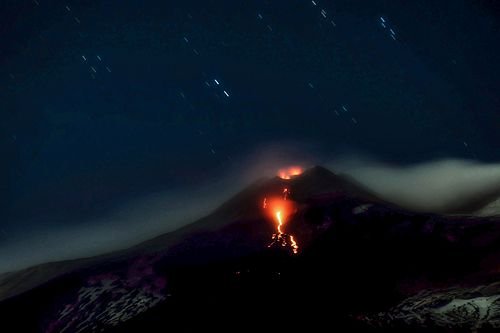
Mount Etna is unique among Earth’s volcanoes, according to a new study published on April 7 in JGR Solid Earth, cited by Live Science.
The research suggests that Etna formed in an unusual way, similar to “petit-spot” volcanoes—small, young submarine volcanoes discovered in 2006 that erupt through cracks in tectonic plates near ocean trenches, CE Report quotes AGERPRES.
These submarine volcanoes typically form far from traditional hotspots, allowing magma from the upper mantle to reach the surface and offering rare insights into mantle composition. However, while petit-spot volcanoes are only tens of meters tall, Etna rises to 3,403 meters, making it dramatically different in scale.
“This represents a new type of volcanism,” said geologist Sarah Lambart from the University of Utah, who was not involved in the study.
Traditionally, geology divides volcanoes into three main types, explained Sébastien Pilet from the University of Lausanne:
- Mid-ocean ridge volcanoes: form where tectonic plates pull apart
- Intraplate volcanoes: like Yellowstone or Hawaii, formed by mantle “ihotspots”
- Subduction zone volcanoes: like Mount Fuji or Mount Rainier, formed where one plate sinks beneath another
However, Mount Etna does not fit any of these categories. It lies near the boundary where the African plate slides under the Eurasian plate, but directly above the meeting point—not inland like typical subduction volcanoes. Chemically, its lava resembles hotspot volcanoes, even though no hotspot exists beneath it.
Etna’s evolution is also unusual:
- Initially, it erupted small amounts of silica-rich lava
- Later, it produced large volumes of alkaline lava (rich in potassium and sodium)
This is atypical because:
- Silica-rich lava usually erupts in large quantities
- Alkaline lava typically erupts in smaller amounts
To understand this, researchers analyzed the geochemistry of Etna’s lava layers over time. They found that the magma likely originates from a partially molten layer in the upper mantle called a low-velocity zone, where seismic waves slow down.
These zones are widespread, but magma rarely reaches the surface. What makes Etna special is its complex tectonic setting:
The subducting plate is partially blocked
This causes folding and deformation of rocks
These folds create pathways for magma to rise
Initially, magma traveled through the African plate and interacted with the crust, producing silica-rich lava. Later, a more direct channel allowed less-altered alkaline magma from the mantle to reach the surface, but in smaller quantities.
According to Sarah Lambart, this discovery is important because the role of interactions between magma and the lithosphere (crust + upper mantle) is still poorly understood.
“The lithosphere may play a much more important role in volcanic activity than we thought—not just at Etna, but globally,” she emphasized.
Photo: Wikipedia