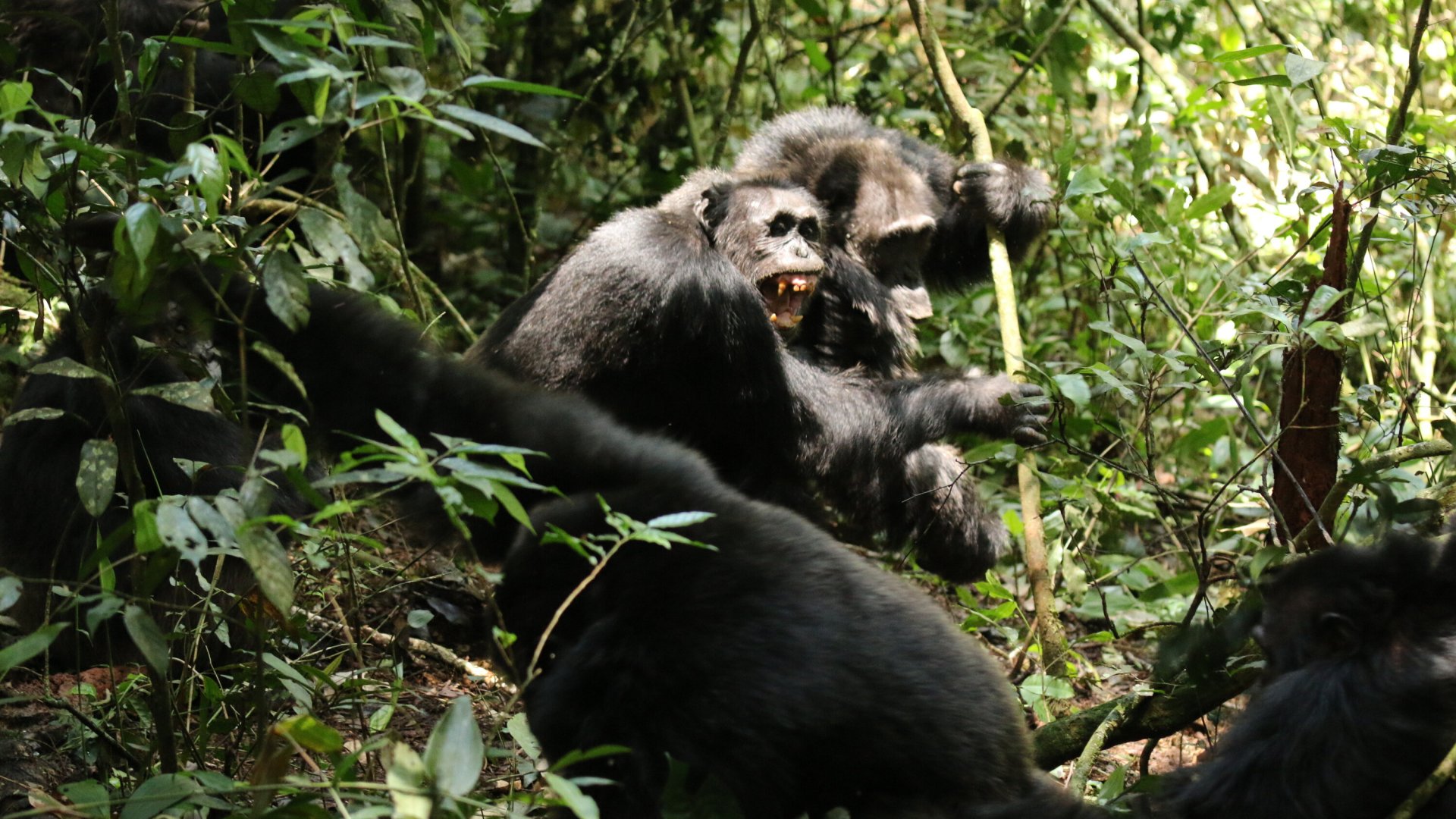
First documented chimpanzee “civil war” splits largest known community
The first documented case of a “civil war” among chimpanzees has been recorded, leading to the split of the largest known community in the world into two rival groups: an extremely rare event that, according to genetic studies, would occur on average once every 500 years.
The conflict, marked by the killing of both adult individuals and infants, was reconstructed thanks to thirty years of field observations in Kibale National Park in Uganda. The study’s results, which offer new insights into understanding conflict dynamics even among humans, were published in Science by a research team led by anthropologist Aaron Sandel from the University of Texas at Austin, CE Report quotes ANSA.
The Ngogo chimpanzee community remained cohesive during the first twenty years of the study. However, in 2015, the first signs of polarization emerged: the western and central groups began increasingly avoiding each other. This shift coincided with a reorganization of the male dominance hierarchy and occurred one year after the deaths of several adult males, who likely acted as “bridges” holding the larger community together.
The split was completed in 2018, when the chimpanzees formed two distinct groups (western and central) with separate territories. This was followed by a series of deadly attacks by the western group against members of the central one. Between 2018 and 2024, researchers directly observed—or reconstructed with high certainty—seven attacks against adult males and 17 against infants.
“What is particularly striking,” Sandel notes, “is that chimpanzees are killing former members of their own group. New group identities are overriding cooperative relationships that had existed for years.”
In many primate species, large groups regularly split into smaller ones, often reducing competition for resources. But among chimpanzees, permanent splits are very rare. The only previously reported case dates back to the 1970s in Gombe, Tanzania, during the long-term study by Jane Goodall. However, that case has remained debated, partly because the chimpanzees were being fed by researchers.
“If relational dynamics alone can generate polarization and lethal conflict in chimpanzees—without language, ethnicity, or ideology—then in humans these cultural markers may be secondary to something more fundamental,” Sandel says. “If that is true, we may have the opportunity to reduce social conflicts in our personal lives.”