Moldova becomes regional hub for sustainable agriculture
The Republic of Moldova has become the center of regional discussions on sustainable agriculture, hosting the South-Eastern Europe Conference on Organic Product Markets.
The regional event, focused on strengthening local producers’ access to the European single market, is being organized by an international and national consortium including SWG RRD, the Research Institute of Organic Agriculture (FiBL), EOCC, Invest Moldova and the Moldova Organic Value Chain Alliance (MOVCA), CE Report quotes MOLDPRES.
The forum brings together senior officials from the Moldovan government, representatives of Germany’s Federal Ministry of Agriculture, delegates of the European Commission, as well as representatives of organisations such as IFOAM Organics Europe, certification bodies, importers and farmers from across the region.
The conference programme focuses on consumer trends in Europe, adaptation to new EU regulations and opportunities to expand exports of organic products from Eastern Europe.
During the opening session, representatives of the Moldovan government stressed that the transition to green agriculture is not only an environmental requirement but also an important strategy for economic growth and alignment with European Union standards.
“I would like to thank all our international partners, representatives of the European Union and Germany for the valuable assistance provided to the Ministry of Agriculture and Food Industry. Our country’s growth is driven by the food industry and the agricultural sector, which remains among the top three engines of economic development, alongside the information technology sector. We are in the era of artificial intelligence and digitalisation, and agriculture is also undergoing these profound transformations. Organic agriculture is being actively promoted in Moldova, but to continue growing, we need the ongoing support of development partners, as well as the exchange of knowledge and experience,” said Eugeniu Osmochescu, Minister of Agriculture and Food Industry.
“We will be guided by the principle that we must go ‘through difficulties to the stars’ in order to join the European Union family. With more than €1.5 billion in EU-allocated budgets available, we look forward to aligning ourselves with European standards, accessing pre-accession funds and following the Union’s economic agenda. By taking these technical and legislative steps, we achieve tangible results with a direct impact on economic growth,” the minister said.
Osmochescu also referred to visits to organic farms across the country, highlighting that direct dialogue between local producers and experts from EU member states creates real opportunities for attracting new investment.
The standardisation and harmonisation of national legislation with the EU’s new organic production framework, Regulation (EU) 2018/848, is considered a key requirement for removing trade barriers.
“It is a great pleasure to be in Chisinau. Organic agriculture must be strictly guided by the regulatory framework of the European Union, while governments have the responsibility to provide the necessary legislative framework so that imports and exports can be promoted transparently and safely. National legislation must be aligned with EU Regulation 2018/848, and authorities must guarantee quality control throughout the entire value chain,” said Boban Ilic, Secretary General of the Regional Rural Development Standing Working Group (SWG).
“At the same time, organic agriculture requires a holistic approach. We are talking about business, but also about healthy food and balanced diets. During discussions in Chisinau, I raised a rhetorical question: ‘Why are we exporting our health?’ We must develop domestic markets in parallel. The local population needs to be informed about the benefits of organic products, while local distribution channels and the tourism sector — which is growing in the Western Balkans and the wider region — should be fully utilised to promote these products,” Ilic added.
German partners, meanwhile, highlighted the support they are providing to countries in South-Eastern Europe and the Black Sea region as they seek to align with the single market, stressing that this assistance is based on equal partnership rather than a relationship of tutelage.
“The complexity of the regulatory framework and international standards requires complete market transparency. Organic legislation is not simple, but once Moldova and other countries in the region align their regulatory frameworks with European standards, the doors to international markets will open,” said Thomas Zebunke, Director for Agriculture at Germany’s Federal Ministry of Agriculture, Food and Regional Identity (BMLEH).
“In Germany, over the past three years we have shifted our strategic focus and developed a new export strategy in which organic products are the most important component. In these uncertain times, ensuring supplies of high-quality food makes organic production a strategic asset. Through programmes such as the International Organic Trade Network, we do not act as mentors but as partners. We learn from one another, exchange ideas and have been building this cooperation network for more than 30 years,” Zebunke added.
One of the highlights of the conference is a panel dedicated to strengthening organic exports to the EU single market. Successful companies from Eastern Europe are presenting case studies and openly discussing logistical challenges, strict certification requirements and the financial opportunities created by growing European demand for organic food.
The conference continues throughout the day with thematic working sessions and round tables aimed at developing concrete proposals for agricultural budgets and policies for next year.
Moldova’s organic agriculture sector is undergoing a broad process of modernisation and alignment with European Union standards. More than 150 certified organic producers are currently registered in the country, managing approximately 30,000 hectares of agricultural land. Moldova’s organic export portfolio is dominated by cereals, oilseeds, nuts, grapes and dried fruit, with Germany, the Netherlands, Italy and Austria among the main European destinations.
The transition towards sustainable agriculture is supported by the Moldovan state and international development partners. By updating the national regulatory framework and harmonising it with EU Regulation 2018/848, the authorities aim to simplify certification procedures, remove tariff and non-tariff barriers and expand direct subsidy measures for farmers undergoing the conversion process.
The Moldova Organic Value Chain Alliance (MOVCA), together with continuous training platforms such as the Organic Farmers’ School, plays a central role in strengthening this ecosystem. These initiatives contribute to increasing the competitiveness of Moldovan products, protecting soil resources and enabling local producers to integrate more effectively into the European single market.
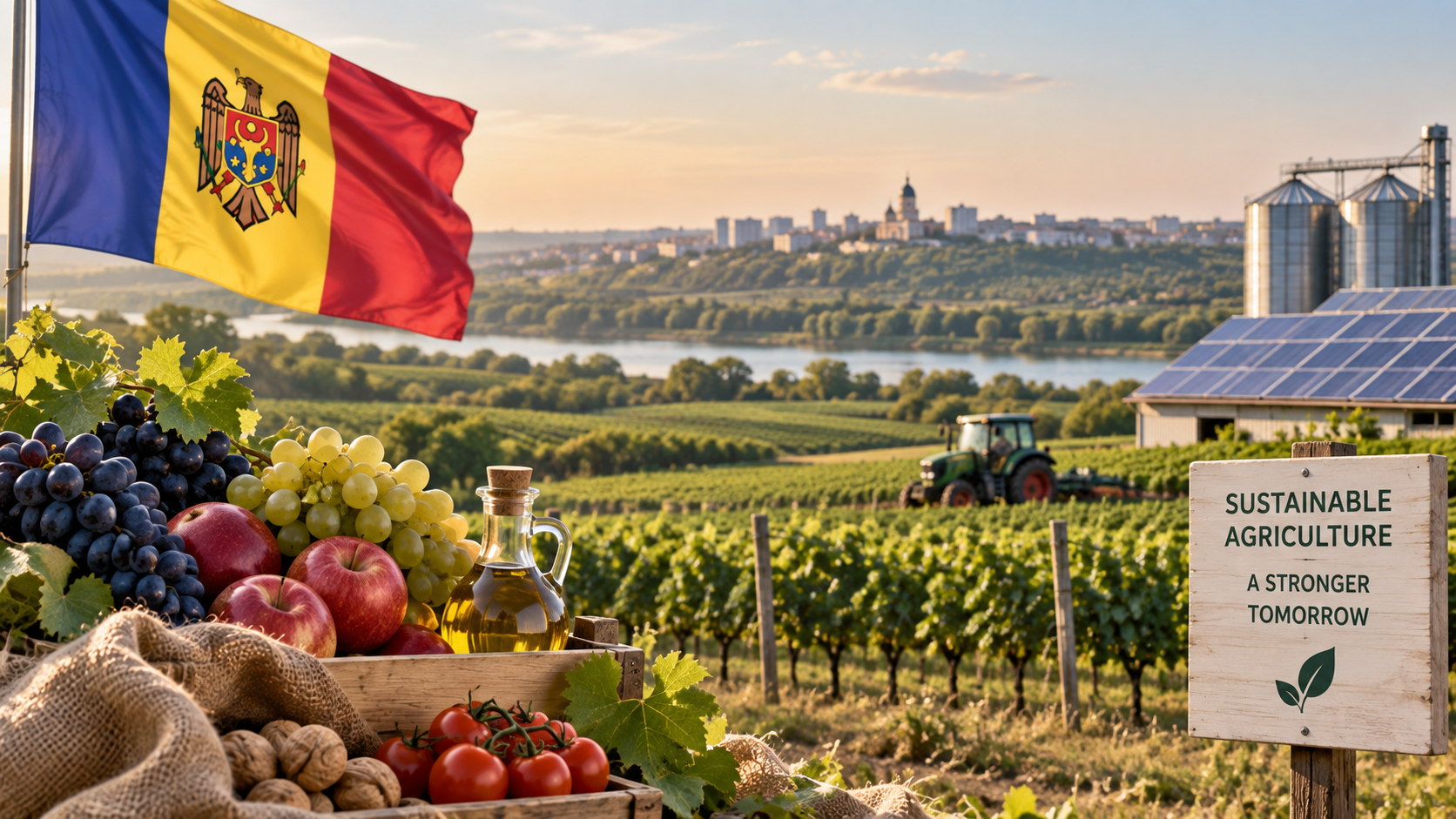
Photo: Chat GPT