Scientists reconstruct brain anatomy of European saber-toothed cats
Researchers have reconstructed, for the first time, the brain anatomy of saber-toothed cats that lived in Europe — including areas between Tuscany and Lazio in Italy — around two million years ago during the Plio-Pleistocene period.
The findings, which provide important clues about the animals' behavior, were published in The Anatomical Record by a research team led by paleontologists from the University of Florence, CE Report quotes ANSA.
Reconstructing the brain anatomy of fossil vertebrates is particularly challenging because it requires exceptionally well-preserved skulls. In such studies, the brain is analyzed indirectly through the reconstruction of the endocranium (endocast), which can only be obtained from intact or sufficiently complete skulls that allow reliable modeling of internal structures.
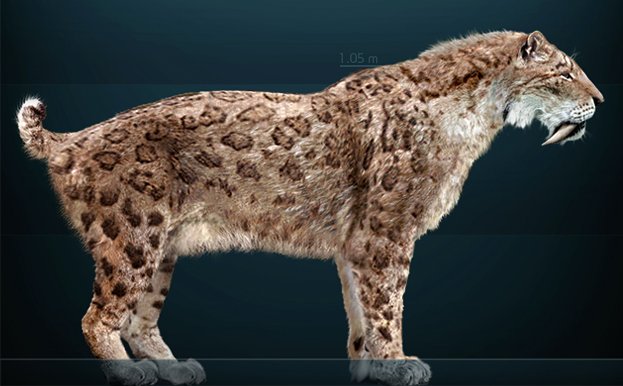
For this study, scientists examined digital endocasts of the saber-toothed cat species Megantereon cultridens, created using CT scans of three fossil skulls discovered in Spain, Italy, and France.
The results show that Megantereon cultridens possessed a brain structure that was intermediate between modern felines and pantherines such as lions, tigers, and leopards, suggesting considerable ecological flexibility. Its brain was compressed along the front-to-back axis, featured relatively developed frontal lobes, and had reduced olfactory tracts.
A possible reduction in cortical hearing areas, combined with enhanced visual regions in the occipital lobe, indicates a strong reliance on vision during hunting. Overall, the findings portray a versatile predator that was comfortable in forest environments but also capable of adapting to a variety of habitats and ecological conditions, much like modern pumas and jaguars.
The animal also appears to have possessed highly developed spatial orientation abilities and a cerebellum structure consistent with exceptional motor skills, supporting the possibility that it was an effective climber.
Photo: Wikipedia