Syrian officer reveals secrets of Israeli spy Eli Cohen’s capture
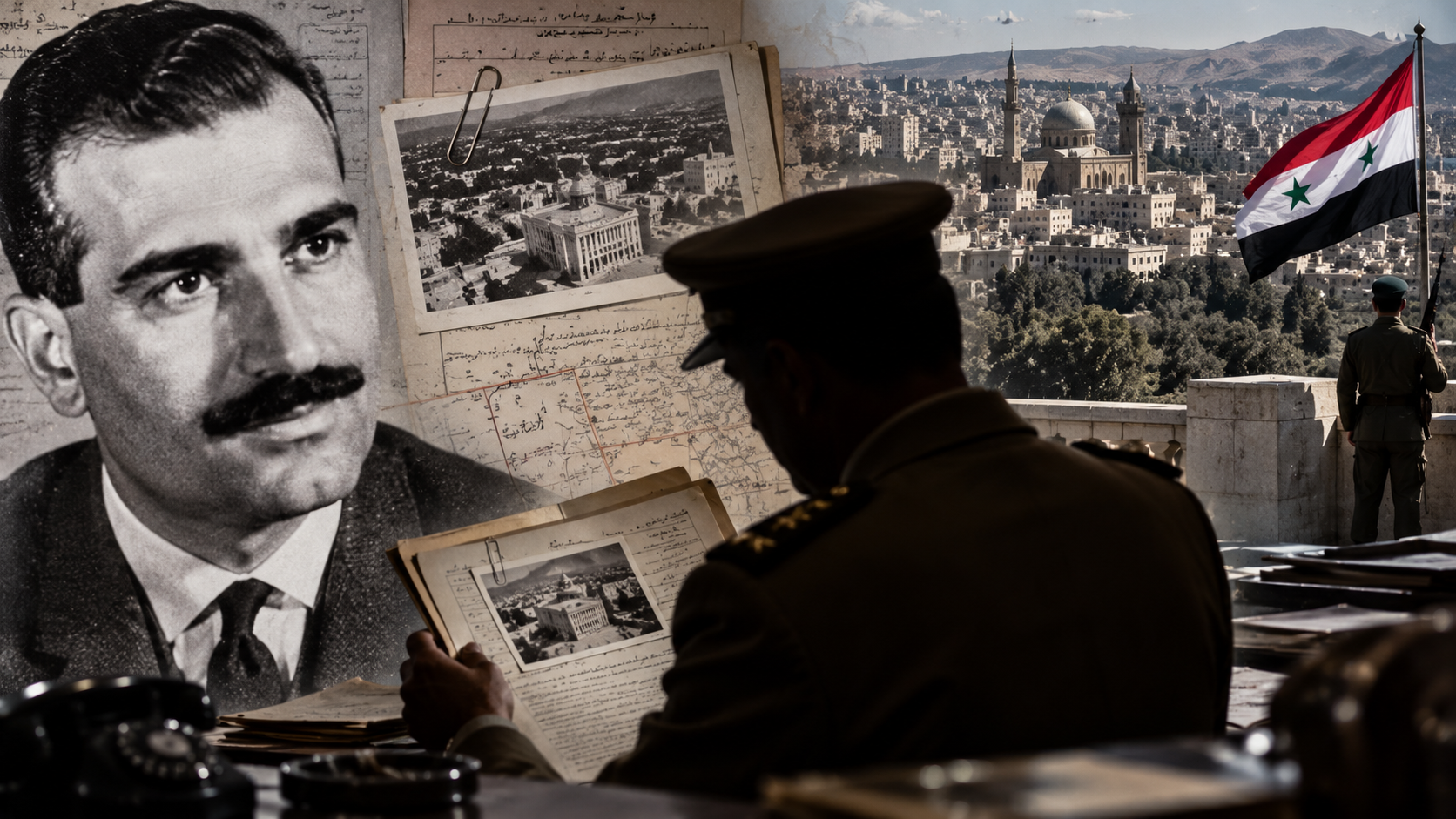
Retired Syrian officer Said Javiş, founder of the “Signal Company No. 134,” who played a key role in uncovering and capturing Israeli spy Eli Cohen while serving in the Syrian army, has revealed details of the operation 61 years later.
In the first three parts of a five-part interview series published by Saudi Arabia-based Al Majalla, Javiş, who played a significant role in Cohen’s capture, described previously unknown details of the operation, CE Report quotes Anadolu Agency.
In the interview, the retired officer said he had endured a difficult childhood in Damascus’s Kurdish Quarter, where he learned Hebrew at a young age from his Palestinian neighbors. He joined the army in 1951 and specialized in signals intelligence.
Javiş said he later taught Hebrew at the Military Academy, adding that among the prominent political figures he taught during his first course were people who would later hold important positions in Syria, including former Syrian Defense Minister Mustafa Tlass.
“Why don’t we monitor the Israeli army’s radio communications?”
Javiş said the idea of monitoring Israeli military radio communications came to him during the 1956 Suez Crisis, when he intercepted Israeli military calls while teaching a class using an old Canadian-made radio.
“I was teaching students in Homs how to operate radio equipment and receive signals. The device was Canadian-made and dated back to World War II. I heard a station calling out ‘Shaal 1, Shaal 2, Salib 1, Salib 2.’ After the class, I returned to my room and thought: ‘Why don’t we monitor the Israeli army’s radio communications?’”
He said he prepared a proposal and presented it to the military command, where it initially met with ridicule. However, he persisted and, with the support of Said al-Akil, an officer involved in operations at the time, eventually put the project into practice.
Javiş said the project was approved by the commander at the time and that, following his official appointment on September 30, 1957, he conducted prolonged surveillance and interception operations in the village of Na'aran in the Golan Heights.
Signal Company No. 134 established
As part of the project, “Signal Company No. 134” was established independently of military intelligence and placed directly under the Signal Corps.
“I trained 44 non-commissioned officers and established listening posts in the Golan,” Javiş said.
He explained that the unit closely monitored Israeli military communications, radio broadcasts and news agencies, while also recording encrypted Morse-code messages transmitted by unidentified stations.
Javiş said the unit was able to decipher codes used by Arab countries relatively easily, but struggled with the more sophisticated codes used by Israel.
“We could not decipher the Morse messages. They began with ‘VVV’ and were followed by an ‘N-O-NOW’ marker. There was no name of the sender or recipient. They consisted of groups of five letters and numbers,” he said.
Eli Cohen’s first message intercepted in 1962
Javiş said that Cohen’s transmissions were among the signals the unit monitored.
“We gradually tracked him. We intercepted his first telegram in 1962, but we did not know who he was or where he was transmitting from. Whenever we intercepted a signal, we recorded its frequency and date and assigned its source a distinctive number or code. We did not know the person, but we had a code for him,” he said.
After narrowing the search to the Abu Rummaneh district of Damascus, the team began examining the residents of the building one by one.
“We continued using surveillance equipment until the search focused on one building. We then investigated its residents. A foreign officer from the International Supervisory Commission lived in the basement. On the ground floor there was a Greek-born pilot working for Syrian Airlines. The apartments in the building were small. A diplomat from the Turkish Embassy lived on the first floor. Among the residents were elderly unmarried Damascene women who worked as seamstresses. We ruled them out.”
Javiş said the team initially focused on the pilot after comparing his travel schedule with the times when the transmissions were detected. They also searched the apartments under the pretext of looking for drugs, but found nothing.
He said he went to the airline and obtained the pilots’ travel schedules from the previous year, then compared them with the transmission times.
“We saw that communications stopped on most days when the pilot was traveling and resumed when he was in Damascus,” Javiş said.
“‘Since we’ve come this far, let’s search the other apartments as well,’ we said. We went down to the foreign officer’s apartment and knocked on the door. We said we were police officers. He told us he would not let us in and that we should speak to the Syrian officer who was his liaison. Nevertheless, we entered and searched, but found nothing. Then we searched the Turkish diplomat’s apartment, but found nothing there either. We returned to the unit empty-handed.”
Cohen’s location identified
Javiş said that after being reprimanded by his superiors, his unit commander closed the case, but he refused to give up. He eventually identified the target through an antenna on the building’s roof and confirmed the apartment by using an electrical outage.
“I began thinking to myself: Would three years of work really go to waste? I came up with the idea of examining the antennas in the area where we had searched the apartments. I took some men with me and went up to the roof of the building. I looked carefully and found an antenna that was different from the others. I told a member of the team to go to the door where the black cable entered and read the name written on it. He came back and said, ‘Kamil Amin Thabit.’
“The next morning, at 7 a.m., the time of the transmission, we were ready. When the transmission began, I cut the electricity three times using the external switch, and the interruptions appeared in the recording. At that point, we were certain that the transmission was coming from that apartment.”
Javiş recalled the 1965 raid on Cohen’s apartment.
“We went upstairs and decided to break down the door without knocking. We broke it and entered. There was an open room visible from the entrance; the man was lying on the bed. When we approached him, he stood up. I noticed the wooden curtain box above the window, with a black object inside. I put a chair there, opened the cover and found a Kodak film canister. When I opened it, I found a small Morse key and the device hidden directly underneath it.”
“When we found the device, Eli Cohen collapsed”
Javiş said Cohen collapsed after the transmitter was discovered.
“I kissed the key. I still feel happy when I remember that moment. Then I turned to him and said, ‘Mr. Kamil, we are not the anti-drug unit; we are the counterintelligence unit.’ When he saw the device, he sat down on the bed and never stood up again. He collapsed,” he recalled.
“I told him, ‘You are considered dead now. Do you want to live?’ He said, ‘Yes.’ I told him that he would remain alive if he cooperated honestly with us and as long as the other side did not know that he had been captured.”
Javiş said the team locked the door again so that the neighbors would not realize it had been broken into. He added that Cohen told them the transmitter they had found was a backup and that the main device was on the table.
“There was a document holder covered in green leather. Cohen pressed a part of it in the corner, and when the mechanism opened, the transmitter appeared. There was also an emergency frequency that he could use whenever he wanted outside his regular communication schedule, frequency crystals and a codebook containing the codes for each day,” Javiş said.
He said Cohen had complained that the smell of diesel fuel was making him sick and had asked the landlord to install a wood-burning device in the bathroom.
“I think he wanted it so he could burn papers that could be considered evidence,” Javiş said.
Javiş also described other items found in the apartment.
“We found another box containing six pieces that looked like colored bars of soap. The man brought a knife and opened the box. There were explosives inside. We asked him questions about encryption. This was very important to us because we had thousands of telegrams whose contents we could not decipher. He told us that during his first year he had encrypted his messages using a French book called ‘The Three Musketeers.’”
The fourth and fifth parts of Al Majalla’s series, containing further details about the operation to capture Eli Cohen, are expected to be published in the coming days.
Cohen, considered one of Israel’s most important spies, operated in Damascus from 1962 to 1965 under the alias Kamil Amin Thabit.
After developing close relationships with senior Syrian military officials, Cohen passed information to Israel about military activity in the Golan Heights and Syria’s decision-making process. He was executed on May 18, 1965.
Photo: Chat GPT