Women still underrepresented in Bosnian police
Women in police structures in Bosnia and Herzegovina remain significantly underrepresented, particularly in leadership positions, where they account for only about four percent.
Although certain progress in their professional advancement has been visible in recent years, CE Report quotes FENA.
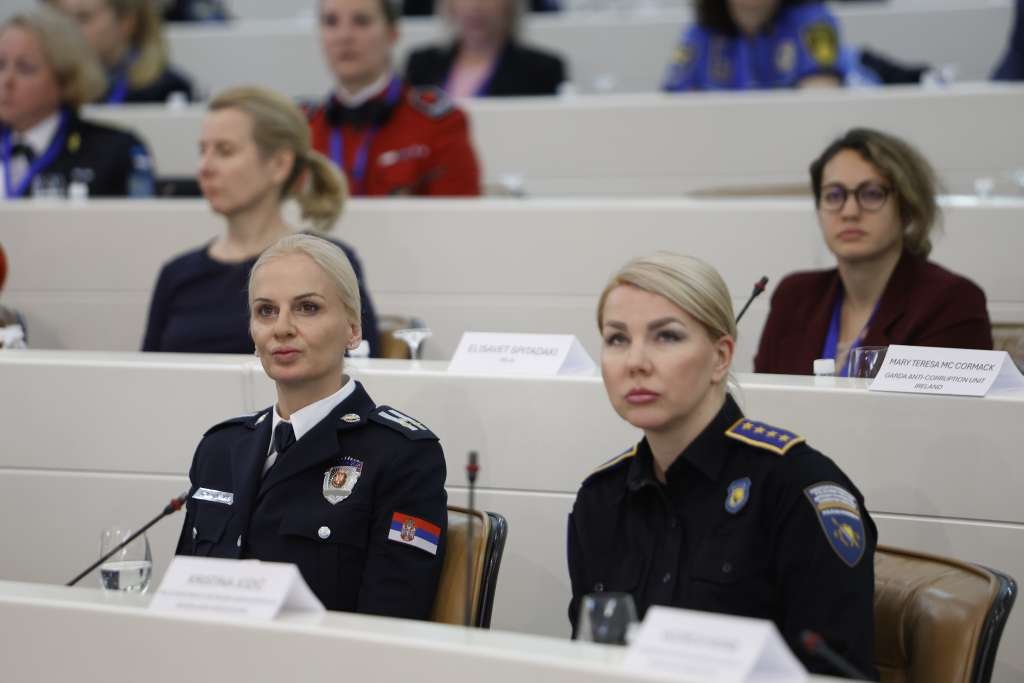
These were the conclusions reached by participants ahead of the conference titled “Advancing Women’s Leadership in Policing: Strengthening Networks Across Europe,” which was organized in Sarajevo, with the support of the European Union, by the EUPA4BiH project, the European Network of Policewomen, the Association “Network of Policewomen” of BiH, and the Directorate for Coordination of Police Bodies of BiH.
Kristina Jozić, representative of the Association “Network of Policewomen” and acting Assistant Director at the Directorate for Coordination of Police Bodies of BiH, pointed out that the role of women in police structures in BiH, as well as globally, has changed significantly in recent years.
“However, female police officers in BiH are still drastically underrepresented, as their share is around 11 percent, while only four percent of women hold leadership positions,” Jozić emphasized.
She recalled that, under the Law on Gender Equality in BiH, the less represented gender should have at least 40 percent participation in order to speak of equality, which shows that BiH is still far from that goal. She also stressed that there have been no women at the head of police agencies in BiH so far, nor female directors or commissioners, and that women are not represented in the highest police ranks, such as general inspector and chief general inspector.
Nevertheless, Jozić also pointed to certain positive developments in recent years, particularly in terms of women’s advancement in the police service. In some police bodies, the first chief female inspectors have been appointed, while the number of women holding the ranks of senior and independent inspectors is increasing.
“We are building a base from which the first female leaders, that is, heads of police institutions in BiH, could emerge in the future,” Jozić said.
Speaking about the importance of the conference, she noted that it represents an opportunity to exchange experiences with colleagues from other European countries that have made greater progress in gender equality in policing.
As examples, she cited the Netherlands, where women make up more than 30 percent of the police workforce and over 40 percent of them are in leadership positions, including leading the Ministry of the Interior; Belgium, with more than 30 percent women and around 15 percent in leadership roles; and Austria, which has set a goal of reaching 20 percent women in leadership positions by 2030.
Katarina Tomašević, a police colonel from the Ministry of the Interior of the Republic of Serbia and a member of the Cabinet of the Director of Police, said that strengthening women’s leadership and improving cooperation among female police officers are key objectives of today’s international conference.
Tomašević, who serves as President of the Network of Women in Police of the Republic of Serbia and President of the European Network of Women in Police, emphasized that an effective police system cannot be built without adequate representation of women.
“We all know that the police system cannot be modern and efficient unless women make up at least one-third of the total police force,” Tomašević stated.
Snežana Galić, Chief Inspector at the Police Administration of the Ministry of the Interior of the Una-Sana Canton and Head of the Criminal Police Sector, stressed that women in police structures have proven to be an equal and indispensable part of the system, as well as an important factor in strengthening it.
Speaking about the role of women in policing, Galić emphasized that the issue of their position should not be viewed solely through the lens of equality, but also through their contribution to the efficiency and professionalism of police structures.
“Women have shown that they can keep pace with their male colleagues and perform all police duties assigned to them, and through their professionalism and responsibility, they have proven to be an indispensable part of the police force,” she said.
She recalled that she was among the pioneers in leadership positions within her institution, noting that she was the first woman to be awarded the rank of chief inspector, after which she held a number of responsible and leadership roles.
“I hope I will not be the last and that my colleagues will also manage to reach these positions and demonstrate that they are worthy of this rank and the responsibilities it carries,” Galić said.
Speaking about the importance of the conference, she assessed that it represents a strong encouragement for future generations of female police officers.
“This conference is certainly a boost for all future chief female inspectors and leaders within police bodies,” Galić concluded.
The media were also addressed by the head of the EUPA4BiH project in BiH, Aleksander Krebl, who pointed out that the project’s work so far has revealed inadequate representation of women both in operational roles and leadership positions.
“Four percent of women in leadership positions is certainly not enough, and that is why, through the project, together with police agencies, we will do everything we can to increase that share,” Krebl emphasized.
According to him, key steps in this process include concrete recommendations that will emerge from the conference discussions.
He also noted that women play a significant role in certain segments of police work, particularly in community policing, as well as in combating human trafficking, working with children, and handling cases of domestic violence.
“The goal is clear—to increase the representation of women at both operational and leadership levels, and we will continue to monitor and develop this together with police agencies until the completion of the project’s implementation,” Krebl concluded.
This event brings together female police officers from BiH and around 20 European countries with the aim of exchanging experiences and best practices in improving gender equality and strengthening the role of women in police structures, particularly in leadership positions.
Photo: Amer Kajmović