India's most expensive film 'Ramayana' set for worldwide release
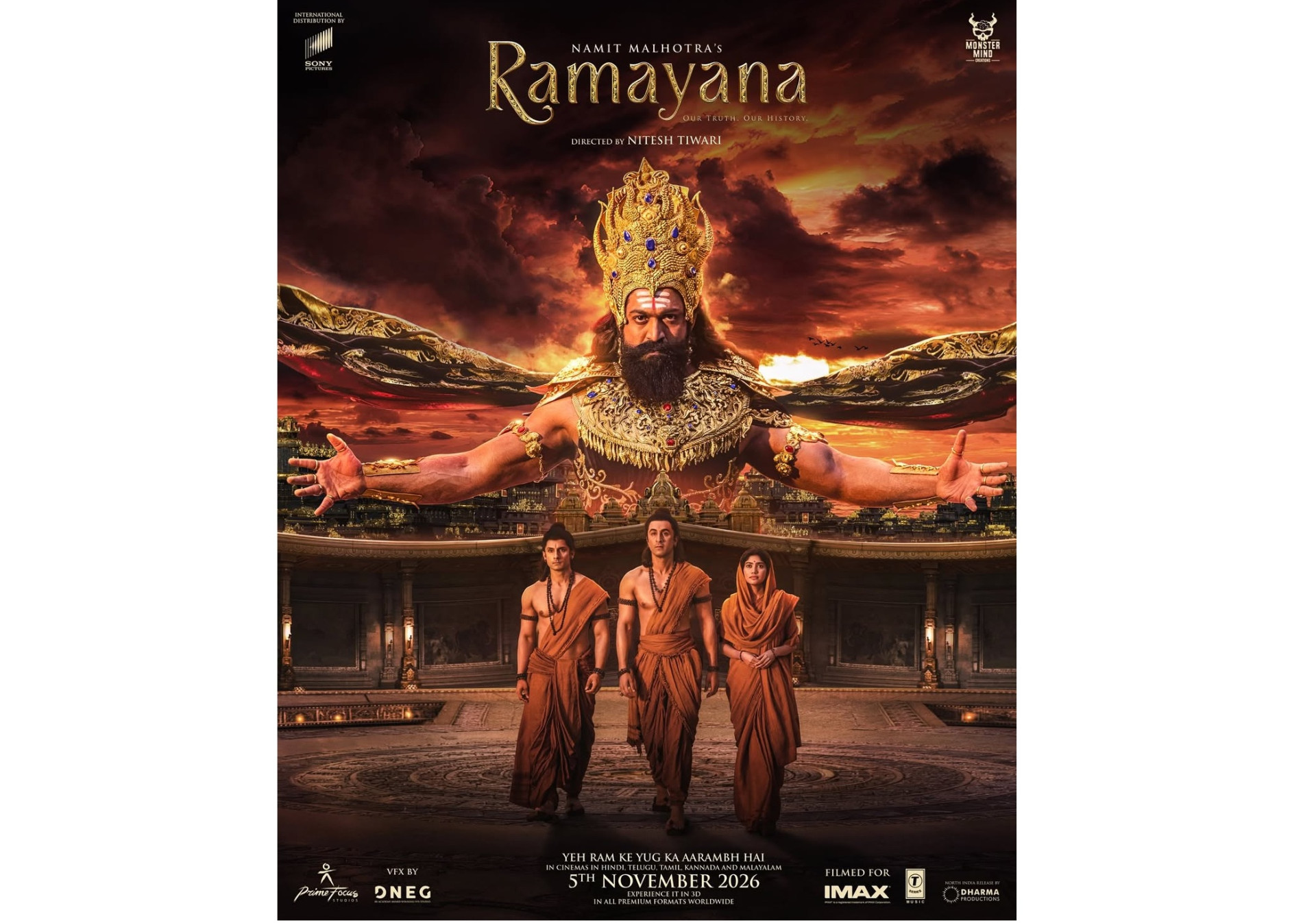
The film Ramayana: Rise of a Legend, described as the most expensive production in the history of Indian cinema and compared to The Lord of the Rings and Star Wars, will be released in cinemas worldwide on Thursday, AFP reports.
Directed by Nitesh Tiwari, the film tells one of Hinduism's most famous religious epics across two parts, with the second installment scheduled for 2028. Some have compared the production to The Odyssey, directed by British-American filmmaker Christopher Nolan, CE Report quotes AGERPRES.
Filmed with the help of artificial intelligence (AI) to synchronize dubbing in 40 languages, the production reportedly cost approximately $420 million, according to some of Bollywood's most knowledgeable industry experts.
"This is the biggest production in the history of Indian cinema," producer Namit Malhotra said, comparing it to Star Wars and The Lord of the Rings. "I believe the story, scale and spectacle of the film have the potential to attract audiences worldwide," he added.
Ramayana: Rise of a Legend (2026), which has been in development for more than a decade, brings together Oscar-winning visual effects experts and some of the biggest names in Indian cinema.
"People from all over the world have worked on this project," Bollywood superstar Ranbir Kapoor, one of the film's leading actors, told AFP ahead of its release.
Attributed to the Sanskrit poet Valmiki, the Ramayana tells the story of Prince Rama, who sets out to rescue his wife, Sita, from the clutches of the demon king Ravana, accompanied by his brother Lakshman and Hanuman, the monkey god.
Another Indian cinema superstar, Yash, plays Ravana in the film, which features spectacular battle scenes and an abundance of digital visual effects, including flying elephants and gigantic demons.
The visual effects were created by London-based studio DNEG, led by Indian producer Namit Malhotra. The studio has won a total of eight Academy Awards for films including Inception and Dune.
The film's soundtrack, produced in two versions — Hindi and English — was composed by Oscar winners Hans Zimmer and A.R. Rahman.
Dominated by Bollywood, India's film industry produces approximately 2,000 movies a year and is gradually expanding its international influence, particularly through the growing availability of Indian productions on streaming platforms such as Netflix and Amazon Prime Video.
Produced by Prime Focus Studios, Namit Malhotra's Mumbai-based company, and Monster Mind Creations, actor Yash's production company, with Sony Pictures handling international distribution, the film moves away from certain traditional Bollywood elements, such as elaborate song-and-dance sequences.
However, many of the industry's essential ingredients remain, including melodrama, romance, action and spectacular landscapes.
"It is a very original retelling of a very original story from India, and we have made no compromises in that regard. It remains authentically Indian," Malhotra said.
For director Nitesh Tiwari, "there is a certain timelessness in the emotions and values conveyed by the Ramayana, and that is exactly what we wanted to share with the rest of the world."
Actress Sai Pallavi plays Sita, portraying her as a fearless and strong-willed woman. Like other cast members, she said she felt a great sense of responsibility taking on the role, as many Indians have "a very personal connection with these characters."
The epic, believed to have been composed in the fifth century BC, has been retold and reinterpreted across South and Southeast Asia over the centuries.
Rama remains one of Hinduism's most beloved heroes and is worshipped as an incarnation of the god Vishnu.
The prince's name is also linked to a contemporary political controversy. In 1992, Hindu nationalist militants demolished a 16th-century mosque in the northern Indian city of Ayodhya, at a site they believed to be the location of Rama's palace. The demolition triggered years of bloody violence across India, resulting in at least 2,000 deaths, most of them among the Muslim community.
In 2019, India's Supreme Court approved the construction of a temple dedicated to Rama on the site. The temple was inaugurated with great ceremony by Prime Minister Narendra Modi in 2024, ahead of the general election in which he secured another term in office.
The Ramayana has already been adapted countless times across different media. Among its best-known adaptations is a hugely successful television series broadcast by public broadcaster Doordarshan in the late 1980s.
At a time when visual representations of Rama were still relatively rare, the series was watched passionately by millions of Indians. Some political experts attribute at least part of the rise of Hindu nationalists to its influence.
The political embodiment of the movement, Narendra Modi's Bharatiya Janata Party (BJP), had just two members in India's lower house of Parliament in 1984. Its representation rose to 85 seats in 1989 and 120 in 1991, as the Ayodhya dispute became a major national issue.
The Ramayana has inspired countless legends and epic traditions far beyond the Indian subcontinent, appearing in numerous languages. Its stories and characters are featured in dances, theatrical performances and puppet shows, including in Thailand and Cambodia.
The epic also plays a central role in several major religious celebrations in India, particularly Dussehra, which marks Rama's victory over Ravana, and Diwali, which is associated with Rama's return to Ayodhya after his exile.
Photo: Instagram/ranbir__kapoor82