French audiences shocked by Gaza documentary NAZA
Audiences in France who watched NAZA, a documentary documenting the killing of civilians by Israel in Gaza, said they were shocked by how Israeli soldiers reduced Palestinians killed in Gaza to numbers rather than seeing them as human beings.
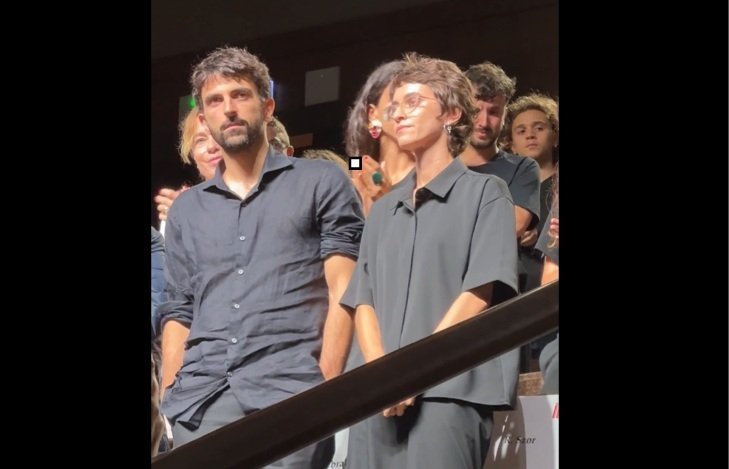
The documentary NAZA, produced by British newspaper The Guardian and directed by Oscar-winning filmmakers Yuval Abraham and Rachel Szor, was screened in French cinemas on October 12–13, CE Report quotes Anadolu Agency.
The documentary attracted considerable interest on its opening day in Paris, with most tickets sold.
French viewers who watched NAZA at two different cinemas in Paris shared their thoughts on the film with an Anadolu Agency (AA) correspondent.
“I think the directors are extremely courageous”
A French viewer named Kenzi said the documentary explained the meaning of NAZA, a term referring to “civilian casualties,” and described the film as deeply shocking.
Kenzi noted that Israeli soldiers in the documentary frequently discussed numbers and calculations, emphasizing that almost all these figures represented people killed in Gaza.
Pointing out that the documentary repeatedly referred to the dead, Kenzi said:
“We know what is happening there (in Gaza), we talk about it and we see it, but not from this perspective. Here, seeing Israeli soldiers talk about it is extremely shocking. Sometimes we sensed some regret, and sometimes we did not. They spoke in a very detached manner. That really shook me. I think the documentary was very well made, and it went by very quickly.”
Kenzi noted that the soldiers compared their actions in Gaza to a video game, adding: “They talk about using artificial intelligence to kill people. At a certain point, we see that they are not calculating civilian casualties, the NAZAs, or the number of people they are going to kill.”
Kenzi said the Israeli soldiers repeatedly referred to a “system,” adding: “It was as if they had been brainwashed and convinced that they were on the right side, until they themselves realised that what they were doing was despicable.”
According to Kenzi, the soldiers repeatedly said they had wanted only to eliminate the enemy.
“They openly said that the enemy consisted of children aged between 3 and 6 and women who had done nothing to deserve this. They usually wanted to kill an enemy leader and ended up killing his entire family, except for him,” Kenzi said.
Commenting on the Israeli directors of NAZA, Kenzi added: “I think the directors are extremely courageous for undertaking such a project.”
“We saw that the documentary affected everyone in the cinema”
A 23-year-old French viewer named Iona said: “I think this film is very important. It is crucial to gain this perspective because we usually hear the testimonies of victims, whereas here the perpetrators themselves are putting their thoughts about the situation in Gaza into words.”
Iona stressed that the documentary was important for helping people understand what was really happening in the region and take the right side of history. She said the words used by the Israeli soldiers and the questions put to them had deeply affected her.
“The soldiers did not hesitate to use the word genocide. They were asked whether this was genocide, and they said, ‘Yes,’” Iona said, describing the soldiers' failure to see the victims in the region as human beings as “crazy.”
Iona noted that the documentary showed people in Tel Aviv continuing their normal lives while people were dying in Gaza.
“Everything in the documentary is extremely striking,” she said.
Iona stressed the importance of making films of this kind and allowing everyone to speak.
“Everyone was in the cinema, young people and older people. We saw that the documentary affected everyone in the audience. There was silence at the end. It was extremely moving,” she said.
Iona urged everyone to watch the documentary, concluding with the words: “Free Palestine.”
“The reduction of human beings to numbers shocked me the most”
Adam, a 27-year-old French viewer, said: “For the first time, I was left speechless from beginning to end while watching a documentary or a film. I was aware of the historical and political issues behind it, as well as the mass killings and genocide taking place in Palestine.”
Adam said the testimonies of people involved in the system were both shocking and gave the atrocities a tangible reality.
“I think the documentary is very well made overall and effectively raises various questions about the dehumanisation of victims through the word ‘NAZA’. The victims, or what they like to call ‘civilian casualties’, are reduced to numbers. The reduction of human beings to numbers was what shocked me the most,” he said.
Adam noted that the mass killings in Palestine did not begin in October 2023 and described the documentary's directors as extremely courageous, despite pressure from the Israeli government.
“One speaker recognised the grave situation unfolding in Gaza”
A French viewer named Yacine said the emphasis on numbers was one of the aspects of the documentary that stood out most to him.
“There was a speaker (Yuval Abraham) who appeared neutral and recognised the grave situation unfolding in Palestine and Gaza,” Yacine said, adding that the soldiers, by contrast, had been conditioned to think in a particular way.
Yacine highlighted the stark contrast between footage showing people in Tel Aviv living their everyday lives in safety and tranquillity and the images of war and destruction in Gaza shown at the end of the film.
“When we see the images from Gaza, we get the impression that there is no life left there, and that people are simply trying to survive and do whatever they can,” he said.
Photo: X/video