4,000-year-old dog paw prints discovered at Bronze Age site in Türkiye
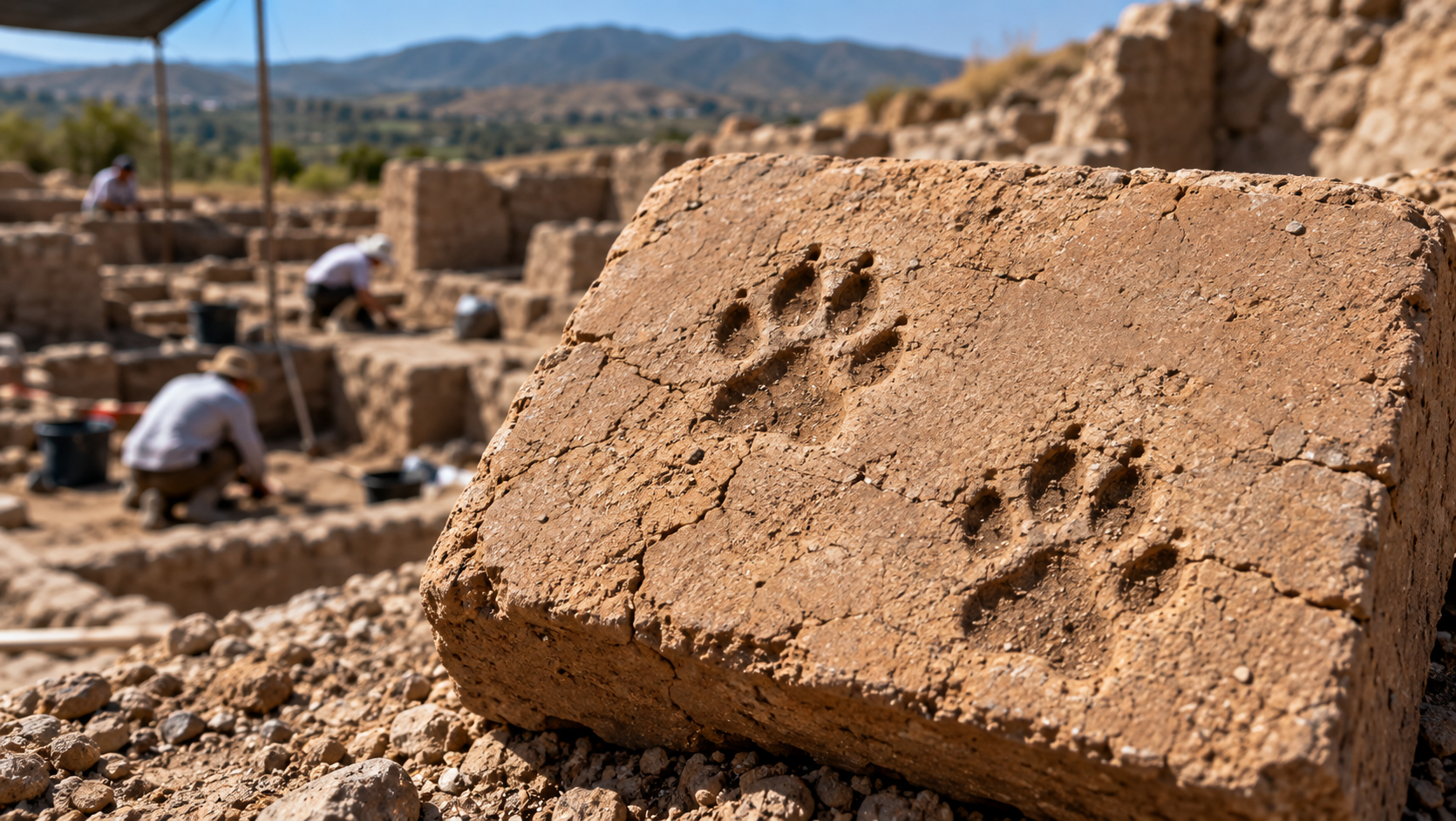
Archaeologists have uncovered approximately 4,000-year-old dog paw prints preserved in a mudbrick at Tavşanlı Höyük, an important Bronze Age settlement in western Türkiye, offering a rare glimpse into everyday life thousands of years ago.
Türkiye's Minister of Culture and Tourism, Mehmet Nuri Ersoy, announced the discovery on October 26, revealing that the impressions were found during excavations in the Kütahya province, CE Report quotes Anadolu Agency.
The paw prints were preserved on a mudbrick recovered from the rubble of a building destroyed by fire during the Bronze Age.
According to the ministry, the brick had originally formed part of a house wall, but before it was used in construction, a dog had walked across its surface while the clay was still wet.
As the mudbrick dried and hardened, the animal's footprints became permanently embedded in the material, preserving a brief moment of life from nearly four millennia ago.
Ersoy described the discovery as an extraordinary reminder of the people and animals that once inhabited the ancient settlement.
He emphasized that excavations at Tavşanlı Höyük are uncovering not only buildings and historical artifacts but also small, unexpected details of everyday life.
The minister also thanked Professor Erkan Fidan, who has directed excavations at the site since 2021, and the archaeological team responsible for the discovery.
Ancient construction techniques preserved footprints
According to the Turkish Ministry of Culture and Tourism, mudbricks were commonly produced during the Bronze Age by mixing soil, water and straw.
The mixture was placed into molds and left to dry naturally under the sun before being used as a construction material.
In this case, a dog apparently stepped onto one of the freshly prepared bricks before the clay had hardened.
The impressions survived the drying process, and the brick was later incorporated into the wall of a residential building.
When the structure was destroyed by fire, the brick became buried beneath collapsed debris, where it remained for thousands of years.
Archaeologists eventually recovered the artifact during their ongoing excavations, revealing the animal's preserved footprints.
Although simple in appearance, the discovery provides valuable evidence of daily life in the ancient community.
It also offers a connection to the past, capturing an ordinary event that occurred long before the development of modern cities and societies.
Tavşanlı Höyük reveals Bronze Age history
Tavşanlı Höyük is considered one of the largest Bronze Age settlements in western Anatolia.
Excavations have been underway since 2021 under the direction of Professor Erkan Fidan, uncovering architectural remains, artifacts and evidence of the settlement's development.
Previous discoveries have helped researchers understand the community's construction techniques, economic activities and connections with other ancient settlements.
The latest finding adds another dimension to that research by documenting an interaction between an animal and the materials used by the settlement's inhabitants.
Unlike monumental structures or valuable objects, the paw prints preserve a small, accidental detail of daily life that would otherwise have disappeared.
The discovery illustrates how even ordinary building materials can provide important archaeological evidence about ancient communities.
Researchers hope that continued excavations at Tavşanlı Höyük will reveal further details about the lives, traditions and activities of people who inhabited the region thousands of years ago.
Photo: Chat GPT