Private donor funds restoration of Pompeii villa
The Villa of Marcus Fabius Rufus, a magnificent residence within the Pompeii archaeological complex, will be restored with the help of a private donor investing 1.4 million euros in the project.
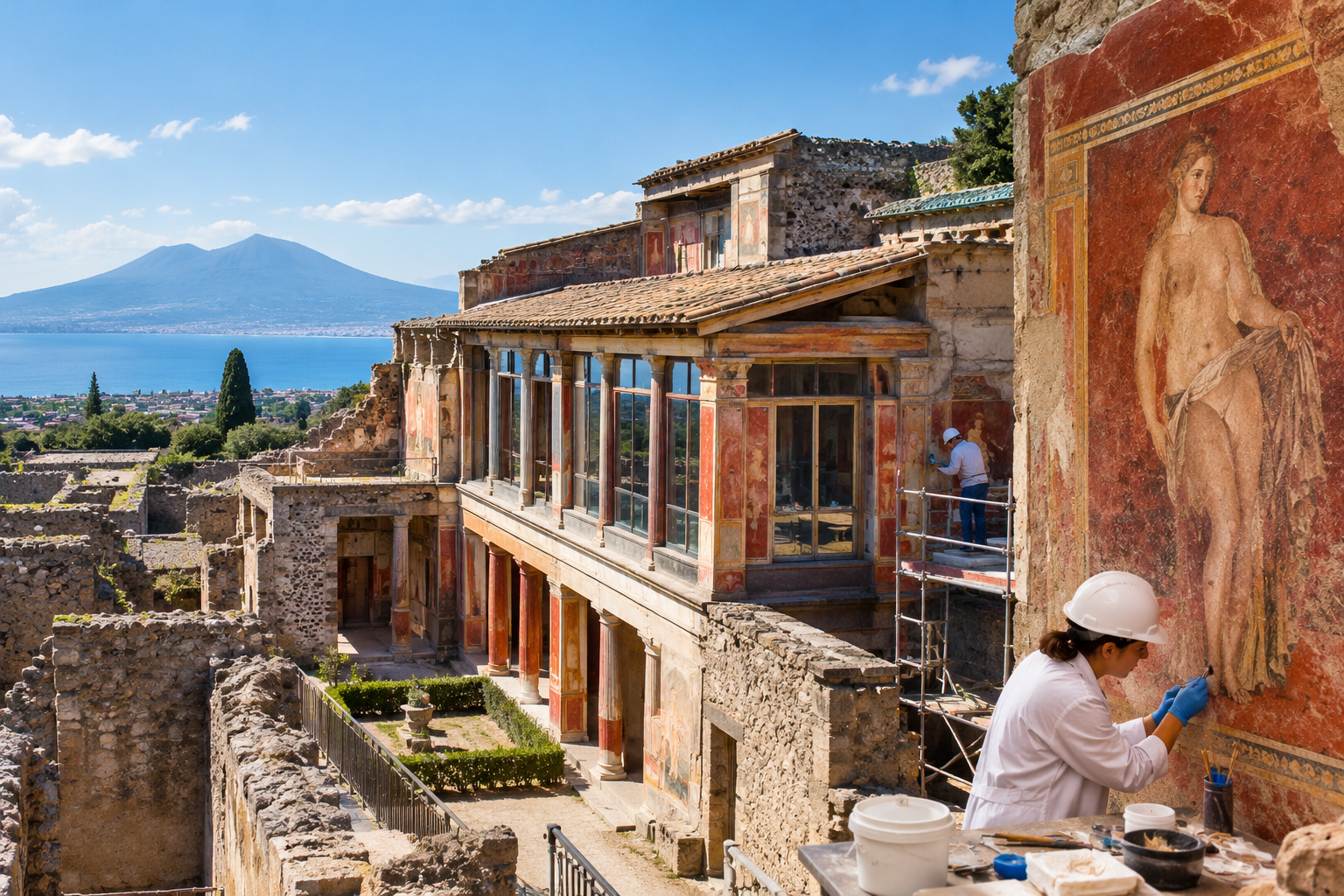
Inspired by Rome’s imperial palaces, the villa was built on the ruins of ancient Pompeii’s walls. It is renowned for its façade featuring large windows overlooking the bay, fitted with wooden frames and, most likely, glass panes, CE Report quotes AGERPRES.
The restoration project, costing more than 1.4 million euros, is being fully funded by a private benefactor, the company PompeiAR.
The sponsorship agreement was recently signed by Gabriel Zuchtriegel, director of the Pompeii Archaeological Park, and Frank Hoefer, the owner of the sponsoring company.
Hoefer, an entrepreneur originally from southern Germany, contacted the Pompeii Archaeological Park after reading a 2023 book by Zuchtriegel entitled Pompeii: The Enchanted City.
“I first visited Pompeii in 1974, at the age of 16, and was immediately impressed by the charm of this ancient city — a place where a model of social life emerges that is, in some ways, very close to our own, yet at the same time extremely different,” Hoefer said.
“Visitors who explore these villas with a keen eye are rewarded with countless details inspired by everyday life, art and ancient craftsmanship.”
“The restoration of the spectacular residence of Marcus Fabius Rufus — which has been closed to visitors since 1980 — and its opening to the public is a project we find truly fascinating. I also see that Pompeii is very open to innovative conservation projects and public involvement,” he added.
“However, bringing the Archaeological Park’s ambitious projects to fruition requires additional support, and I would like to help find other funders,” Hoefer said.
The restoration work, which has already begun, focuses on the frescoes, including the famous Venus of Pompeii, located inside a ritual “chapel” within the residence. It follows structural stabilisation and excavation work carried out by the park administration between 2021 and 2023.
The Villa of Marcus Fabius Rufus, together with the neighbouring Casa di Castricius and Casa del Bracciale d’oro, stands along the edge of Pompeii’s ancient fortifications. The complex has no fewer than four levels, interconnected by a labyrinth of corridors, staircases and passageways encompassing both formal reception areas and functional spaces.
The villa’s owner, possibly a magistrate from Pompeii itself or a freed slave from an imperial household, was probably considerably wealthy, given that he built an urban residence unparalleled in Pompeii.
Several victims of the eruption of AD 79 were also discovered in this complex of villas. Some remain where they took their last breaths: three victims on the staircases of the Villa of Marcus Fabius Rufus, another three in the so-called Casa di Castricius, discovered during excavations in 1961, and further victims found in the Casa del Bracciale d’oro in 1974.
“We are currently working on a project to improve the site,” Zuchtriegel said.
“We are also using digital technology to help convey the complexity of this incredible labyrinth.”
“Sometimes it feels as though you are in a 19th-century Neapolitan palace, but in fact, it is a Roman house dating back 2,000 years. We intend to open part of it around Christmas and welcome guided groups,” he added.
Photo: Chat GPT