Historic Turkish cemetery found in Küçükanfarta village
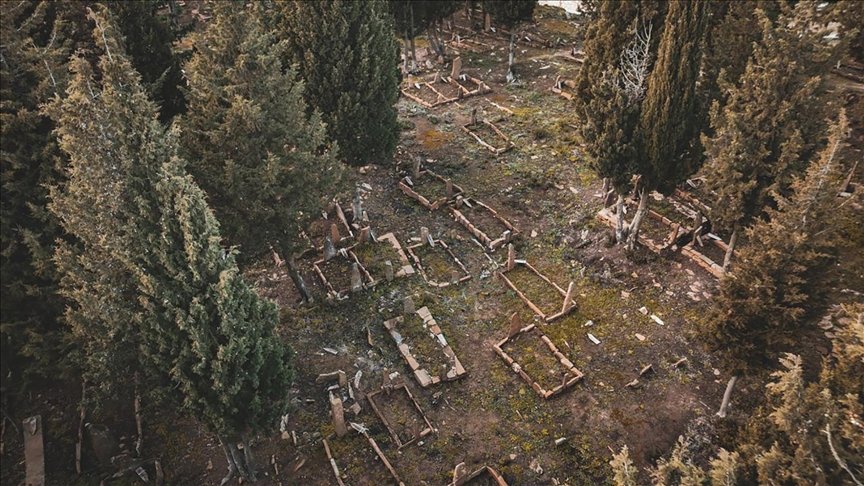
During work carried out at the Küçükanafarta Historical Turkish Cemetery in Küçükanafarta village, part of the Eceabat district, 8,731 graves were discovered across an area of 100 decares, resembling the burial traditions of Central Asian Turks.
İsmail Kaşdemir, President of the Gallipoli Historical Site of the Çanakkale Wars, told journalists in Küçükanafarta that a new page in Turkish history has been opened with the discovery of this cemetery. He said the graves belong to the first Turks—namely raiders (akıncılar)—who crossed into Rumelia, and were identified at the Küçükanafarta Historical Turkish Cemetery, CE Report quotes Anadolu Agency.
Emphasizing that the graves uncovered should be regarded as the seal of the Turkish nation in historical terms, Kaşdemir said, “Burials here were carried out in a manner similar to those across the Turkish-Islamic world. Just as the Ahlat cemetery represents Turkish presence in Anatolia, the Küçükanafarta Historical Cemetery holds the same importance for Turkish presence in Rumelia, the Balkans, and Europe.”
Kaşdemir explained that after identifying the cemetery, the Historical Site Authority began detailed work, consulting art historians, historians, and universities for documentation and expert opinions. They determined that the cemetery dates back to the 1300s and belongs to the first Turks who entered Rumelia. He noted that about three-quarters of the work in the 100-decare area has already been completed and that restoration will be finalized soon.
He added that once completed, the cemetery will become an important destination for visitors. While the martyrs’ cemeteries of the Gallipoli Historical Site are well known, revealing Turkish presence from the 1300s will serve as a crucial historical document. Kaşdemir stressed that each grave is treated with great care and said that when finished, the site will stand as an Ahlat-like cemetery on Thracian soil.
Providing further details, Kaşdemir said extensive scientific studies were conducted, including carbon dating, analysis of gravestones, and examinations by art historians. The grave forms were found to be similar to those in the Turkish-Islamic geography, with tall gravestones rising like balbal stones, which hold great significance.
Referring to one of the oldest graves studied at the site, Kaşdemir noted that it measures approximately 3–4 meters above ground with nearly 2 meters below the surface. Based on carbon tests, burial forms, and historical evaluation, the cemetery was confirmed to belong to akıncı Turks from the 1300s.