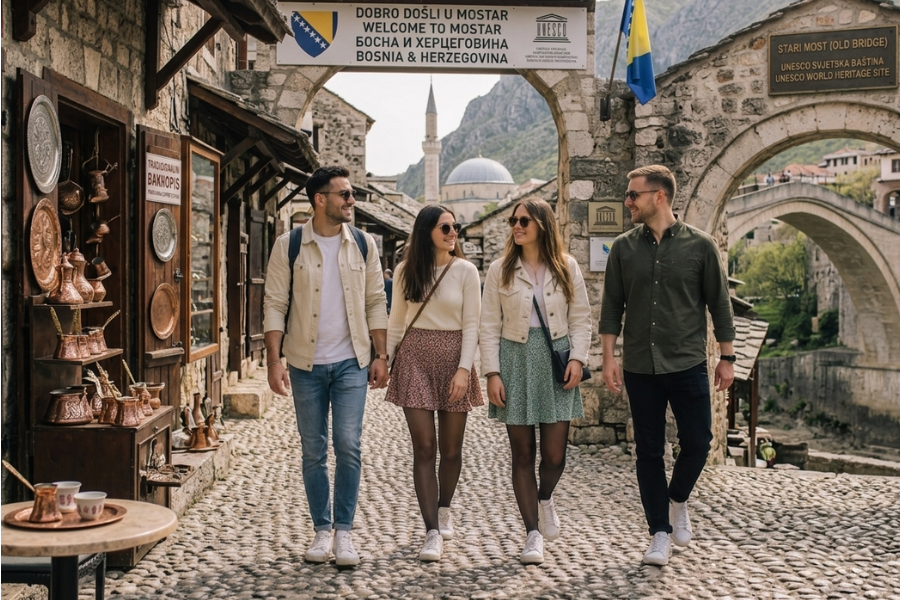
Ministry: Tourism in Bosnia remains strongly dependent on foreign visitors - EXCLUSIVE
Tourist arrivals and overnight stays in March 2026 recorded a notable increase compared to both February 2026 and March 2025, indicating a recovery and stabilization of tourism flows in the Federation of Bosnia and Herzegovina. The increase is primarily attributed to seasonal factors, as March marks the transition into the pre-spring tourism period following a traditionally weaker February.
This was said by the source in the Federal Ministry of Environment and Tourism of Bosnia and Herzegovina in an exclusive interview with CE Report.
Growth in domestic tourism played a significant role, with higher participation in short and frequent trips. At the same time, foreign tourist activity showed signs of recovery, contributing to overall demand. Favorable calendar effects, including weekend distribution and travel timing, further supported the increase in tourist movements.
The growth in overnight stays outpaced the increase in arrivals, suggesting a modest extension in the average length of stay. This indicates improved demand quality and potentially stronger destination appeal.
Overall, the upward trend in March 2026 reflects a combination of seasonal recovery, strengthened domestic demand, and stabilizing international tourism flows. While part of the increase is linked to a lower comparative base in February, the indicators point to a positive trajectory for the upcoming period.
Recent months show that tourism in the Federation of Bosnia and Herzegovina remains strongly dependent on foreign visitors, while domestic tourism has gradually strengthened. Domestic tourists are increasingly important in sustaining overall performance, particularly during weaker periods, while foreign tourists continue to dominate in terms of total arrivals and overnight stays.
This indicates a gradual structural rebalancing toward a more resilient and diversified tourism base.
Although the number of registered beds has declined, current measures are focused not only on increasing capacity, but also on formalizing existing accommodation supply, improving quality standards, and diversifying accommodation types.
This approach aims to create a more sustainable and competitive tourism sector rather than relying solely on numerical growth.
Future growth in tourism arrivals in the Federation of Bosnia and Herzegovina is expected to be driven primarily by regional markets, supported by key European countries with strong air connectivity, and complemented by Türkiye and rapidly growing Middle Eastern markets.
In addition, long-haul markets such as China and the United States represent emerging opportunities with significant growth potential.
In March 2026, the net bed occupancy rate in hotels and similar accommodation establishments in the Federation of Bosnia and Herzegovina stood at 16.8%.
Current occupancy levels remain modest due to seasonal factors; however, strategies are focused on reducing seasonality, increasing year-round demand, and improving market positioning.
The objective is not only to achieve higher occupancy rates, but also to ensure more stable and sustainable utilization of accommodation capacities.
Photo: AI
This interview was prepared by Julian Müller