September brings major science advances
From evidence that some African elephants consume specific medicinal plants to Anthropic’s Claude model contributing to the discovery of a new enzyme system, September saw a series of notable developments in science and technology.
Advances in science and technology continue to shed light on mysteries hidden in the depths of the universe while offering new insights and potential solutions to challenges facing humanity, CE Report quotes Anadolu Agency.
Anadolu compiled some of the most notable scientific developments and discoveries reported in September.
Developments in space and technology
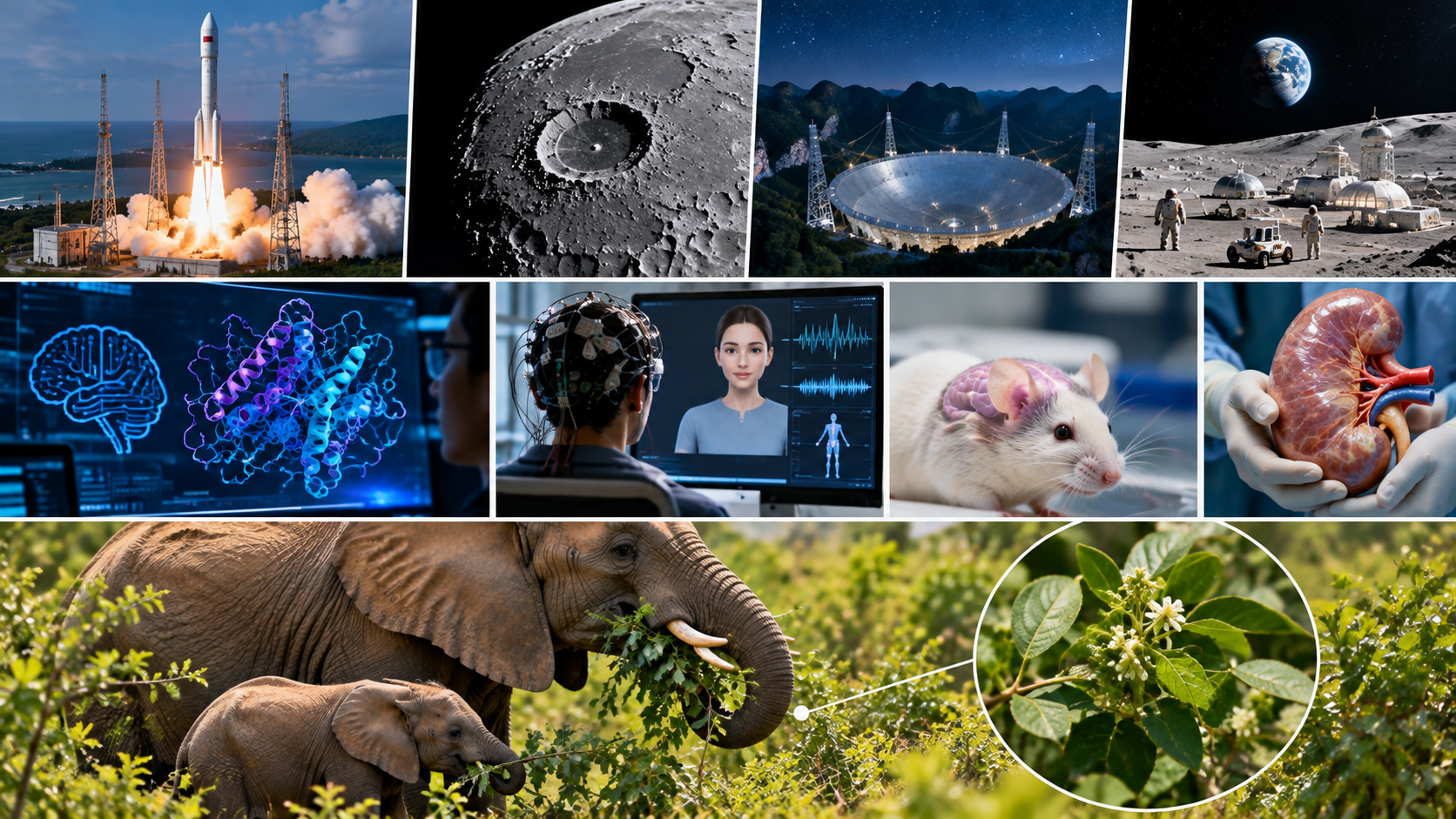
China on September 25 launched the 26th group of internet satellites that will form part of its Guowang constellation in Low Earth Orbit.
The satellites were launched aboard a Long March 8A rocket from a commercial spacecraft launch site on Hainan Island.
The satellites reached their planned orbit, with the launch marking the 669th mission carried out using the Long March rocket series.
Massive crater detected on the Moon
NASA’s Lunar Reconnaissance Orbiter (LRO) has detected a massive crater on the Moon created by a powerful impact approximately two years ago.
The crater was formed when an asteroid or comet fragment struck the Moon’s near side in May 2024.
The steep-sided crater measures approximately 222 meters in diameter and 43 meters in depth.
Described as the largest impact crater known to have formed recently in the Solar System, it was named after Thomas McGetchin, former director of the Lunar and Planetary Institute in Houston.
The newly discovered crater is around three times larger than the previous crater detected by NASA’s Lunar Reconnaissance Orbiter a decade ago and is wider than the Colosseum in Rome.
More than 1,300 pulsars discovered
China’s Five-hundred-meter Aperture Spherical Telescope (FAST) has detected more than 1,300 neutron stars known as pulsars since it became operational in 2016.
Pulsars rotate rapidly and emit powerful electromagnetic radiation due to their intense magnetic fields.
FAST, the world’s largest single-dish radio telescope, has detected more pulsars over the past decade than all other telescopes worldwide combined.
Moon’s water resources may not sustain large settlements for long
Scientists have found that although the Moon is believed to contain significant quantities of water, those resources may not be sufficient to sustain a permanent settlement inhabited by millions of people.
A study published in Frontiers in Space Technologies calculated the water requirements of lunar settlements of various sizes based on an estimated one billion tonnes of water potentially suitable for human use.
Taking into account water needed for human consumption, sanitation, food production, rocket fuel and oxygen production, researchers calculated that a lunar city of one million people could exhaust available water resources in less than 2.5 years.
Researchers said lunar water reserves may therefore be insufficient to support a permanent large-scale settlement. Even with extensive recycling, they estimated that the resources could last no more than 100 years.
Anthropic’s Claude helps discover new enzyme system
US-based artificial intelligence company Anthropic said its Claude model contributed to the discovery of a new enzyme system.
A research team established by the company to conduct biological research with Claude instructed around 950 Claude agents to search a large database of DNA sequences for “new and interesting examples” of reverse transcriptase enzymes, which synthesize DNA from RNA.
The research team was involved only in providing instructions and conducting laboratory work.
After approximately 21 hours of searching, one of the agents identified an unusual finding.
Subsequent laboratory experiments showed that the finding pointed to a previously uncharacterized enzyme system associated with viruses that infect bacteria.
Developments in health and biology
The US National Institutes of Health (NIH) announced the development of a new brain-computer interface capable of simultaneously conveying speech and body language from patients with paralysis.
Scientists succeeded in translating brain signals from three patients with paralysis into the actions of a virtual character using a machine-learning-based brain-computer interface.
Through specialized connections attached to the patients, the system simultaneously transfers brain signals associated with speech and body movements to a digital avatar.
The technology could particularly help people with ALS communicate more quickly.
While previous devices had separately succeeded in transmitting speech or body movements, researchers said the new system is the first to achieve both simultaneously.
Mice developed with brains containing large amounts of human tissue
Researchers at Stanford University have developed mice whose brains consist of approximately 50% human tissue by transplanting human brain cells into the animals.
Scientists genetically restricted the development of the cerebral cortex and hippocampus in the mice, creating space in which human brain tissue could grow.
Cells obtained from human brain organoids, which were produced in laboratories by reprogramming donated skin cells, were then transplanted into the brains of newborn mice.
Around 100,000 human brain cells were used in each injection. Following transplantation, approximately four million human brain cells developed in the mice, accounting for roughly half of their brain volume.
Patient lives 271 days without dialysis using genetically modified pig kidney
A US patient who lived for 271 days without dialysis after receiving a genetically modified pig kidney subsequently received a kidney from a human donor, marking a medical milestone.
Tim Andrews, who had end-stage kidney disease associated with type 2 diabetes, survived for 271 days with the genetically modified pig kidney while awaiting a human donor organ.
Andrews received the pig kidney transplant at a Massachusetts hospital in January 2025, with the organ allowing him to remain off dialysis for 271 days.
African elephants may use medicinal plants
Scientists have found evidence suggesting that African elephants may use medicinal plants to treat themselves and their calves when they become ill.
Researchers observed that some elephants consumed specific plant species when unwell and that mothers may also provide such plants to their calves.
Researchers identified 35 plant species used by the elephants, 25 of which are also used for medicinal purposes by local communities.
A wildlife officer reported that elephants chew the leaves of a locally known plant called “Angurweet,” used to treat conditions including stomach pain, together with the roots of certain trees to create a mixture. Mothers were observed giving the mixture to their calves along with breast milk.
Photo: Chat GPT