Turkish scientist suggests Sun swallowed planet billions of years ago
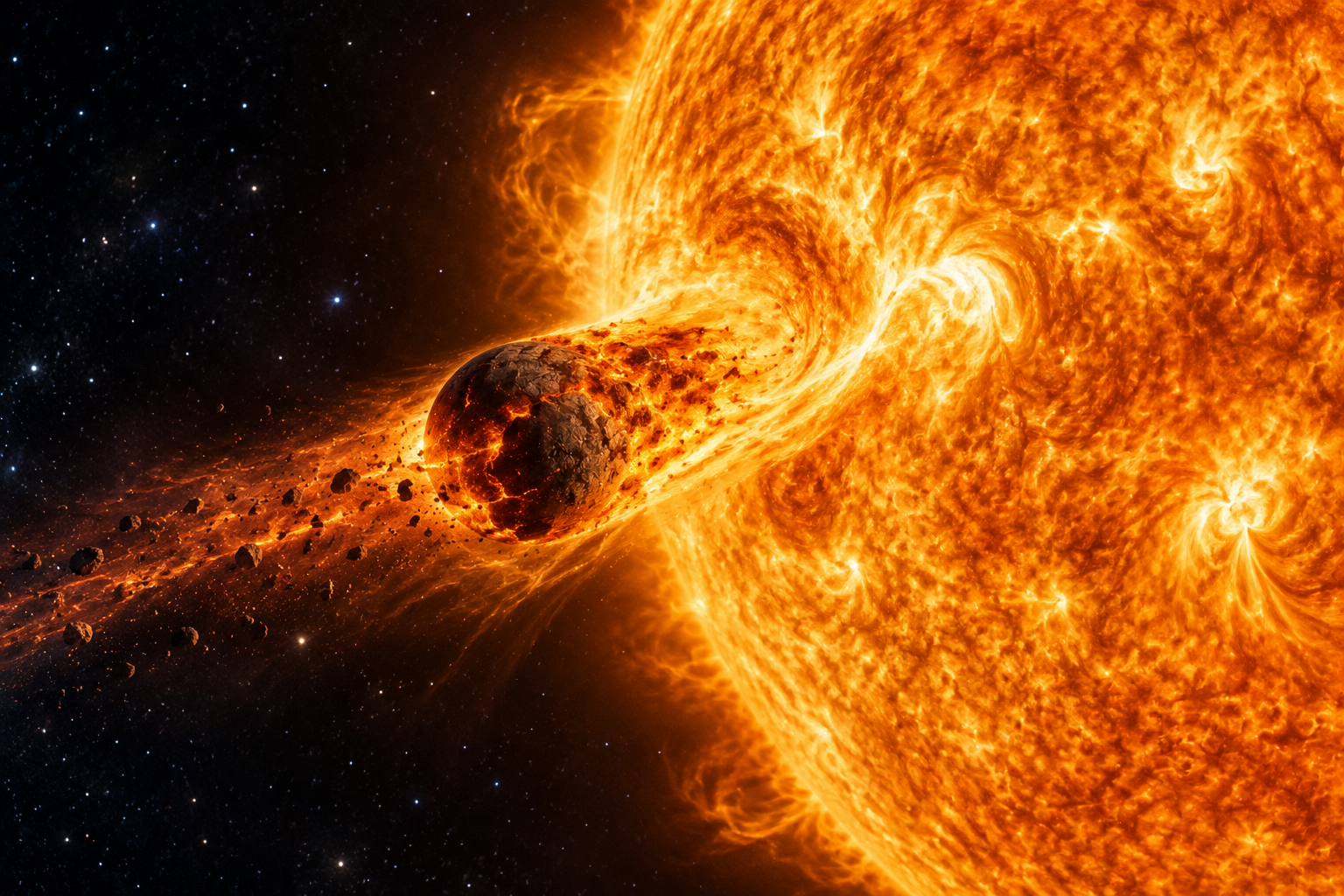
A study by Professor Mutlu Yıldız of Ege University’s Department of Astronomy and Space Sciences suggesting that the Sun may have engulfed a rocky planet billions of years ago has been published in an international peer-reviewed astronomy journal.
According to a statement from the university, the research suggests that the Sun may have swallowed a rocky celestial body with a mass equivalent to between five and 10 Earths. The study was published in the Monthly Notices of the Royal Astronomical Society (MNRAS), a leading peer-reviewed journal in astronomy and astrophysics, CE Report quotes Anadolu Agency.
Yıldız said the research was prompted by discrepancies between existing theories about the Sun and precise observations made from space.
Scientists have long sought to explain why the speed of sound propagation inside the Sun and the amount of lithium on its surface are lower than expected, he said.
“My research shows that a planet several times larger than Earth may have fallen into the young Sun and left a permanent chemical signature inside it,” Yıldız said.
“When I modeled the Sun’s evolution from the past to the present on a computer and compared the results with observations of its internal structure, I found that the possibility of planetary engulfment explains a large part of these discrepancies that scientists have struggled with for years.”
Yıldız tested different scenarios through computer simulations and named the hypothetical lost celestial body that produced the most consistent results “Dev Dilek.” The object was estimated to have had a mass about 5.6 times that of Earth.
Explaining the name, Yıldız said “Dev” refers to the planet’s large size, while “Dilek” is linked to an old Turkish name associated with Mercury.
“Even if the planet itself disappeared, the models show that the traces it left behind could have been preserved in the heart of the Sun for billions of years,” he said.
Yıldız stressed that the study provides strong support for a hypothesis rather than definitive proof that the Sun swallowed a planet.
“It would not be correct to say that we have proven with 100% certainty today that the Sun swallowed a planet,” he said.
“However, if the chemical signatures indicated by the models can be confirmed through future observations, we could obtain very strong evidence that such an event occurred billions of years ago. The next fundamental question is whether we can independently detect these fingerprints.”
Photo: Chat GPT