OpenAI claims AI solved 90-year-old mathematics problem
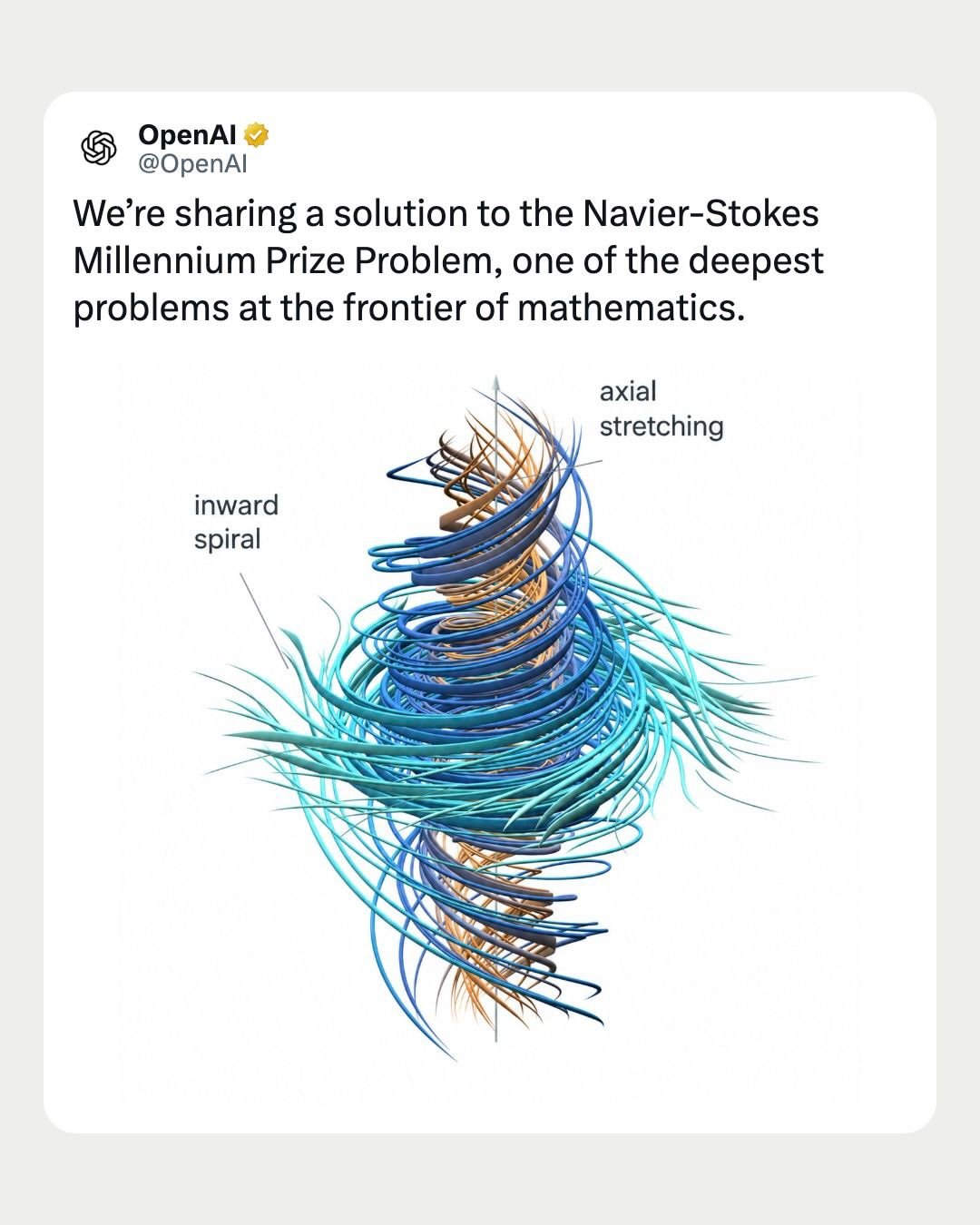
U.S.-based artificial intelligence company OpenAI has announced that it solved an advanced mathematics problem that had remained unsolved for 90 years, using a next-generation AI model, in just 88 hours.
OpenAI, known for its work in artificial intelligence, said in a statement that it had solved a mathematical problem that had remained unresolved for decades by using thousands of AI agents, CE Report quotes Anadolu Agency.
The company said it used a group of approximately 10,000 AI agents capable of carrying out tasks with a degree of autonomy to solve the complex mathematical problem in 88 hours.
The problem concerns the Navier-Stokes equations, which describe the motion of fluids. OpenAI emphasized that the problem had remained unsolved for 90 years.
OpenAI described the solution it obtained as a “milestone” demonstrating the rapid development of AI agents.
The solution has not yet been independently verified and has not been officially recognized by the U.S.-based Clay Mathematics Institute, which awards the international “Millennium Prizes” in mathematics.
130 billion data points used
OpenAI said it began developing the mathematical model in question at the end of August and used approximately 3 million messages and 130 billion data points related to the Navier-Stokes equations.
The company said 10,000 AI agents were actively involved in solving the problem and that, after 88 hours of work, they arrived at a solution to the problem concerning the motion of fluids.
Two New York University mathematicians challenge OpenAI’s claim
Tristan Buckmaster, a mathematics professor at New York University, said in a statement that he and mathematician Levent Alpöge, who works at Anthropic, had also been working on solving the problem and claimed that their research had been used by OpenAI.
Buckmaster alleged that OpenAI only began working on the mathematical problem after his and Alpöge’s research had been published.
In response to these claims, OpenAI congratulated Buckmaster and Alpöge on their work but argued that Buckmaster’s claim was incorrect.
Photo: Instagram/openai