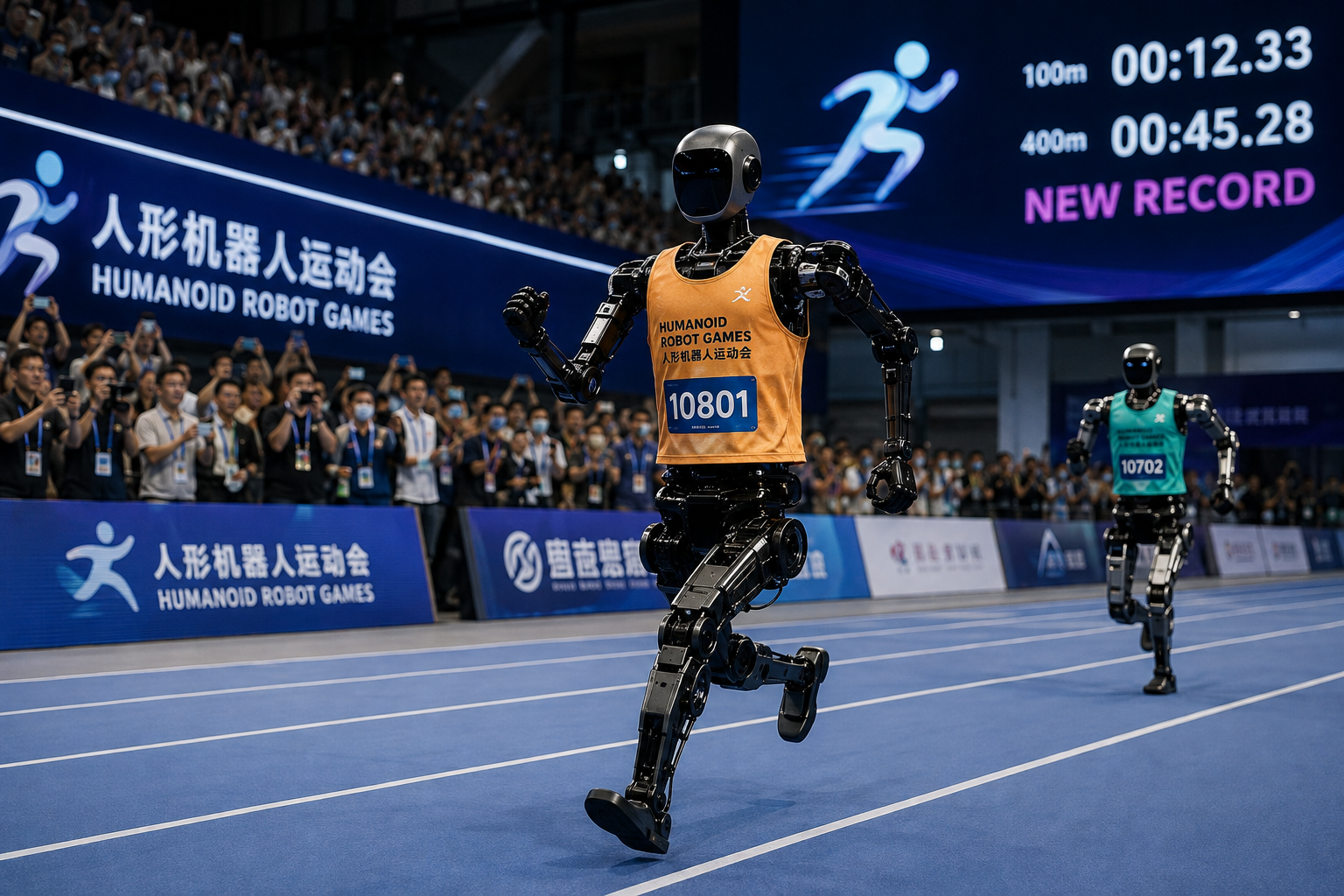
Humanoid robots break records at Beijing games
Humanoid robots broke human records in the 100-meter and 400-meter races at the Humanoid Robot Games, being held in Beijing from August 22 to 26, Xinhua reported on Tuesday.
The achievement marks a major leap forward from last year’s inaugural edition, which produced numerous viral clips of robots freezing at the starting line or comically veering off course, CE Report quotes AGERPRES.
As athletic performance steadily improves, robotics entrepreneurs attending the event stressed the need to translate advances in robotics into real-world productivity. Since purely demonstrative products are unlikely to secure orders, industrial and manufacturing sectors increasingly expect robots to deliver tangible results.
Reflecting this shift, 21 scenario-based competitions have been added to this year’s program, covering environments such as factories, hotels, homes and logistics facilities. Tasks ranging from industrial assembly and housekeeping to emergency rescue and library book sorting are designed around work that can be repetitive, physically demanding, dirty, dangerous or difficult.
Housework is one of the main areas where people want robots to provide assistance. In a housekeeping competition, robots are required to complete a full sequence of domestic chores, including organizing scattered objects, folding clothes and putting them into wardrobes, and hanging laundry to dry.
These are not easy tasks. “Some objects are on top of the counter and can be picked up directly. Others are underneath and require the robot to overcome certain obstacles. For humans, this is instinctive, but for robots, it requires different motion algorithms and greater versatility in trajectory planning,” said Liu Bingbing, an associate professor at the College of Robotics at Beijing University of Technology.
The challenges have prompted new solutions. One team developed a lighter structure and materials to improve the robot’s movement flexibility. Another introduced a “lifelong learning mechanism” that allows a robot to continuously adjust its movement programs based on real-time changes in its own joint dynamics, compensating for wear and hardware variations unique to each unit to maintain stable performance.
Despite remaining limitations — for example, only a few robots can coordinate both arms to hang clothes on a hanger — the progress on display attracted the attention of judges.
“Last year, most robots could barely fold clothes. After just one year, they can all fold them neatly and then open the wardrobe to put them away,” one judge said.
In industrial and agricultural settings, some robots have already been introduced into production processes. Hangzhou Electrochemical Group Co., Ltd. in eastern China has deployed inspection robots to monitor equipment deterioration and toxic gas leaks in corrosive, high-temperature industrial environments.
At a tomato farm in Shanghai, dual-arm picking robots have undergone field tests involving fruit recognition, ripeness sorting and picking-sequence planning, enabling harvesting without losses.
China’s humanoid robot industry is entering a critical stage of commercialization and large-scale deployment as intelligent robots move from small-batch trials toward broader adoption, Xu Xiaolan, president of the Chinese Institute of Electronics, said at the 2026 World Robot Conference (WRC).
A key challenge for the industry remains how to achieve widespread, large-scale deployment of artificial intelligence (AI) in industrial scenarios so that robots can handle diverse real-world tasks through simple language commands.
Xi Yue, co-founder of Robotera, said the industry’s short-term path toward large-scale deployment lies in controlled, closed-loop scenarios such as logistics, high-performance manufacturing and hazardous operations. More complex environments are expected to follow as technologies mature.
The main challenge is to build a fundamental embodied intelligence system based on high-quality real-world data platforms and open-source algorithm ecosystems to strengthen robots’ decision-making capabilities and dexterous manipulation skills in dynamic environments, he added.
Many robotics companies have already begun deploying their systems in manufacturing and logistics to drive technological progress through practical operation. Many in the industry believe its future lies not in standalone hardware but in the integration of three pillars: hardware, foundational AI models and real-world industrial applications.
At the WRC, held in Beijing from August 19 to 23, the Galbot S1 humanoid robot demonstrated autonomous industrial manipulation capabilities, including handling, transporting and stacking industrial containers. Galbot S1 continuously perceives its surroundings, detects environmental changes and dynamically adjusts its movements according to object positions, task progress and real-time conditions.
Galbot S1 has already been deployed in industrial environments, including CATL’s battery manufacturing facilities, where it performs demanding tasks requiring high levels of efficiency, precision and reliability. Galbot has also partnered with SAIC Motor and German automotive supplier Bosch to further explore the integration of embodied intelligence into smart manufacturing.
According to Wang He, founder and CTO of Galbot, the company is developing industry-specific vertical models alongside its foundation models. Through a deployment-driven development loop, Galbot conducts post-training using real-world operational data, continuously improving robot performance and enabling more efficient deployment across different applications.
To further accelerate application-driven innovation, the “Global Robot Application Exploration Program” was launched during this year’s WRC. The initiative was jointly launched by the World Robot Cooperation Organization and the Chinese Institute of Electronics in collaboration with international industry organizations, research institutions and enterprises.
The initiative will select 1,000 scenarios annually for free robot testing and secondary development, aiming to bridge the gap between technological breakthroughs and industrial value while promoting an open and mutually beneficial global innovation ecosystem.
China’s robotics market is also creating opportunities for international cooperation. Jack Perry, chairman of the UK’s The 48 Group, noted that China’s robotics sector is advancing rapidly, particularly in physical intelligence. Many European companies are considering AI-driven transformation and hope to improve efficiency by purchasing robots, he said, according to Xinhua.
Photo: Chat GPT