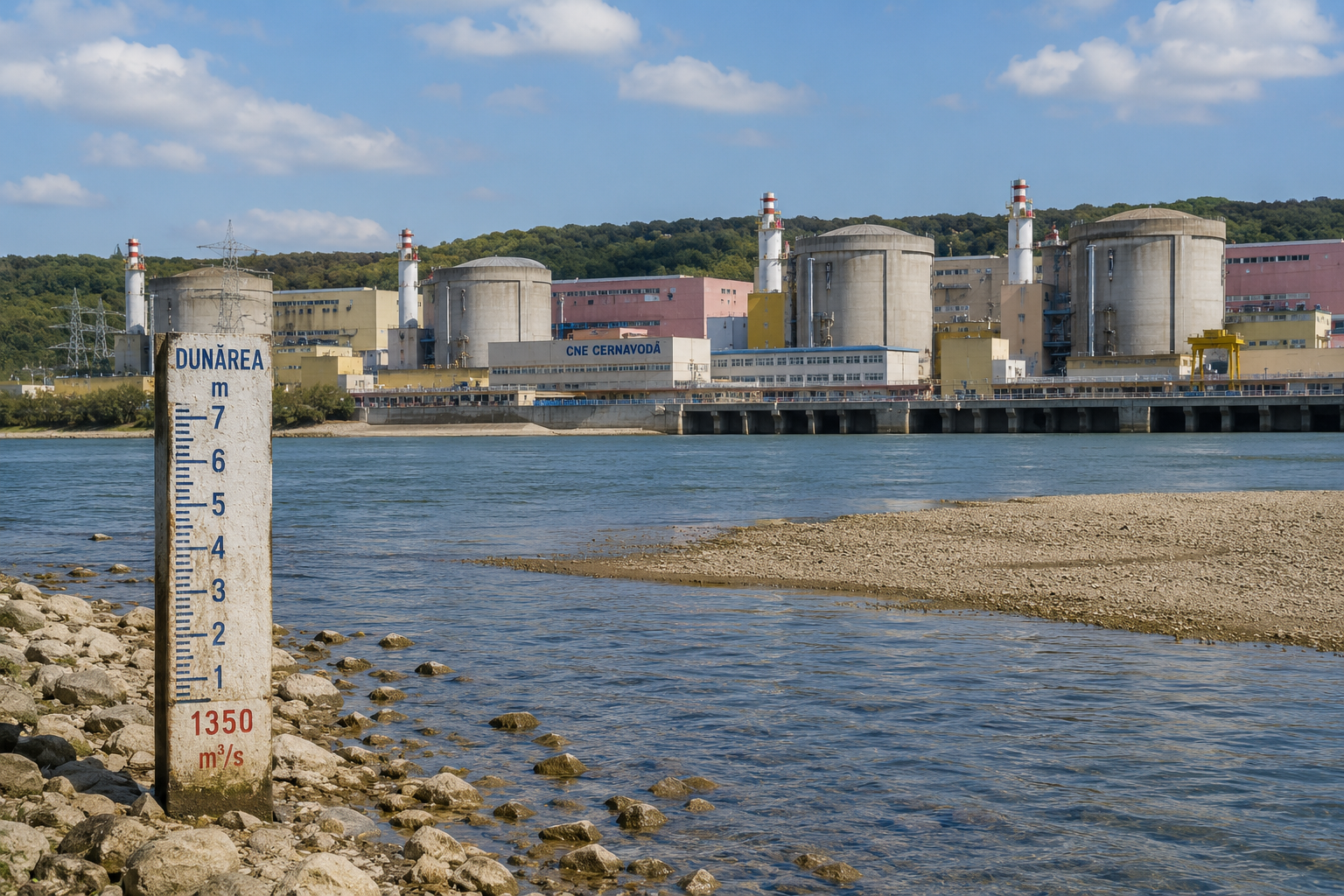
Danube flows begin to rise in Romania after weeks of decline
Recent rainfall in the upper Danube basin has begun to have an impact in Romania, where the river is recording its first increases in flow rates at the country’s entry point after two weeks of steady decline.
However, levels remain significantly below those recorded on the day Romania declared an energy alert, according to assessments and forecasts from the National Institute of Hydrology and Water Management (INHGA), Mediafax reported, CE Report quotes MOLDPRES.
The increase will not immediately affect the intake basin for the cooling pumps of the reactors at the Cernavodă nuclear power plant, where dredging work has been underway since Saturday.
The Danube’s flow rate at Baziaș, where the river enters Romania, increased between Monday and Tuesday morning to 1,350 cubic meters per second, up from 1,300 cubic meters per second the previous day, when it had remained stable.
The level is still almost three times lower than the August multiannual average of 3,900 cubic meters per second, according to official INHGA data.
Experts said the flow has begun to increase due to recent rainfall, particularly in Austria.
According to the forecast for the entire week, water flows are expected to continue rising. By the morning of August 31, INHGA expects the flow rate at Romania’s entry point to reach 1,600 cubic meters per second.
However, the latest forecast indicates that after remaining at this level for two days, the flow is expected to return to a downward trend on September 1. Experts say it theoretically takes around five days for Danube waters to travel from the country’s entry point to Cernavodă.
Romania has been under an energy alert since August 1, following the shutdown of the first reactor at Cernavodă, with a capacity of 700 MW, on July 28 due to extremely low Danube water levels.
The low flows have also halved production at the two hydropower plants on the river near Romania’s entry point, which normally account for 10-15% of the country’s total multiannual electricity generation. Under normal operating conditions, the Cernavodă nuclear power plant provides around 20% of Romania’s electricity production.
On August 1, the Danube’s flow at the country’s entry point was slightly declining, reaching 1,550 cubic meters per second.
Last Monday, August 17, the Danube’s flow at the Iron Gates had fallen to 1,350 cubic meters per second, significantly below the previous historical minimum recorded at the hydrological complex on the river near the country’s entry point.
The previous record at the Iron Gates was reported almost 23 years ago, in September 2003, when the flow fell to 1,474 cubic meters per second.
That same year also marked the first — and, until July 13, the only — time Romania was left without nuclear power due to extremely low Danube water levels in the intake basin for the pumps used to cool the turbine condensers at the Cernavodă nuclear power plant.
Photo: Chat GPT