Clarita targets accuracy in maritime AI
At a time when the shipping industry is facing geopolitical crises and disruptions to maritime routes, regulatory requirements and cyberattacks, Clarita Global Matrix Ltd is seeking to differentiate itself from general artificial intelligence applications by focusing on accuracy and verification of results.
The Liverpool-based company has developed specialized platforms for shipping, ports and other industries which, it says, do not simply rely on searching for and reproducing already stored information, but instead use specialized mathematical models to perform specific calculations, CE Report quotes ANA-MPA.
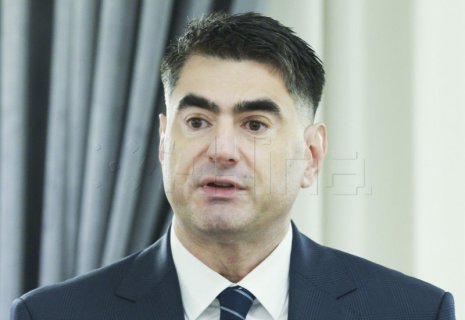
Dimitrios Christodoulou, Founder & CEO of Clarita Global Matrix Ltd, points out that one of the main problems with today’s general AI systems is the consistency of their answers.
“If you ask AI the same question twice, you can get two different answers,” he notes, adding that it is a particularly useful tool for general questions and information searches, but not always for situations where absolute accuracy is required.
According to Christodoulou, this distinction is critical in sectors such as shipping, defense, industry and science, where an incorrect answer can have significant operational or financial consequences.
One platform instead of multiple applications
In shipping, one of the problems Clarita has sought to address is the need for companies and shipbroking firms to use multiple applications and subscription services simultaneously.
A shipbroker or ship manager may need different platforms for port data, weather conditions, routes, freight rates, geopolitical developments and contractual obligations.
“Knowing this problem, we created a single platform,” Christodoulou says.
According to him, the system can combine information on the destination port, weather, political and geopolitical conditions in a country, and other parameters affecting a voyage within a very short time.
The goal is for users to receive a comprehensive picture within seconds, without having to switch between different applications and compare the information themselves.
Neptune for ships and chartering
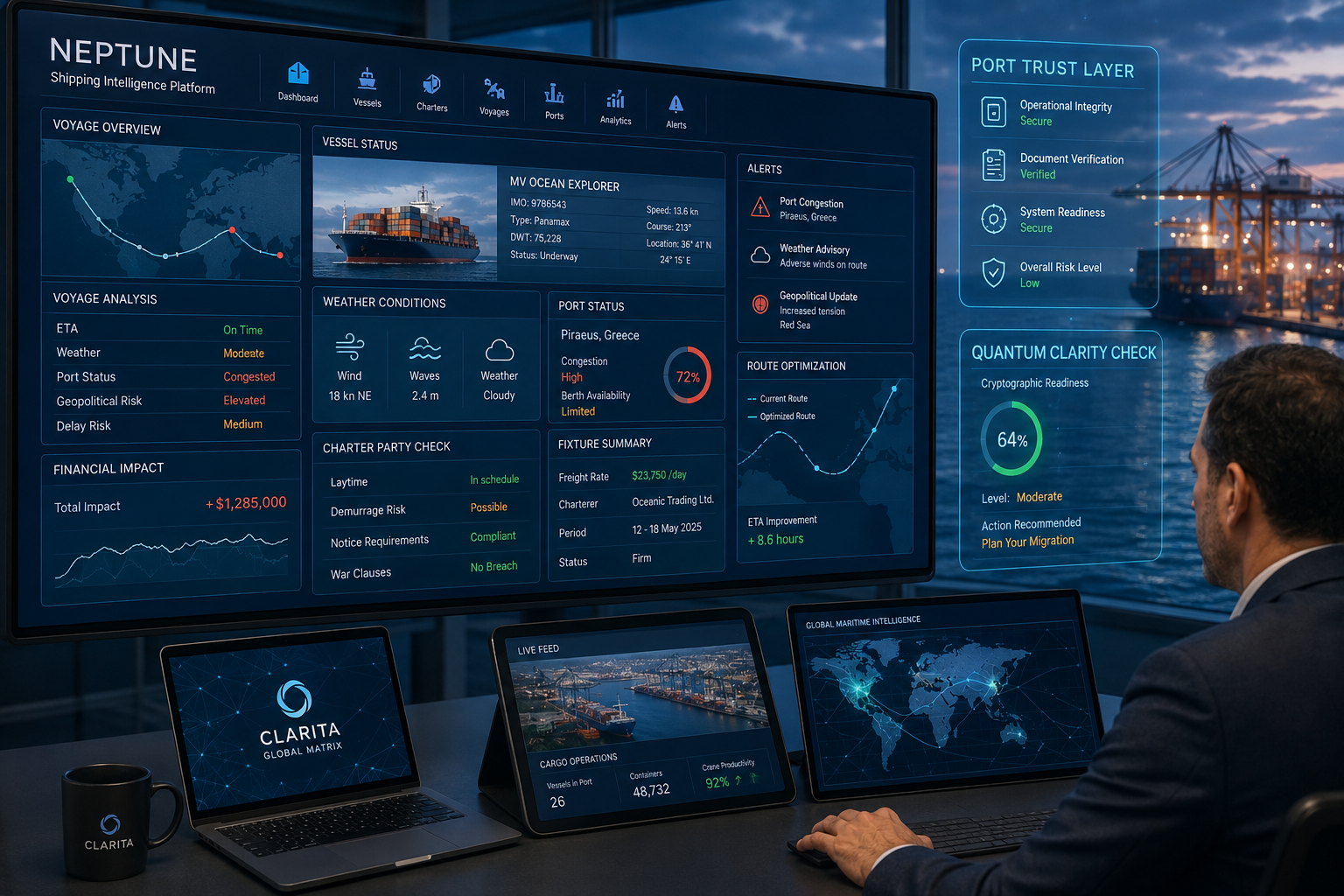
At the heart of Clarita’s shipping activities is Neptune, a platform designed to analyze vessels, charters, charter parties, fixtures, voyages and operational data.
The system can compare what a charter party stipulates with what is actually happening during a voyage.
For example, it can take into account the vessel’s arrival time, weather conditions, the status of a port, possible congestion, delays or geopolitical developments and calculate how these factors affect the voyage and the financial or contractual obligations of the parties involved.
The company says it has already developed applications with measurable results and also has a platform designed for use in port environments.
Christodoulou stresses that the calculations are not simply based on retrieving stored information. “The calculations are performed using mathematical models designed for specific tasks,” he says.
According to him, the company’s technological approach is sufficiently specialized that it would be difficult to replicate directly over the next two to three years.
Ports as critical infrastructure
Clarita also places particular emphasis on ports, where a large part of operations now relies on digital systems.
Terminal operating systems, cranes, VTS, electronic EDI connections and Port Community Systems form part of a single information chain.
A serious cyberattack or failure of a critical information system could affect not only the operation of a computer, but also vessel traffic, cargo loading and unloading, and the overall smooth operation of a port.
For port authorities, Clarita proposes what it calls a “Port Trust Layer,” which combines operational information, document verification and an assessment of cryptographic readiness.
The next challenge: quantum computers
Christodoulou also places particular emphasis on the next generation of computing systems: quantum computers.
Quantum computers operate differently from today’s conventional computers and, in theory, once they achieve sufficient power and reliability, could solve certain mathematical problems much faster.
One of the issues currently concerning the international scientific and technology community is their potential impact on existing encryption systems.
Christodoulou estimates that the commercialization of powerful quantum computers is closer than is often suggested and that they will fundamentally change the landscape in terms of speed, accuracy and cybersecurity.
“Quantum computing is no longer theory — it exists and is evolving. I do not believe we have the luxury of waiting three or four years. Preparation must begin now,” he says.
He goes further with a particularly strong assessment regarding encryption, noting that the spread of sufficiently powerful quantum computers could make public-key cryptographic algorithms, such as RSA, currently used by banks, businesses and critical infrastructure, vulnerable.
This is Christodoulou’s assessment and does not mean that today’s quantum computers can already break widely used modern encryption systems within minutes.
Precisely because of this future threat, Clarita has developed Quantum Clarity Check, a tool that examines the extent to which an organization still relies on forms of encryption that could become vulnerable in the era of powerful quantum computers.
The tool does not install new security systems by itself. Rather, it functions as a “readiness assessment,” allowing a business or port to identify which infrastructures will require upgrades and where potential risks exist.
Accuracy rather than simply generating answers
The core philosophy described by Clarita can be summarized as the difference between a general AI application that produces a possible answer and a specialized system that is expected to provide a result on which a real operational decision can be based.
In shipping, where a decision can involve a voyage worth millions of dollars, changing a vessel’s route or ensuring the security of a port facility, this distinction becomes particularly important.
This is where Clarita Global Matrix seeks to position itself: developing specialized tools that combine data, mathematical calculations and information verification, with the aim of enabling users to understand not simply what a system “answers,” but how much they can rely on the answer they receive.
Photo: Chat GPT