James Webb Telescope unlocks new secrets of universe
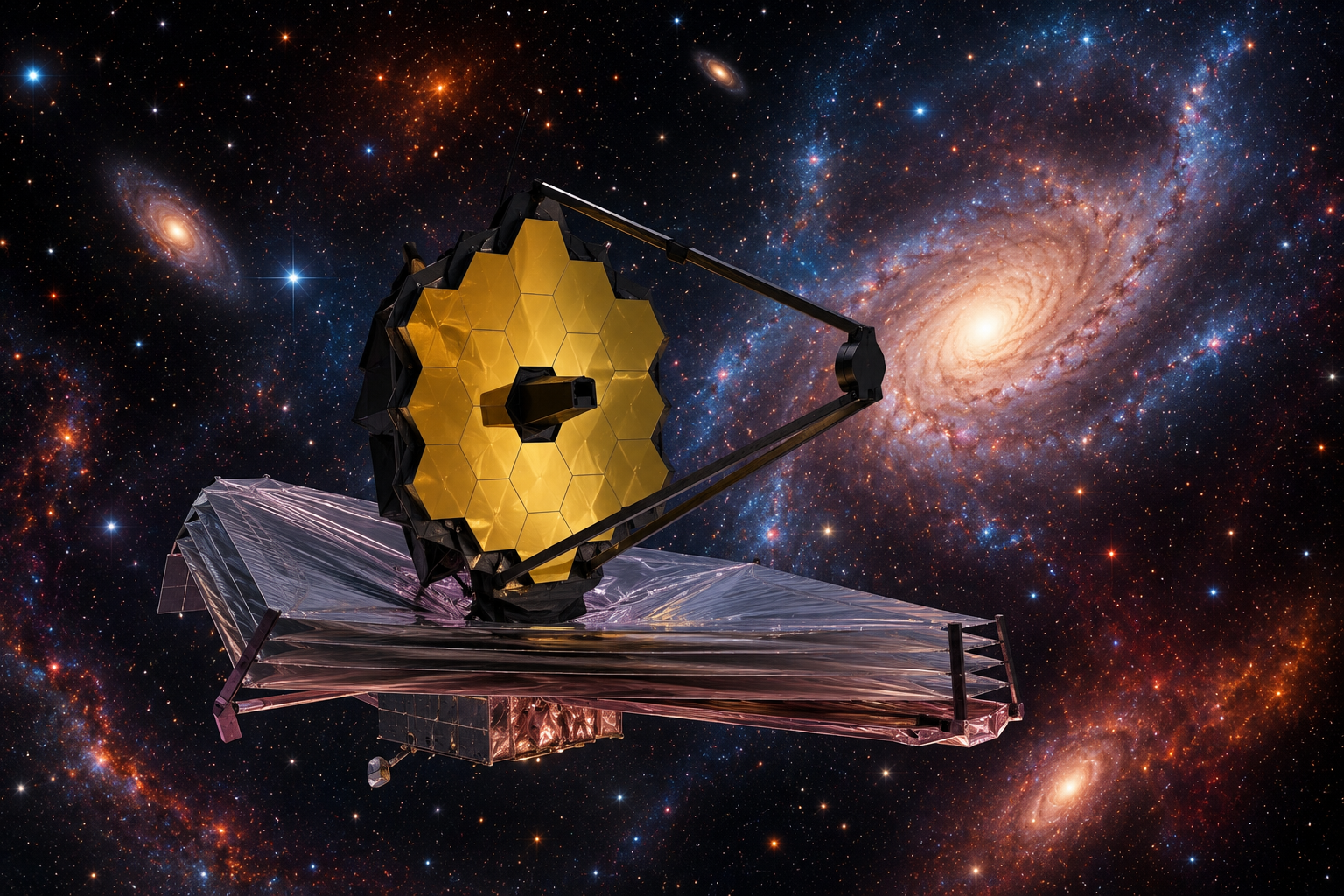
The James Webb Space Telescope (JWST), developed through a collaboration between NASA, the European Space Agency (ESA), and the Canadian Space Agency (CSA), has continued to revolutionize our understanding of the universe since its launch on December 25, 2021.
Designed as the most powerful space telescope ever built, JWST is conducting extensive research on the Solar System, the Milky Way, the first stars and galaxies formed after the Big Bang, as well as exoplanets and celestial bodies that may have the potential to support life, CE Report quotes Anadolu Agency.
Equipped with advanced infrared instruments capable of observing beyond the distortions of Earth's atmosphere, the telescope is providing unprecedented high-resolution images and revealing regions of the universe that had never been observed before.
The deepest and most detailed image of the universe
Approximately five and a half months after its launch, JWST captured the deepest and most detailed full-color image of the universe ever obtained, including galaxies located billions of light-years from Earth.
The image, produced after 12.5 hours of observation, demonstrated that the telescope had successfully achieved its first major scientific objective and confirmed its expected performance.
It revealed the SMACS 0723 galaxy cluster, located about 4.6 billion light-years from Earth, along with distant galaxies dating back to approximately 13.1 billion years after the Big Bang, showing them in unprecedented detail.
The historic image was unveiled to the public by then-U.S. President Joe Biden during a White House event on July 11, 2022.
The following day, NASA released additional full-color images and spectroscopic data collected by the telescope.
Discovering the most distant galaxies
The release of JWST's first images opened the door to major discoveries about the early universe.
In 2024, scientists observed JADES-GS-z14-0, a galaxy dating to roughly 300 million years after the Big Bang, making it the most distant confirmed galaxy at the time.
The discovery suggested that the earliest galaxies were larger and brighter than previously expected, prompting scientists to reconsider existing models of the early universe.
JWST observations in 2024 also provided strong evidence for the presence of oxygen in JADES-GS-z14-0.
Later, the telescope identified another galaxy, MoM-z14, dating back approximately 280 million years after the Big Bang. As of 2026, it is recognized as the most distant confirmed galaxy ever discovered.
The finding suggests that the first stars and galaxies may have formed much earlier than scientists had previously believed.
Unexpected chemical elements in early galaxies
Scientists had long believed that the early universe consisted mainly of hydrogen, helium, and small amounts of lithium.
However, JWST observations in 2024 detected unexpectedly high levels of nitrogen, along with helium, neon, and carbon, in several early galaxies.
These findings indicate that some galaxies evolved much more rapidly than previously thought and suggest that current models of galactic evolution may need to be revised.
Discovery of faint early galaxies
Using the gravitational lensing effect created by massive galaxy clusters, JWST has also detected galaxies too faint to be observed previously.
These observations revealed that the early universe contained many small galaxies producing nearly four times more light than expected after the Big Bang.
Scientists believe these galaxies played a crucial role in ending the universe's early cosmic dark ages.
Using the telescope's Near Infrared Camera (NIRCam), researchers also discovered Earendel, a star magnified by the gravitational lensing effect of the WHL0137-08 galaxy cluster.
Earendel is estimated to be twice as hot as the Sun, approximately one million times brighter, and significantly more massive. It dates back to about one billion years after the Big Bang.
The mystery of the "little red dots"
JWST has also identified numerous previously unknown objects that astronomers refer to as "little red dots."
Initially believed to be compact galaxies, these objects may instead consist of hydrogen gas orbiting supermassive black holes at speeds of thousands of kilometers per second.
Researchers have also found that these objects display characteristics of both stellar clusters and galactic nuclei, leading to several competing theories. Some scientists suggest they may represent star clusters evolving into galaxy cores.
Observations of the HR 8799 planetary system
JWST has also studied the HR 8799 planetary system, located approximately 130 light-years from Earth, which has long been considered an important target for understanding planetary formation.
Using its coronagraph, designed to observe planets orbiting distant stars, the telescope detected carbon dioxide in the atmosphere of an exoplanet outside the Solar System.
The findings provide strong evidence that the system's four giant planets formed gradually through the accumulation of solid cores, in a process similar to the formation of Jupiter and Saturn in our own Solar System.
Photo: Chat GPT