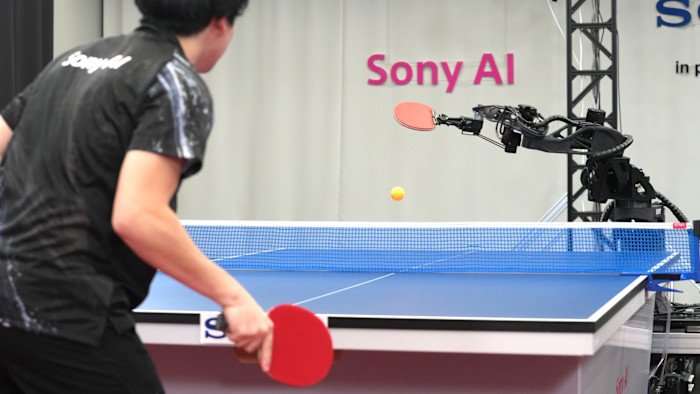
AI robot Ace beats top human table tennis players
An autonomous table tennis robot called Ace has reached a milestone for artificial intelligence and robotics in Tokyo, competing against top human players and sometimes defeating them—a performance that could signal a wide range of future applications for similarly skilled robots, Reuters reported on Wednesday.
Ace, created by the AI research division of Sony, is the first robot to achieve expert-level performance in a competitive physical sport—one that requires rapid decision-making and precise execution, according to the project leader.
It accomplished this using high-speed perception, AI-based control, and a cutting-edge robotic system, CE Report quotes AGERPRES.
Various table tennis robots have been developed since 1983, but until now they could not compete with highly skilled human players. Ace has changed that with its performances against elite and professional players in matches conducted under the rules of the International Table Tennis Federation and officiated by certified referees.
“Unlike computer games, where previous AI systems have surpassed human experts, real-time physical sports such as table tennis remain a major open challenge due to the need for fast, precise, and adversarial interactions near obstacles and at the limits of human reaction time,” said Peter Durr, director of Sony AI Zurich and leader of the Ace project.
The goal of the project was not only to compete in table tennis, but also to gain insights into how robots can perceive, plan, and act with human-like speed and precision in dynamic environments, Durr explained.
“The success of Ace, with its perception system and learning-based control algorithm, suggests that similar techniques could be applied in other areas requiring fast, real-time control and human interaction—such as manufacturing and service robotics, as well as applications in sports, entertainment, and safety-critical physical domains,” Durr added. He is the lead author of a study describing Ace’s achievements, published Wednesday in the journal Nature.
Regarding its performance, Ace won three out of five matches against elite table tennis players in April 2025. The matches were played against top-level professional players. Sony AI said that since then, Ace has defeated professional players again in December 2025 and last month.
Companies around the world are making rapid progress in robotics. For example, on Sunday, robots outperformed human runners in a half marathon race in Beijing.
AI systems have already excelled in digital domains such as strategy games like chess and Go, as well as complex video games. However, while video games take place in simulated environments, table tennis requires rapid decision-making, precise physical execution, and continuous adaptation to an unpredictable opponent, Durr noted. The ball moves at high speeds with complex spin and trajectories, pushing both humans and robots to the limits of detection, prediction, and motor control.
Ace’s architecture integrates nine synchronized cameras and three optical tracking systems to follow a rapidly spinning ball with exceptional accuracy and processing speed.
“This is fast enough to capture motion that would appear blurred to the human eye,” Durr said.
Researchers developed a custom robotic platform with eight joints—the minimum needed to execute competitive strokes: three for paddle position, two for orientation, and three for speed and force.
Professional player Mayuka Taira, who lost a match to Ace last December, said the robot’s strengths are that “it is very hard to predict and shows no emotion.”
“Because you can’t read its reactions, it’s impossible to sense which shots it dislikes or struggles with, making it even harder to face,” she added.
Elite player Rui Takenaka, who both won and lost matches against Ace, described his strategy: “When I used serves with complex spin, Ace returned them with equally complex spin, making it difficult. But when I used simpler serves, Ace returned simpler balls. That made it easier for me to attack on the third shot, which I think was the main reason I managed to win.”
According to Durr, “Ace has a superhuman ability to read spin and a very fast reaction time. It doesn’t learn by watching human players—it is trained through simulation, reacts differently from humans, and creates ‘surprising situations.’”
“At the same time, professional athletes are very good at adapting to their opponents and identifying weaknesses—an area we are still working on,” he added.