China’s humanoid robot startups target household labor market
Humanoid robots picking up trash or arranging flower bouquets were showcased in Beijing, during a demonstration highlighting how such machines could be used in the future for more complex household tasks, Reuters reports.
The event, organized by startup X Square Robot, was relatively modest by the standards of the industry, which in recent years has presented robots capable of running, jumping, and dancing, CE Report quotes AGERPRES.
However, it signals a deeper shift: Chinese companies like X Square Robot are trying to demonstrate not what humanoid robots can do on stage, but the value they can bring in messy, unpredictable real-life environments.
“Hardware is already in place,” said Wang Qian, CEO of X Square Robot at the event. “But the brain hasn’t reached that level yet.”
Simple tasks still difficult for robots
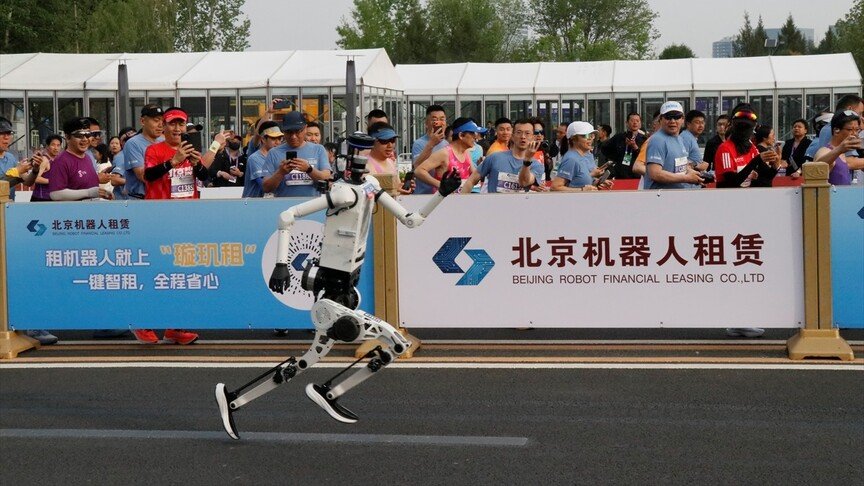
This gap is becoming increasingly visible as companies move from pre-programmed demonstrations to real-world applications. Humanoid robots can complete half-marathons faster than elite athletes, yet tasks that seem simple for humans—cleaning a room, loading a dishwasher, or folding clothes—remain challenging for these machines.
“Why don’t marathon-running robots face this challenge? Because the only thing they have to overcome is a constant gravitational field,” Wang Qian explained.
“When we handle objects with our hands, even a deviation of 0.1 millimeters can cause the entire task to fail.”
Repetitive actions like running require training on relatively simple datasets. Managing a household—where no task is ever exactly the same—requires a far more advanced AI “brain” capable of perceiving gravity and light similarly to humans.
X Square Robot, based in Shenzhen, says it has developed such an AI model, Wall-B, trained on data collected from over 100 homes. The company claims exposure to “disruptive” conditions—from pets to clutter—is essential for improving performance.
The model will be introduced in cleaning robots at the end of May. Last month, X Square partnered with the Chinese services platform 58.com, allowing users in Shenzhen to hire a human cleaner alongside one of the company’s robots. A three-hour session costs 149 yuan ($21.9), and the company says its robots have already served more than 50 households.
Market potential for household labor
Although customers currently find the robots slow and clumsy, Wang says real-world exposure is the only way for them to improve.
“Sometimes it puts slippers in the kitchen or stops halfway through a task to ‘think’,” he said, adding that when the robot fails, a company employee can intervene remotely.
Wang emphasized that once the technology matures and robots become reliable household assistants, the potential market could be enormous.
“Domestic labor accounts for about 20% of GDP, so theoretically, this represents a market equal to 20% of GDP,” he said.
Founded less than three years ago, X Square Robot has raised billions of yuan through multiple funding rounds, including investments from Chinese tech giants such as Xiaomi and Alibaba.