Polish MFA warns Europe must prepare for prolonged war in Ukraine - EXCLUSIVE
The meeting between the Minister of Foreign Affairs of Poland, Radosław Sikorski, and the Minister for Foreign Affairs, European Union and Cooperation of the Kingdom of Spain, José Manuel Albares Bueno, in Barcelona on 1 June 2026, confirmed mutual willingness to deepen an already solid bilateral relationship. Both sides underlined the need to strengthen cooperation, not only bilaterally but also within the European Union and through NATO. This is especially important in the face of Russia's invasion of Ukraine, now in its fourth year.
This was said by the source in the Ministry of Foreign Affairs of Poland in an exclusive interview with CE Report.
The Ministry noted that on security and defence, Poland and Spain agree on sustaining strong pressure on Russia and supporting Ukraine.
"Support involves both direct military assistance and involvement in humanitarian and reconstruction projects. Both countries want to strengthen the European pillar of NATO and boost European responsibility for security, while fully maintaining transatlantic Alliance ties. On the economic front, bilateral trade reached over €19 billion in 2025, providing a solid foundation for growth. Poland sees Spain as an important investment partner. Spanish companies invest in Poland and create jobs. Both ministers expressed confidence that there is still significant untapped potential for intensifying bilateral relations," the source added.
Poland consistently maintains that NATO is the cornerstone of Euro-Atlantic security and cannot be replaced by any European structure. The response to present challenges is not "less NATO”, but rather a stronger European pillar within the Alliance. A stronger Europe will reinforce NATO, not compete with it. Europe should assume more security responsibility by increasing investment in air defence, ammunition, long-range capabilities, military mobility, critical infrastructure, and the defence industry. EU defence initiatives, such as the White Paper on European Defence Readiness 2030 and the SAFE instrument, should complement NATO rather than duplicate it. The SAFE instrument provides roughly €150 billion for joint defence investment. Poland's preferred model is open strategic autonomy: a stronger European defence base that remains fully interoperable with its allies. Strategic autonomy should lead to more European responsibility, not separation from partners like the United States. The strong U.S. presence in Europe remains a key security element.
Poland assesses that Russia is not achieving strategic victory. Economic pressure on Russia persists, Russian losses are high, and territorial gains are limited. Moscow continues striking Ukrainian civilian infrastructure to undermine resilience but lacks the capacity for decisive breakthroughs at the front. Russia's capabilities have proven worse than expected, but so did their intentions. Ukraine responds with rapid technological innovation and improved long-range capabilities. These increasingly limit Russian operations. The most likely outcome remains a prolonged war of attrition with limited territorial change but growing pressure on logistics, industry, and both sides' political resilience. There are no genuine negotiations or prospects for a near-term end to the conflict, making sustained support for Ukraine essential. Poland recognises that escalation in the Middle East could indirectly benefit Russia by diverting U.S. and European resources, attention, and will away from Ukraine. The response should be to expand production capacity, enhance coordination, and secure long-term financing, not reallocate resources. Europe must manage multiple crises at once. Implications for European security include maintaining sanctions unity, providing predictable support for Ukraine, and pursuing a long-term strategy to contain Russia.
With bilateral trade exceeding €19 billion in 2025, the economic relationship between Poland and Spain is well developed. First, the defence industry and defence technologies present new opportunities for cooperation, given increased defence spending across the EU and a policy of joint procurement. The EU aims to have 40% of procurement conducted jointly by 2035. Second, energy technologies and the energy transition are priorities, as both partners work on European climate policy and reducing reliance on Russian energy. Third, direct investment is growing. Spain already invests actively in Poland. At the same time, we can observe the growing scale of Polish investments in Spain, including in the IT, finance, construction, chemicals, automotive, pharmaceuticals, and food sectors. There is room for further expansion of Spanish companies in Poland and for Polish companies to access Latin American markets through Spanish networks. Fourth, innovation and emerging technologies, including defence (AI, autonomous systems) and digital transformation, remain a major focus of Polish and European policy.
Poland believes that the current EU treaties provide enough tools to admit new members and tackle today's challenges effectively. This is clear from 19 sanctions packages against Russia, the SAFE instrument, tariffs on Russian and Belarusian agricultural goods, and plans to phase out Russian energy by 2027. Poland does not support extending the use of qualified majority voting (QMV) as an end in itself. This debate has continued in the EU for 7-8 years without result, and Member States still have deeply divergent positions. In the Polish view, the right approach is to use the flexibility of the treaties case by case when unanimity blocks necessary action. The real problem is not the procedure but its abuse by a single Member State opposing the Union's strategic direction.
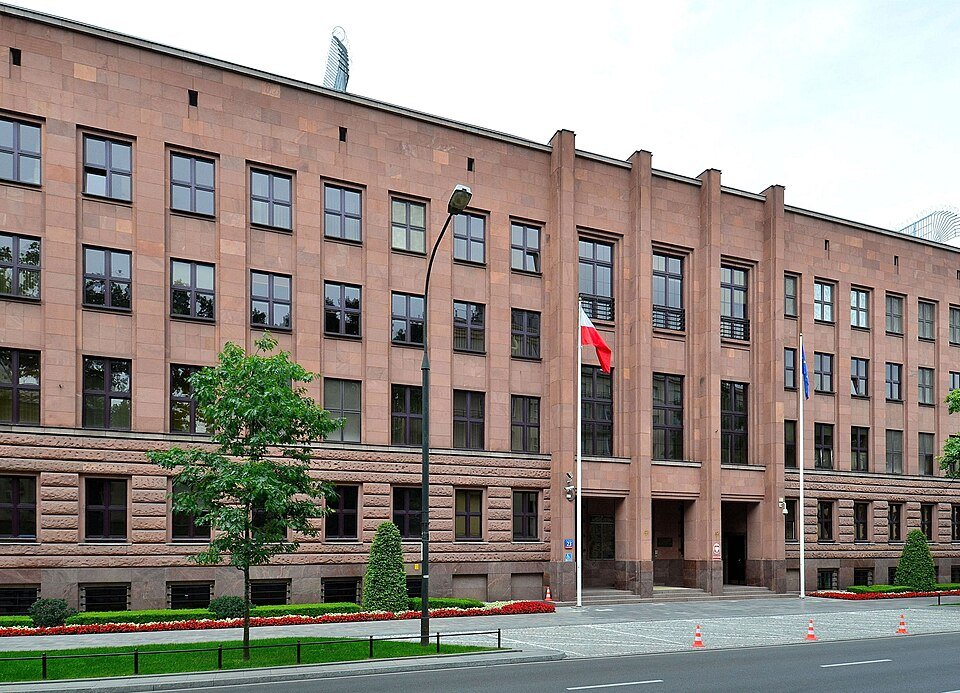
Photo: Wikipedia
This interview was prepared by Julian Müller